

The gap between being excellent at the technical work and running a financially healthy HVAC business is real. According to recent industry data, the median HVAC net profit margin sits at just 5.8%, while top-performing contractors achieve 13.2% or higher. That 7+ percentage point difference comes down to disciplined financial management—specifically, rigorous job costing and cash flow planning that many owner-operators never learned in trade school.
This guide addresses what makes HVAC bookkeeping uniquely complex: job-based revenue with variable costs, dramatic seasonal swings, technician payroll that spans overtime and emergency calls, and inventory scattered across service vehicles. We'll cover the core tasks every HVAC company must track, the most common financial pitfalls, actionable best practices that protect your bottom line, and how to recognize when it's time to bring in professional help.
Key Takeaways
- HVAC bookkeeping goes beyond general accounting — job costing, seasonal swings, and technician payroll each add layers most bookkeepers miss
- Weekly priorities: log income and expenses per job, run AR aging reports, process payroll accurately, and reconcile bank accounts
- The most expensive mistakes are mixing personal and business finances, falling behind on invoicing and ignoring cash flow forecasting during shoulder seasons
- Implement weekly expense logging, detailed job costing on every project, and contractor-focused accounting software to improve profitability visibility
- If bookkeeping takes more than a few hours a week — or you can't tell which jobs made money — it's time to bring in a trades-savvy bookkeeper
Why HVAC Bookkeeping Is Different from Standard Small Business Bookkeeping
HVAC companies operate in a financial hybrid zone that combines service business and product-based business models. You're billing for technician labor hours while also selling equipment, parts, and materials—creating a more complex financial picture than most retail shops or pure service businesses face.
Three Key Financial Differentiators
Job-based income with variable costs: Unlike businesses with predictable recurring revenue, every HVAC project carries unique costs. A residential AC replacement in July has different labor requirements, parts costs, and profit margins than an emergency furnace repair in January. Without tracking costs at the job level, contractors can stay busy all season while quietly losing money on underpriced or mismanaged projects.
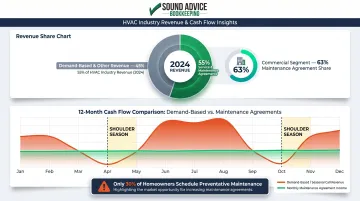
Seasonal cash flow swings: Demand peaks during summer cooling season and winter heating season, with significant slowdowns during spring and fall shoulder months. Fixed overhead costs—insurance premiums, shop rent, vehicle payments, loan obligations—don't pause during April and October when call volume drops. Retrofits and replacements now dominate demand, with winter exposing aging heating systems and summer pushing AC failures to the top of the call queue.
Industry-specific expense tracking: HVAC contractors manage costs that standard small business bookkeeping doesn't anticipate—fleet vehicle maintenance and fuel, refrigerant and specialized tools, EPA compliance certifications, parts inventory across multiple service trucks, and warranty tracking for installed equipment. Lumping these into generic expense categories obscures where money actually goes.
Residential vs. Commercial: Two Different Financial Games
The financial profile of residential HVAC work differs sharply from commercial contracts:
- Residential jobs: Typically paid at completion or within 7 days, providing immediate cash inflow that supports lean operations
- Commercial contracts: Often carry Net 30, Net 60, or even Net 90 payment terms, with average Days Sales Outstanding (DSO) running 45-90 days
This payment timing gap creates real liquidity pressure when transitioning from residential to commercial work. Carrying $100,000 in receivables for 60 days costs thousands in interest and lost opportunity.
A chart of accounts that lumps all revenue into a single "HVAC Services" line won't tell you whether residential service calls, commercial maintenance contracts, or new installs are actually driving profit. That distinction matters when you're deciding where to grow.
Core Bookkeeping Tasks Every HVAC Company Needs to Track
Job Costing: Tracking Profit at the Project Level
Job costing is the discipline that separates intentional growth from survival mode. It requires recording every direct cost tied to a specific job: technician labor hours, parts and materials used, vehicle mileage, subcontractor fees, permits, and disposal charges.
Without job costing, HVAC owners know their total revenue but have no visibility into actual job-level profitability. A job generating $350 in revenue for one technician hour might yield $180+ in profit per hour after overhead allocation—highly lucrative. Another job billing $800 might lose money once all costs are tallied.
How to implement job costing in accounting software:
- Create unique job codes for every project in your system
- Configure expense categories so labor entries, parts purchases, and overhead charges map back to specific job codes
- Calculate a labor-hour allocation rate for overhead: Total Annual Overhead ÷ Total Annual Billable Tech Hours
- Apply this overhead rate to every job (e.g., 4 technician hours × $60/hr overhead = $240 allocated)
- Compare actual costs to original estimates once jobs close to identify pricing gaps
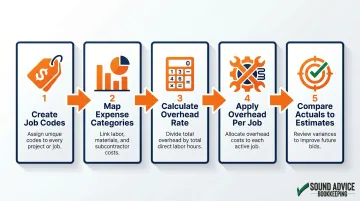
This granular tracking reveals which job types, service areas, or technicians consistently deliver profit—and which consistently lose money.
Invoicing and Accounts Receivable
Prompt invoicing directly impacts your operating cash flow. The longer the gap between job completion and invoice delivery, the longer you wait for payment—and the greater the risk that invoices fall overdue or become uncollectible.
Standard invoicing practices:
- Invoice immediately upon job completion, not days or weeks later
- Set clear payment terms upfront (Net 15 or Net 30) and communicate them before work begins
- Include a "Pay Now" button on digital invoices to reduce friction
- Use automated payment reminders at 7, 14, and 21 days after invoice date
Industry data reveals that approximately 55% of all B2B invoices in North America are paid after the due date, with 43% of credit-based B2B sales becoming overdue due to customer cash flow pressures. Bad debts affect 5% of long-overdue invoices.
Managing your accounts receivable aging report:
- This report groups unpaid invoices by age: current (0-30 days), 30-60 days, 60-90 days, 90+ days
- Review it weekly to identify which customers owe money and how long payments are outstanding
- Follow up on invoices at 30, 60, and 90 days with second invoices, phone calls, and late payment fees
- Prioritize collection on commercial accounts with longer payment cycles before they become bad debt
Implementing faster invoicing procedures and automation can reduce DSO by at least six days, directly improving cash availability.
Payroll, Equipment, and Inventory
Payroll complexity: HVAC technicians typically work hourly with overtime at time-and-a-half after 40 hours weekly. Many also earn sales performance incentive funds (spiffs) or commissions for upselling service agreements or equipment upgrades.
Critical compliance detail: When a technician earns a spiff, that amount must be factored into their "regular rate" of pay to correctly calculate overtime compensation for that week. Failing to do this violates Fair Labor Standards Act (FLSA) regulations and can trigger severe federal penalties.
According to May 2024 Bureau of Labor Statistics data, median HVAC technician wages are $28.75/hour ($59,810 annually), with the 90th percentile earning $43.76/hour ($91,020 annually). Fully-loaded labor costs (including payroll taxes, workers' compensation insurance, and benefits) run significantly higher and must be accurately tracked for job costing.
Equipment and vehicle tracking: Service trucks, diagnostic tools, and refrigerant recovery equipment are depreciable assets, not one-time expenses. Proper classification enables tax deductions spread over the equipment's useful life and provides accurate balance sheet reporting.
Inventory management: HVAC contractors make 69% of their total purchases through wholesale distribution, managing parts across both central warehouses and mobile truck stock. Gaps in truck stock have real consequences:
- Reduces First Time Fix Rate (FTFR) below the 70-80% industry standard
- Triggers costly return trips that add labor and fuel expenses
- Distorts Cost of Goods Sold (COGS) when consumption isn't tracked
- Creates stockouts during peak season when demand spikes
The Biggest Bookkeeping Challenges HVAC Contractors Face
Seasonal Cash Flow: The Shoulder Season Cash Crunch
Overhead costs don't pause when call volume drops. Insurance premiums, rent, loan payments, vehicle leases, and base salaries continue during April and October when demand slows.
Cash flow problems are cited as a primary reason HVAC businesses fail—often more so than poor technical work. Contractors who don't plan ahead find themselves cash-poor during slow months, unable to cover fixed expenses despite having been busy and profitable just weeks earlier.
Cash flow forecasting: Use historical data from prior slow seasons to anticipate the dip. Track revenue patterns from the past 2-3 years to identify your typical slowdown periods and magnitude. Build a cash reserve during peak summer and winter months specifically to cover 2-3 months of overhead during shoulder seasons.
The recurring revenue anchor: Maintenance and service agreements captured 55% of HVAC industry revenue in 2024, with commercial businesses deriving 63% of total revenue from service agreements. These contracts provide predictable monthly income year-round, stabilizing cash flow when demand-based service calls decline. Yet only 30% of homeowners currently schedule preventative maintenance—a massive growth opportunity. Train technicians to convert 25-50% of emergency service calls into ongoing maintenance agreements.
Mixing Personal and Business Finances
Owner-operators frequently commingle personal and business funds, especially in the early years. Using the same bank account for both creates serious problems:
- Tax preparation nightmare: Identifying legitimate business expenses becomes nearly impossible when personal transactions are mixed in
- Missed deductions: Without clean separation, tax-deductible expenses get overlooked, directly reducing your bottom line
- Audit risk: Commingling attracts unwanted IRS attention and weakens your legal liability protection
- Inaccurate profitability: You can't measure true business profit when personal spending distorts the numbers
Industry data shows that 27% of small businesses still mix personal and business accounts—and the habit tends to stick even as revenue grows.
Non-negotiable solution: Open a dedicated business checking account and obtain a business credit card. Route all business income into the business account and pay all business expenses from it. This separation simplifies tax filing, protects you legally, and makes accurate profit measurement possible.
Falling Behind on Bookkeeping
The longer you wait to record transactions, the more expensive catch-up becomes. Missing receipts mean missed deductions. Unrecorded expenses distort job costing. Delayed bank reconciliation hides your true cash position.
Small business owners already spend 5-20 hours monthly on bookkeeping—time not spent on revenue-generating work. When records slip weeks or months behind, that burden multiplies. The IRS Failure to File penalty is 5% of unpaid tax for each month a return is late, up to 25%.
Weekly expense entry prevents the end-of-month scramble and keeps job costing data current and actionable.
HVAC Bookkeeping Best Practices That Protect Your Bottom Line
Choose the Right Accounting Method: Cash vs. Accrual
Cash accounting: Records income when payment is received and expenses when bills are paid. Simpler to manage but can distort profitability when you purchase equipment and parts in advance of the jobs they're used for.
Accrual accounting: Records transactions when they're incurred, regardless of payment timing. Revenue is recorded when earned (job completed), and expenses are matched to the jobs they support. This provides a truer picture of profitability, especially for businesses with longer payment cycles or significant inventory.
The IRS allows businesses with under $31 million in average annual gross receipts (for 2026) to use cash-basis accounting. However, financial experts recommend accrual accounting for construction and contractor businesses because it matches expenses with seasonal revenue, enabling accurate profit measurement and better job costing.
Recommendation: Even before IRS thresholds require it, growing HVAC companies should consider accrual accounting to understand real job-level economics rather than just cash timing.
Set Up a Purpose-Built Chart of Accounts
Generic accounting software templates lump all revenue into "Sales" and all expenses into broad categories like "Supplies" or "Repairs." This makes monthly profit and loss statements nearly useless for operational decisions.
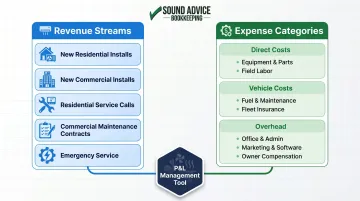
Separate revenue streams by job type:
- New residential installations
- New commercial installations
- Residential service and repair calls
- Commercial maintenance contracts
- Emergency/after-hours service
Mirror this detail on the expense side:
- Direct costs: parts and materials, technician labor, subcontractors
- Vehicle costs: fuel, maintenance, insurance, depreciation
- Overhead: rent, insurance, office salaries, marketing, utilities
This level of detail transforms your P&L from a tax compliance document into a management tool. You'll immediately see which service lines drive profit and which drag it down, enabling confident pricing adjustments and resource allocation decisions.
Log Expenses Weekly, Not Monthly
Weekly expense entry—fuel receipts, parts runs, supplier invoices, vehicle maintenance—prevents the end-of-month scramble and ensures job costing data stays current and accurate.
Every delayed entry increases the risk of lost receipts, forgotten transactions, and incorrect job cost allocation. The longer the gap between a purchase and its entry, the harder it is to assign costs accurately to the right job.
Set a recurring calendar block: Every Friday afternoon or Monday morning, dedicate 30-45 minutes to entering the week's expenses. This small weekly investment eliminates hours of month-end catch-up work.
Use Accounting Software Built for Contractors
General-purpose software like basic Excel spreadsheets can handle simple bookkeeping, but HVAC contractors benefit significantly from software that supports job costing, time tracking, and field service integration.
QuickBooks is the most widely used platform, with 74% of small businesses relying on it. QuickBooks Online, Desktop, and Enterprise all offer job costing capabilities, payroll integration, and compatibility with field service management tools.
Field service management (FSM) integration: Fifty-six percent of HVAC contractors use FSM software like ServiceTitan, FieldEdge, or Jobber, but many underutilize it as merely "glorified invoicing software." Establish two-way sync between your FSM platform and QuickBooks to eliminate double data entry and maintain accurate job-level profitability tracking.
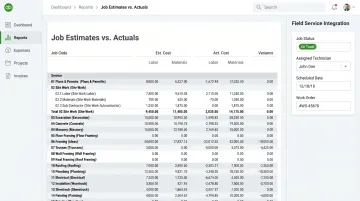
Getting the software configured correctly is where most contractors stumble. Sound Advice Bookkeeping brings over 100 combined years of QuickBooks expertise and works with HVAC clients to set up their software around how their business actually operates, not just what satisfies a tax return.
Keep Digital Records of Everything
Paper receipts fade, get lost, or become illegible. Digital records protect against audits, simplify tax preparation, and make it seamless to hand off work to a bookkeeper or accountant when needed.
What to digitise:
- Parts and materials receipts
- Vendor invoices
- Equipment purchase documentation
- Payroll records
- Service vehicle expense logs
- Customer contracts and change orders
Use expense management tools like HubDoc or Expensify to capture receipts via mobile phone immediately after purchase. These integrate directly with QuickBooks, automatically categorising and filing expenses.
When to Hire a Professional HVAC Bookkeeper
Signs DIY Bookkeeping Has Run Its Course
You've reached the tipping point when:
- You spend more than a few hours weekly on paperwork and financial record-keeping
- You can't confidently answer whether individual jobs are profitable
- Tax season creates anxiety and last-minute scrambling
- Payroll errors occur regularly, frustrating technicians
- Your books haven't been reconciled in months
- You're uncertain about your true cash position
Almost half (45%) of all small businesses employ neither an accountant nor a bookkeeper. One study found that small business owners who outsourced bookkeeping gained back an average of 15 hours per week for revenue-generating activities. Professional bookkeeping typically runs $300–$500 per month — a cost that's often offset by the tax deductions identified, compliance penalties avoided, and billable hours freed up.
What to Look for in an HVAC Bookkeeper
Not all bookkeepers understand contractor businesses. Look for someone who:
- Has experience with job-based businesses and project-level cost tracking
- Understands contractor-specific expenses: vehicle fleets, parts inventory, EPA compliance, warranty tracking
- Is proficient in QuickBooks or your accounting platform of choice
- Can configure FSM integrations to eliminate double data entry
- Views bookkeeping as a business-building tool, not just compliance work
- Offers transparent, predictable pricing
Sound Advice Bookkeeping works specifically with small and mid-sized business owners who need clean books and strategic insight. Monthly packages start at $170, determined by transaction volume rather than hours spent — so HVAC owners know exactly what to expect each month without unnecessary overhead. The company has served over 1,000 small businesses since 2007, bringing a combined 100+ years of QuickBooks knowledge to help contractors configure systems that support growth.

The Value of Ongoing Financial Reporting
A professional bookkeeper doesn't just record transactions. They deliver monthly financial statements—profit and loss reports, cash flow statements, and balance sheets—that enable confident operational decisions.
How monthly reports drive better decisions:
- P&L statements reveal which job types and service lines generate the highest profit margins, informing pricing strategy and marketing focus
- Cash flow reports forecast seasonal dips weeks in advance, enabling proactive expense management and reserve building
- Balance sheets track asset depreciation and debt obligations, supporting equipment purchase and financing decisions
These reports transform financial data from historical records into forward-looking management tools.
Frequently Asked Questions
What is the best accounting software for HVAC businesses?
QuickBooks is the most widely recommended platform for HVAC contractors due to its job costing capabilities, payroll integration, and compatibility with field service management tools. The "best" choice depends on your business size and complexity. However, software selection matters less than proper configuration—setting up job codes, chart of accounts, and integrations correctly makes the difference between useful financial visibility and meaningless data entry.
How often should HVAC businesses update their books?
Weekly updates are the industry standard best practice. Log expenses, record payments, and review open invoices once per week to prevent backlogs, keep job costing accurate, and eliminate the end-of-year scramble. This weekly discipline takes 30-45 minutes but saves hours of month-end catch-up work and reduces costly errors.
What is job costing and why does it matter for HVAC companies?
Job costing tracks all labor, materials, overhead, and other direct costs tied to a specific project to determine actual profitability. Without it, HVAC owners can stay busy all season and still lose money on underpriced or mismanaged jobs. It reveals which service types, customer segments, and technicians deliver profit—and which drain resources.
How do HVAC companies manage cash flow during slow seasons?
The foundation is cash flow forecasting using historical data to anticipate seasonal revenue dips. Maintenance and service agreements provide recurring income year-round, stabilizing cash during slow months. Building cash reserves during peak season then covers fixed overhead when call volume drops.
Should HVAC contractors separate business and personal bank accounts?
Yes—it's essential. A dedicated business checking account simplifies tax filing, protects you during an audit, and enables accurate profit measurement. Mixing personal and business finances increases IRS audit risk and leads to missed deductions.
Are HVAC parts considered COGS or business expenses?
Parts installed in a customer's system are classified as Cost of Goods Sold (COGS); general tools and shop supplies used across multiple jobs are operating expenses. The distinction affects both profit margin reporting and tax treatment—COGS reduces gross profit directly, while operating expenses appear further down the income statement.