

Introduction
Therapists running private practices wear many hats—clinician, administrator, and accidental accountant. While mastering clinical skills takes years of training and supervision, managing the business side of a practice often comes with no roadmap at all. Yet keeping clean financial records is as essential to a thriving practice as client care itself.
Choosing the wrong bookkeeping software can mean wasted hours reconciling bank accounts at midnight, compliance risks that jeopardize your license, and missed tax deductions that cost thousands of dollars. According to Intuit, 23% of self-employed and small business owners feel anxious about accounting — many relying on error-prone spreadsheets with no built-in accuracy checks.
The right software changes that. This guide covers the top bookkeeping tools for therapists, what features actually matter for a private practice, and how to choose the option that fits your caseload and budget.
Key Takeaways
- The right bookkeeping software tracks session fees, insurance reimbursements, co-pays, and deductible expenses without chaos
- No mainstream bookkeeping platform is HIPAA compliant—keep client names and PHI out of your ledger entirely
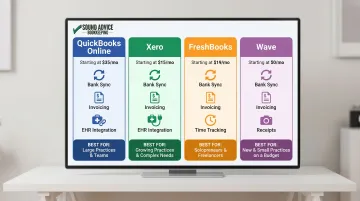
- QuickBooks Online leads in accountant compatibility; Xero and FreshBooks are simpler alternatives; Wave works for solo practices on tight budgets
- Pick your platform based on ease of use, practice management integrations, pricing, and tax prep support
- When software alone isn't enough, a professional bookkeeper saves time and prevents costly tax filing errors
Why Therapists Need Specialized Bookkeeping Software
Therapy practices generate income streams unlike most small businesses. Instead of straightforward product sales, therapists manage session fees, co-pays, insurance reimbursements, HSA/FSA payments, and sliding-scale arrangements—each requiring distinct categorization to produce accurate financial reports. A retail business can reconcile credit card batches and call it a day; a therapist must track which payments came from clients directly, which from insurance payers, and which remain outstanding after filing claims.
Self-employed therapists face additional complexity. According to the 2022 AAMFT workforce study, 46% of marriage and family therapists work in individual private practice and 16% in group practices. The 2024 Social Work Workforce Survey estimates that 26% of clinical social workers are self-employed. These practitioners carry a heavier tax burden than W-2 employees, including:
- Self-employment taxes calculated on a 92.35% multiplier of net earnings
- Quarterly estimated tax payments to avoid underpayment penalties
- Schedule C deductions that require detailed, well-organized expense records

Without clean books, each of these obligations becomes a guessing game at year-end.
Unlike retail or consulting businesses, therapists must also navigate HIPAA-related data privacy rules when choosing software that touches financial records. Recording "Jane Doe - Session 3/15" in your general ledger creates a compliance violation. This makes software selection more consequential than in most fields: the wrong choice doesn't just waste time—it puts your license at risk.
Best Bookkeeping Software for Therapists
All five options below are cloud-based, offer transaction tracking and financial reporting, and are evaluated based on ease of use, pricing, integration capabilities, and suitability for solo or group therapy practices.
QuickBooks Online
QuickBooks Online is the most widely adopted bookkeeping software among small business owners and therapists, holding 62.23% market share in the accounting software market. It offers robust expense tracking, automated bank syncing, and financial reporting that accountants and bookkeepers know well.
QuickBooks supports multiple cash flow reporting methods, automates quarterly and annual tax calculations, and allows easy collaboration with a professional bookkeeper or CPA. While SimplePractice doesn't offer a direct API integration, therapists can export billing activity, payments, and invoices as CSV or QuickBooks-formatted files for manual import—keeping PHI out of the accounting system entirely.
| Feature | Details |
|---|---|
| Best For | Solo and group practices earning $20,000+ annually who want comprehensive reporting and accountant-friendly records |
| Starting Price | $38/month (Simple Start); promotional rate $19/month for first 3 months |
| Key Therapist Features | Automated bank reconciliation, expense receipt scanning via mobile app, cash flow reporting, compatible with SimplePractice billing export |
Xero
Xero is a user-friendly QuickBooks alternative built for small business owners without an accounting background. It offers a clean interface and comparable core features at a competitive price point, making it approachable for therapists who find QuickBooks overwhelming.
Xero includes unlimited users on all plans—useful for group practices that need multi-user access without per-user fees. It integrates directly with practice management tools like Cliniko and Timely, automatically pushing invoices and payments from the EHR to the accounting system.
Fast bank reconciliation and online payment collection via Stripe and PayPal make day-to-day financial admin considerably lighter.
| Feature | Details |
|---|---|
| Best For | Therapists who find QuickBooks overwhelming, or group practices needing multi-user access without per-user fees |
| Starting Price | $25/month (Early plan); promotional rate $5/month for first 3 months; 30-day free trial |
| Key Therapist Features | Unlimited users, integrates with Cliniko and Timely, automated bank reconciliation, online invoice payments via Stripe and PayPal |
FreshBooks
FreshBooks is a cloud-based platform designed for service-based freelancers and small business owners, valued for its simplicity, mobile accessibility, and automated invoicing. It's approachable for therapists new to bookkeeping software who need a gentle learning curve.
FreshBooks supports automated bank reconciliation, mobile receipt scanning, customizable invoices, and recurring billing features that align with regular therapy session schedules—keeping billing predictable for clients on weekly or biweekly schedules. The trade-off: FreshBooks lacks direct EHR/EMR integration, so therapists must manually export data from their practice management system.
| Feature | Details |
|---|---|
| Best For | Solo therapists in early practice stages who need simple, affordable invoicing and expense tracking without a steep learning curve |
| Starting Price | $23/month (Lite plan); promotional rate $6.90/month for 4 months; 30-day free trial |
| Key Therapist Features | Automated invoicing, mobile receipt scanning, recurring billing, expense tracking, accessible mobile app |
Wave
Wave is a free-to-use accounting and invoicing platform best suited for therapists just starting out who need basic financial tracking without upfront software costs. Core accounting features are free, though payment processing fees apply.
The accounting and invoicing features remain free, but credit card processing costs 2.9% + $0.60 per transaction (Visa/Mastercard/Discover) and ACH payments cost 1%. More critically, Wave explicitly states it is not HIPAA compliant and does not integrate with EHR/practice management tools—limiting its viability as a practice grows beyond basic cash-pay clients.
| Feature | Details |
|---|---|
| Best For | New solo practices with limited budgets and simple financial needs (primarily cash-pay clients, few transactions) |
| Starting Price | Core accounting features free; Pro Plan $19/month; payment processing fees apply |
| Key Therapist Features | Free transaction tracking and invoicing, basic financial reports, recurring billing; Note: No EHR integration, not HIPAA compliant |
Sage 50 Accounting
Sage 50 is a more advanced accounting platform suited for established or growing therapy practices that need customizable workflows, time-tracking for session billing, and multi-user controls with role-based access.
For larger practices, its most notable feature is EMR integration via Sage Intacct EMRConnect, which includes HIPAA-compliant data handling when using the Advanced Audit Trail module. This allows clinical and financial data to interface securely—a meaningful consideration for multi-therapist offices or institutional practices. The steeper learning curve makes it less suitable for solo practitioners new to accounting software.
| Feature | Details |
|---|---|
| Best For | Established group practices or multi-therapist offices needing advanced reporting, time-tracking, and multi-user controls |
| Starting Price | $124.42/month (Pro Accounting for 1 user); 30-day test drive available |
| Key Therapist Features | Time-tracking for session billing, customizable workflows, multi-user access, receipt scanning, EMR integration via Sage Intacct |
HIPAA Compliance and Bookkeeping Software: What Therapists Must Know
No mainstream bookkeeping software—including QuickBooks, Xero, FreshBooks, or Wave—is inherently HIPAA compliant. These platforms are not designed to store protected health information (PHI). Intuit explicitly states QuickBooks Online is "not compliant with HIPAA standards for privacy", and Xero does not warrant HIPAA compliance or offer a Business Associate Agreement (BAA).
Therapists who include client names or identifying details in their general ledger entries risk a compliance violation.
The practical rule: Bookkeeping entries should never include client names, diagnoses, or any identifying information. Instead:
- Use confidential client ID numbers or anonymized codes in transaction descriptions
- Keep clinical records in a HIPAA-compliant EHR (such as SimplePractice or TheraPlatform)
- Share only anonymized financial data with bookkeepers or accountants
The exception: Sage Intacct's EMRConnect integration is designed for healthcare organizations and includes HIPAA-compliant data handling when the Advanced Audit Trail module is utilized—making it relevant for larger or institutional therapy practices that need clinical and financial data to interface.
The cost of non-compliance far outweighs the inconvenience of maintaining two separate systems. HIPAA civil monetary penalties for 2026 break down as follows:
| Violation Tier | Description | Penalty Per Violation | Annual Cap |
|---|---|---|---|
| Tier 1 | Lack of knowledge | $145 | $34,464 |
| Tier 2 | Reasonable cause | $1,379 | $137,886 |
| Tier 3 | Willful neglect (corrected) | $13,785 | $689,264 |
| Tier 4 | Willful neglect (uncorrected) | $73,011 | $2,190,294 |

Keeping client identifiers out of your books entirely is the simplest way to stay on the right side of these rules — and it only takes a consistent naming convention to do it.
How We Chose the Best Bookkeeping Software for Therapists
Our evaluation focused on four criteria most relevant to therapy practice owners:
- Ease of use for non-accountants with no accounting background
- Pricing transparency and scalability as practice revenue grows
- Integration with practice management or EHR billing tools
- Fit across practice stages, from new solo practices to established group practices
The common mistake therapists make: selecting a tool based on general small-business popularity without considering whether it supports insurance reimbursement tracking, integrates with their billing workflow, or accommodates the involvement of a professional bookkeeper. Many end up switching systems mid-growth, losing time and continuity.
That switching cost is why the right software choice matters—but software alone has limits. For practices earning $50,000 or more annually, or those billing multiple insurance payers, professional bookkeeping support often becomes necessary to keep things accurate and audit-ready.
Sound Advice Bookkeeping works directly with clinical social workers and therapists to manage QuickBooks, track income by payer, and handle the month-to-month reconciliation that practice owners rarely have time for. The result: cleaner books, fewer year-end surprises, and more time for client care.
Conclusion
The best bookkeeping software for any therapist depends on practice size, budget, comfort with technology, and whether you bill insurance. There is no single right answer, but the wrong choice costs time, money, and compliance confidence.
Software is a tool, not a solution. Clean, accurate books require consistent habits: reconciling monthly, categorizing entries correctly, keeping client PHI out of financial records, and reviewing financial reports regularly. Even the best software can't replace sound financial discipline.
If you want expert financial guidance tailored to your therapy practice, Sound Advice Bookkeeping has supported over 1,000 small businesses across 30+ states since 2007—including private practices—with QuickBooks management, monthly reconciliation, and bookkeeping that gives you a clear picture of where your money actually goes.
Reach their team at 303.228.8911 or visit their website to schedule a consultation.
Frequently Asked Questions
What is the best bookkeeping software for therapists?
QuickBooks Online is the most widely used option due to its comprehensive features and accountant compatibility, while Xero and FreshBooks are strong alternatives for therapists who prefer simplicity. The best choice depends on practice size, budget, and whether insurance billing is involved.
What accounting software is HIPAA compliant?
No standard bookkeeping software — QuickBooks, Xero, FreshBooks, or Wave — is HIPAA compliant on its own. Therapists should use a separate HIPAA-compliant EHR for client data and keep all PHI out of their bookkeeping records entirely.
How much does it cost to outsource bookkeeping?
According to a 2026 Accounting Today benchmark report, monthly bookkeeping and accounting services typically range from $250 to $499 per month. For therapists specifically, outsourced bookkeeping costs generally range from $200 to $1,500 per month depending on transaction volume and scope of services. The cost is fully tax-deductible as a professional service expense under IRS Schedule C, Line 17.
How much should a bookkeeper charge an hour?
Freelance bookkeepers typically charge between $25 and $60 per hour, while experienced bookkeepers charge $60 to $100 per hour. The Bureau of Labor Statistics reports the median annual wage for bookkeepers at $49,210. Many firms offer flat monthly packages, which tend to be more budget-predictable for small practices.
What can a therapist write off on taxes?
Therapists in private practice can typically deduct the following under IRS Schedule C:
- Office rent and utilities (business portion)
- Continuing education and clinical training
- EHR and bookkeeping software subscriptions
- Professional liability insurance
- Bookkeeping and accounting fees
- Phone and internet (business-use percentage)
- Clinical assessment tools and client care materials
- Professional association memberships
- Marketing costs such as website hosting
What are the 4 types of bookkeeping?
The four common types are:
- Single-entry: Basic tracking suited for very simple finances
- Double-entry: The standard method used by most accounting software
- Cash-basis: Records transactions when money actually changes hands
- Accrual: Records transactions when earned or incurred, regardless of payment
Most therapy practices use double-entry bookkeeping with cash-basis accounting.