

Introduction
Multi-unit franchise bookkeeping is the structured financial management system that tracks, reconciles, and reports on every location's performance while meeting franchisor compliance requirements. If you operate two or more restaurant franchises, you've likely discovered that instinct and bank balance checks no longer cut it. When one location underperforms, it can quietly drain profits from your stronger units—and without proper systems, you won't see it until the damage compounds.
This guide addresses the specific challenges multi-unit restaurant franchise owners face:
- Managing separate books for each location without losing visibility across the group
- Consolidating performance data into actionable reporting
- Tracking royalties and advertising fund contributions accurately
- Producing both unit-level and consolidated financials that satisfy franchisor requirements
You'll learn what systems to build, which metrics matter most, and how to spot the margin leaks that grow quietly when your bookkeeping lags behind your operation.
Key Takeaways
- Multi-unit franchise bookkeeping requires separate systems per location and consolidated reporting—not just scaled-up single-location accounting
- Franchise-specific obligations like royalty tracking (typically 4-8% of gross sales) and advertising fund contributions (1-5% of sales) add complexity that general bookkeepers often miss
- Three foundational pillars: standardized chart of accounts, POS-integrated daily sales tracking, and QuickBooks class/location tracking for unit-level P&L
- Prime cost (food + labor combined) is your most critical metric—best-in-class QSRs target 55-60%, while full-service concepts target 60-65%
- Outsourcing to a franchise-experienced bookkeeper typically costs 60-75% less than hiring in-house—and delivers the location-level P&Ls you need to make real decisions
What Makes Multi-Unit Franchise Bookkeeping Different From Single-Unit Accounting
Single-unit restaurant accounting focuses on one set of financials—one cash flow statement, one payroll register, one vendor bill stack. Multi-unit franchise bookkeeping must maintain that same discipline across every location simultaneously, then consolidate the data into a coherent group-level view. Managing three locations isn't three times the work—the interdependencies between sites, shared vendors, and consolidated reporting make it fundamentally more complex.
Franchise-specific obligations create an entirely different bookkeeping landscape than independent restaurants face. You must track royalty fees (which average 4-8% of gross revenue across major brands), national and local advertising fund contributions (typically 1-5% of sales), and brand-mandated reporting formats. Many franchise agreements specify exact chart of accounts structures and require audit-ready documentation on demand. Standard franchise agreements grant franchisors the right to audit your books "at all reasonable times," and if sales are understated by 2% or more, you'll pay the deficiency, interest, and reimburse the franchisor's full audit costs.
Each new location adds a distinct set of operational variables that interact with every other site in your portfolio:
- State tax jurisdictions: Varying sales tax rates and filing deadlines across locations
- Labor law differences: Minimum wage, overtime rules, and break requirements shift by state and city
- Vendor relationships: Location-specific pricing that complicates consolidated cost analysis
- Expense categorization: Inconsistent coding across sites makes cross-location performance comparisons unreliable
Without standardized systems across all units, you can't reliably answer the most important question: which locations actually make money?
Core Components of a Multi-Unit Franchise Bookkeeping System
The foundation is a standardized, streamlined chart of accounts shared across all locations. Overcomplicating your account structure produces reports owners can't interpret quickly. At minimum, separate food and non-alcoholic beverage income and COGS from alcoholic beverage income and COGS, and isolate labor as its own category—it's typically your highest controllable expense and deserves granular tracking.
That structure only works, though, if the daily data feeding into it is accurate and consistent across every location.
Setting Up POS-Integrated Daily Sales Tracking
Each location needs its own daily sales journal entry pulled from a properly configured POS system. This entry should mirror actual bank deposits by day: the only reliable way to catch discrepancies, flag potential theft, and ensure your books reflect real cash movement rather than lagging weekly summaries.
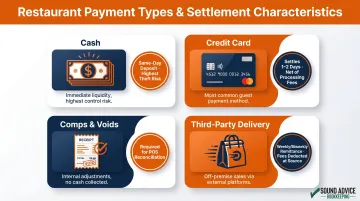
The daily sales entry must capture more than just top-line revenue. Break out each payment type, since each settles differently into your bank account with its own timing and fee structure:
- Cash: Deposits same day; easiest to track, easiest to steal
- Credit card: Typically settles 1-2 business days later, net of processing fees
- Comps and voids: Must be recorded to reconcile against POS totals
- Third-party delivery (DoorDash, Uber Eats, GrubHub): Remitted weekly or biweekly, with platform fees deducted at source
When POS totals don't match bank deposits, you have a red flag. Investigate immediately, whether it's a batch processing error, unrecorded refunds, or something more concerning.
Using Location-Level Tracking in Accounting Software
QuickBooks class tracking (or location tracking in QuickBooks Online) enables a single company file to generate both individual location P&Ls and a consolidated group P&L. To enable class tracking in QuickBooks Online, go to Settings → Account and Settings → Advanced → Categories → Track classes. Set it to "One to entire transaction" or "One to each row in transaction" based on your workflow.
The discipline required: assign a class to every single transaction. Unclassified entries corrupt your reporting entirely, rendering location-level P&Ls unreliable. Many franchise owners find this is where clean books start to unravel. At Sound Advice Bookkeeping, we set up class tracking from day one and enforce consistent classification across every transaction, so your location-level reports stay reliable month after month.
Centralized Accounts Payable and Bank Account Structure
Centralize all vendor invoices and bill payments through one process rather than managing payables location-by-location. Decentralized AP creates duplicate payments, missed bills, and zero visibility into group-wide cash obligations. Use your accounting software to tag expenses by location through class tracking, but process all vendor payments centrally.
Recommended bank account structure:
- One operating checking account where all location deposits flow
- One payroll checking account funded from operations as needed
- One savings account linked for overdraft protection
Separate checking accounts per location are rarely necessary unless each location operates as its own legal entity. Consolidating into one operating account gives you cleaner reconciliation and better visibility into group-wide cash position.
Key Financial Metrics Every Multi-Unit Franchise Owner Must Track
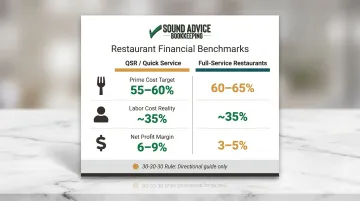
Prime cost—total food cost plus total labor cost as a percentage of revenue—is the single most important operational metric in restaurant franchising. Even a 1-2% variance per location compounds significantly across multiple units. Current industry benchmarks show best-in-class quick-service restaurants (QSR) targeting 55-60% prime costs, while full-service concepts target 60-65%. Calculate this weekly, not monthly—by the time monthly reports close, you've lost the ability to correct course.
Contribution margin by location reveals which units actually generate cash to cover fixed overhead and support growth. After subtracting variable costs (food and direct labor), contribution margin shows your real unit-level profitability. A location with high revenue but low contribution margin may be draining your business through poor cost controls or underpriced menu items.
Break-even sales per unit is the minimum revenue a location must generate to cover all costs — fixed and variable. Calculate it before signing a lease or committing capital. At minimum, factor in:
- Rent and utilities
- Insurance and minimum labor requirements
- Royalties and advertising contributions
- Average COGS
This figure tells you exactly how many covers per day a new unit needs to survive.
Store-level EBITDA measures four-wall profitability before corporate overhead allocations. Lenders, investors, and sophisticated franchise operators use this metric to evaluate true unit-level performance. For context, average 4-wall EBITDA in 2022 was approximately $140,000 for Burger King U.S. locations and $210,000 for Popeyes U.S. locations. Consolidated reports without store-level EBITDA make it impossible to identify which locations justify reinvestment versus which need intervention.
Once you have store-level EBITDA dialed in, benchmarks like the 30-30-30 rule become useful context — not rigid targets. The rule suggests food cost at ~30% of revenue, labor at 30%, and occupancy/overhead at 30%, leaving roughly 10% for profit. Industry experts now view this as an outdated benchmark that doesn't account for wage pressures and market variation. Labor costs typically run closer to 35% today, and actual net margins average just 3-5% for full-service restaurants and 6-9% for QSRs. Treat it as a directional guide, not gospel.
Common Bookkeeping Mistakes Multi-Unit Franchise Owners Make
The most damaging mistake: treating all locations as one business financially. Running a single QuickBooks file with no class or location tracking, consolidating all revenue into one account, and reviewing only a group P&L makes it impossible to know which locations are profitable and which erode margins. Unit-level problems go undiagnosed until they've already cost you money.
Inconsistent chart of accounts across locations destroys meaningful comparisons. When different managers or bookkeepers set up each unit independently, one location codes cleaning supplies under "Janitorial," another under "Supplies," and a third under "Operating Expenses." Cross-location variance reports become meaningless, and you often inflate apparent profitability by accidentally miscategorizing expenses that belong elsewhere.
Failing to track royalties, advertising contributions, and brand fees as distinct line items creates two problems at once: compliance risk with the franchisor and distorted unit-level margins. Lumping these into generic "Fees" or "Miscellaneous Expenses" means you can't benchmark them accurately against sales. These fees should be tracked as separate expense categories, ideally as a percentage of sales for easy benchmarking.
Tracking fees correctly matters — but only if your books are current. Delayed financial reporting is a structural problem that compounds losses across every location.
When books close three weeks after the period ends, corrective action on food cost overruns, labor inefficiencies, or inventory shrinkage comes too late to matter. Multi-unit operators need monthly close cycles at minimum, with key metrics like prime cost reviewed weekly so managers can adjust staffing and prep before waste compounds.
When to Outsource Your Franchise Bookkeeping
Clear signals indicate in-house or DIY bookkeeping no longer works:
- Books consistently close two or more weeks after month-end
- Location-level P&Ls aren't being produced at all
- Royalty tracking is manual, prone to errors, or frequently disputed
- You're making financial decisions based on bank balance rather than actual unit-level financials
- You're adding a new unit without a solid financial foundation for the existing ones
- Your current bookkeeper lacks franchise or restaurant-specific experience
When evaluating a franchise bookkeeping partner, look for:
- Experience with restaurant or food service franchises specifically
- QuickBooks proficiency for multi-entity or multi-location setup
- Ability to produce both unit-level and consolidated reports on predictable schedules
- A team structure that functions as an extension of your operation, not a once-a-year tax vendor
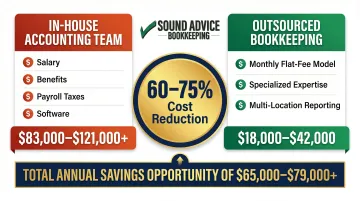
The cost difference alone makes the case. In-house accounting teams run $83,000–$121,000+ annually when you factor in salary, benefits, payroll taxes, and software. Comprehensive outsourced accounting typically ranges from $1,500–$3,500 per month ($18,000–$42,000 annually) — a 60–75% reduction while gaining specialized industry expertise.
Boutique firms like Sound Advice Bookkeeping bring hands-on, franchise-experienced support without the overhead of large accounting firms. Founded in 2007 and now serving clients across 30+ states — including franchise operators like Miracle Method Franchise — they've built their practice around small and mid-sized business owners who need reliable reporting, not just year-end tax prep.
Their flat-fee pricing model is based on transaction volume, starting at $170/month. Their three-phase onboarding process ensures clean data and reliable reporting from day one.
Outsourcing doesn't mean losing control—it means gaining cleaner data and more reliable reporting, which gives franchise owners more informed control over every location they operate.
Frequently Asked Questions
How do you do bookkeeping for multi-location restaurants?
Multi-location restaurant bookkeeping requires a standardized chart of accounts across all units, daily sales journal entries per location pulled from POS systems, and location-level tracking in accounting software (typically QuickBooks class or location tracking) so each unit produces its own P&L while contributing to a consolidated group report.
What is the best accounting method for multi-location restaurants?
Accrual accounting is recommended for multi-unit restaurant franchises because it matches revenue and expenses to the period in which they occur, giving a more accurate picture of each location's performance. The IRS requires accrual accounting when inventory is necessary to account for income, which applies to all restaurants.
What is the 30-30-30 rule for restaurants?
The 30-30-30 rule is a guideline suggesting food costs, labor costs, and overhead/occupancy costs each represent approximately 30% of revenue, leaving roughly 10% for profit. It's a useful directional benchmark, but modern labor pressures and varying franchise agreements mean actual performance often differs significantly.
What bookkeeping records do franchisors typically require from franchisees?
Most franchisors require regular financial reporting such as weekly or monthly sales summaries, annual P&L statements, and sometimes direct access to POS data. Franchise agreements specify reporting frequency and format. Failure to maintain accurate records can trigger audit clauses or compliance issues.
Should multi-unit restaurant franchisees use QuickBooks or restaurant-specific software?
QuickBooks Online with location tracking works well for most multi-unit operators when properly configured. Restaurant-specific platforms like Restaurant365 offer deeper POS integration, automated intercompany accounting, and theoretical vs. actual food cost tracking. The right choice depends on the number of locations, budget, and whether you need recipe-level cost tracking.
What is the difference between unit-level and consolidated financial reporting?
Unit-level reports show the P&L for each individual location separately, enabling performance comparison and targeted intervention. Consolidated reports combine all locations into a single group view for overall financial health. Multi-unit franchise owners need both to manage operations effectively.