
AR is uniquely complex for restaurants. Multiple revenue channels — dine-in, catering contracts, delivery platforms like DoorDash and Uber Eats, corporate accounts, and private events — each come with their own billing cycles and payment terms. High transaction volumes compound the challenge, and with profit margins thin enough that even a few delayed payments can trigger a cash crunch, effective receivables management isn't just good practice. It's survival.
This guide covers what AR services restaurants can outsource, the key benefits of doing so, how to select and transition to a provider, and the best practices that keep collections running smoothly without pulling you away from operations.
Key Takeaways
- Multiple revenue channels and distinct billing cycles make restaurant AR harder to manage than most industries
- Outsourcing frees owners from chasing invoices — dedicated professionals handle collections and reconciliation instead
- Core services cover invoice generation, payment follow-up, reconciliation, aging reports, and dispute resolution
- Look for a partner with QuickBooks expertise, food service knowledge, and transparent reporting
- Track Days Sales Outstanding (DSO) to measure whether your AR process is actually getting better
Why AR Is Uniquely Challenging for Restaurants
Multiple Revenue Streams, Multiple Headaches
Modern restaurants earn revenue from far more than table service. Catering contracts, third-party delivery platforms, corporate accounts, private events, and loyalty programs all generate invoices or payouts with different terms, schedules, and reconciliation requirements. In 2025, off-premises sales represented 35.4% of customer traffic in the full-service segment and 89.9% in limited-service, making multi-channel revenue management a critical operational reality.
Third-party delivery platforms create their own distinct challenges. Each platform runs on a different payout schedule and fee structure:
- DoorDash calculates net payouts as sales minus commission, fees, and marketing spend, with weekly default settlements
- Uber Eats issues payments weekly via direct deposit
- Grubhub offers weekly, twice-weekly, or bi-weekly options
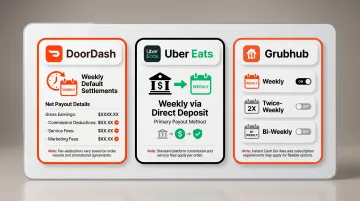
Each platform deducts fees and refunds after the fact, and none sync cleanly with POS data without dedicated reconciliation.
The stakes are high. In 2024, median profit margins were just 2.8% for full-service restaurants and 4.0% for limited-service operations. When you're operating on margins this thin, delayed or missed payments aren't inconveniences — they threaten payroll, vendor payments, and basic working capital. Consistent AR collections become a survival issue.
AR Services Restaurants Can Outsource
Here's a breakdown of the specific AR functions restaurants commonly hand off to outsourced teams.
Invoice generation and management: Outsourced AR teams create and send accurate, timely invoices for catering orders, corporate clients, and event services — covering all non-POS revenue channels. Invoice errors and delays are among the most common triggers of disputed payments, and faster invoicing directly drives faster collection.
Collections and payment follow-up: A dedicated AR team sends reminders before due dates and follows up on overdue balances consistently, sparing your team the friction of chasing clients directly. Professional follow-up protects client relationships while maintaining cash flow discipline.
Payment application and reconciliation: This involves matching incoming payments to the correct open invoices and reconciling POS sales data, delivery platform deposits, and bank records. High transaction volume makes manual reconciliation error-prone and time-consuming.
Integrating delivery apps with a POS system reduces manual errors and consolidates reporting, but still requires skilled oversight to catch discrepancies.
Aging report management: An AR aging report categorizes outstanding balances by how long they've been overdue — typically 0–30, 31–60, 61–90, and 90+ days. Outsourced teams monitor and act on aging data proactively.
The collection window closes fast: the probability of recovering a delinquent balance drops to 68.9% at 90 days, 51.3% after six months, and just 21.4% after one year.
Dispute resolution: Billing disputes are especially common in catering and large corporate orders. An outsourced team researches discrepancies, communicates with clients, and reaches resolution without pulling internal staff away from operations. Nearly one-third of AR teams' days are spent resolving invoice disputes — a significant drain when handled in-house.
Financial reporting and AR analytics: Outsourced providers deliver regular, structured reports covering key AR metrics — outstanding balances, collection rates, client-level aging. This gives restaurant owners real-time visibility into cash flow health rather than discovering payment gaps weeks later.
Key Benefits of Outsourcing Restaurant AR
Outsourcing AR isn't just about offloading paperwork — it directly affects cash flow, staffing costs, and how much time you spend on the business versus in it. Here's what restaurants typically gain:
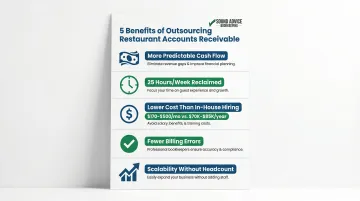
More predictable cash flow: Consistent follow-up shortens payment cycles and reduces overdue accounts — giving owners reliable working capital for food costs, payroll, and vendor payments. This matters most during slow seasons when cash reserves are thin.
Time back for owners and operators: Businesses spend an average of 25 hours per week on manual data entry or reconciling data across apps, and 33% of small business owners work more than 50 hours per week. Outsourcing AR reclaims that time for operations and hospitality.
Lower cost than in-house hiring: A full-time AR specialist runs $70,000–$85,000 per year once you factor in salary and the 29.9% employer cost of benefits — based on starting salaries of $54,750–$65,750. Outsourced AR delivers the same expertise at a flat monthly fee starting around $170–$500, depending on transaction volume.
Fewer billing errors and faster dispute resolution: Experienced AR professionals using QuickBooks catch invoice errors before they go out, apply payments correctly the first time, and resolve disputes without the back-and-forth that strains client relationships.
Scalability without added headcount: Whether you're launching a catering program, opening a second location, or growing a corporate account roster, outsourced AR scales with you — no new hire required.
How to Choose and Transition to an Outsourced AR Partner
What to Look for in a Provider
When evaluating AR partners, start with software compatibility. Prioritize providers who work fluently with the accounting software your restaurant already uses — for most small to mid-sized operators, that means QuickBooks. QuickBooks holds an 81.99% market share in the small-business-accounting market globally, making it the practical standard. A provider with deep QuickBooks knowledge integrates AR management directly into your existing books without creating a parallel system.
Sound Advice Bookkeeping, for example, brings 100+ combined years of expertise across QuickBooks Online, Desktop, and Enterprise, and has worked with restaurant clients including Sage Catering — making them a practical fit for operators who want AR support alongside full bookkeeping.
On pricing, request a written fee structure and a detailed list of included services before committing. Flat monthly pricing offers more predictability than hourly billing, and knowing exactly what's covered — and what isn't — prevents surprises after onboarding.
Setting Up the Transition for Success
Once you've identified a provider that fits, the way you onboard determines how quickly you see results.
Two practices make the biggest difference early on:
- Map your specific pain points first. Where does your current AR process break down — delayed catering invoices, unreconciled delivery payouts, slow corporate account collections? Confirm the provider's services address those bottlenecks directly, not just AR in general.
- Schedule monthly financial reviews from day one. Cover outstanding balances, DSO trends, and cash flow concerns so the relationship stays aligned with your restaurant's actual needs rather than running on autopilot.
Best Practices for Managing Restaurant AR
Track Days Sales Outstanding (DSO)
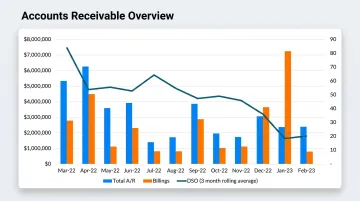
DSO measures the average number of days between issuing an invoice and receiving payment, calculated as (Accounts Receivable / Total Credit Sales) × Number of Days. Lower is better.
Restaurant Brands International reported a DSO of 28.77 days as of December 2025 — a useful benchmark. Tracking DSO month over month shows whether collections are improving or slipping. The Collection Effectiveness Index (CEI) is a strong secondary metric, measuring what percentage of collectible AR is actually being collected.
Set Written Payment Terms Before Every Service
Every catering contract, event booking, and corporate account should include written payment terms — Net 15 or Net 30 are common for restaurants, though food and beverage businesses average immediate to 3 days for standard transactions. Agree on these terms before services are rendered. That single step eliminates the ambiguity behind most disputed payments and long collection cycles.
For catering specifically, most businesses collect 20–50% of the total balance a few days before the event, with the remainder due on the event day.
Review Aging Reports Regularly — and Act on Them
Review the AR aging report at least monthly to catch accounts entering the 60-day and 90-day overdue buckets, where collectibility drops sharply. Proactive outreach at 30 days is far more effective than waiting until accounts are seriously delinquent.
86% of businesses report that up to 30% of their monthly invoiced sales are overdue — consistent monitoring isn't optional, it's what keeps that number from compounding.
Frequently Asked Questions
What is the 10 rule for accounts receivable?
The "10-day rule" in AR refers to issuing invoices within 10 days of service delivery. Invoices sent promptly are significantly more likely to be paid on time. For restaurants, this is especially relevant for catering and event billing, where delays in invoicing commonly lead to delayed payment.
Which accounting software is best for restaurants?
QuickBooks is the most widely used accounting platform for small to mid-sized restaurants due to its flexibility, broad integration capabilities, and strong support ecosystem. Larger multi-unit operations may also use Restaurant365 or Sage Intacct, but QuickBooks remains the practical standard for independent and growing restaurants.
Can small restaurants benefit from outsourcing AR?
Small restaurants often benefit the most from outsourcing AR because it gives them professional collections expertise and consistent follow-up without the cost of a full-time hire. The cross-industry median sits at 2,800 customer accounts per full-time AR employee, per APQC benchmarks — well within the scope of most single-location or small-chain operations.
How do I know if my restaurant's AR process is working?
Track DSO and review aging reports monthly. If DSO is declining over time and fewer invoices are landing in the 60-day or 90-day overdue buckets, AR performance is improving.
What is the difference between accounts receivable and accounts payable for restaurants?
AR is money owed to the restaurant — from catering clients, corporate accounts, or event customers. AP is money the restaurant owes to vendors and suppliers. Both sides of the ledger need active management to maintain healthy cash flow.