
The problem isn't the quality of your work—it's accounts receivable management. According to industry data, 82% of contractors face payment waits exceeding 30 days, with the average Days Sales Outstanding stretching to 79 days for general contractors and 96 days for subcontractors. That's three months of waiting for money you've already earned.
This article explains why construction AR is uniquely complicated, which tasks you can outsource, the tangible benefits of getting help, and how to choose the right partner who understands your industry.
Key Takeaways
- Construction AR is harder than standard billing due to progress payments, retainage, lien waivers, and multi-party approval chains
- Outsourcing AR frees you from chasing payments so you can focus on running profitable projects
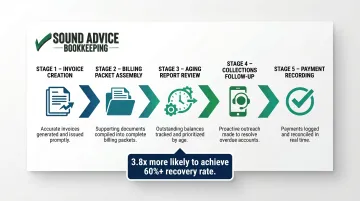
- Outsourced providers manage invoicing, aging reports, billing packets, payment recording, and collections
- Expect faster cash flow, lower overhead than in-house staff, and hands-on construction billing expertise
- Look for construction experience, QuickBooks proficiency, and clear, consistent communication
Why Accounts Receivable Is Uniquely Challenging for Construction Companies
Construction AR is structurally different from retail or service business billing. Your projects span months, payments are tied to completion milestones, and the gap between finishing work and receiving cash can stretch past 90 days. Many construction owners manage cash by watching their checking account balance—a dangerous habit that masks the real health of receivables.
Progress Billing and AIA Format Complexity
Unlike standard invoices, construction billing requires detailed documentation. Commercial projects typically use AIA G702 (Application and Certificate for Payment) and G703 (Continuation Sheet) formats that demand Schedule of Values breakdowns, percentage-of-completion calculations, and work-in-place reporting. Each invoice must prove what work was completed, what materials are stored on-site, and how change orders affect the contract value.
Manual processing of these complex invoices costs construction companies an average of $42 per invoice compared to $2.36 for automated systems. Worse, 23% of construction invoices require revision due to errors or compliance issues—each revision adding weeks to your payment timeline.
The Retainage Trap
Retainage is standard practice where clients withhold 5-10% of every payment until project completion. Because construction profit margins typically run 2-5%, a 10% retainage withholding can exceed your entire profit margin—forcing you to float costs from cash reserves or credit lines. Tracking retainage receivables across multiple projects creates accounting demands that standard bookkeeping wasn't built for.
Multi-Party Payment Chains
General contractors wait on owner funding before paying subcontractors. Lien waivers must be collected and submitted before payments release. Change orders alter contract values mid-project, and only 12 states require statutory lien waiver forms—using the wrong form can invalidate your payment rights entirely.
Every added stakeholder and approval step creates another opportunity for delay. When billing shares an office manager with field coordination and vendor payments, follow-up slips—and you don't notice until cash runs dry.
Small Firms Bear the Heaviest Burden
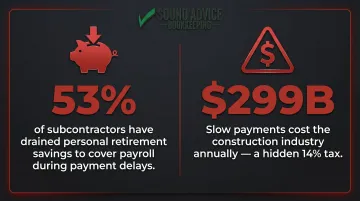
If you're running a small-to-mid-sized construction company, you rarely have dedicated AR staff. Billing falls to whoever has a spare hour that week. The financial consequences show up in the data:
- 53% of subcontractors have drained personal retirement savings to cover payroll while waiting on late payments
- Slow payments act as a hidden 14% tax on the industry, costing $299 billion annually
What AR Tasks Can Be Outsourced for Construction Firms
Outsourcing AR doesn't mean handing over your entire financial operation. You can outsource specific functions while retaining oversight and control. Here's what specialized AR providers typically handle:
Invoice Creation and Progress Billing
Outsourced AR professionals prepare AIA-compliant invoices including:
- Schedule of Values breakdowns showing work completed to date
- Materials stored on-site documentation
- Change order additions with supporting approvals
- Percentage-of-completion calculations
Accurate, timely invoices are the starting point of the payment cycle. Delays or errors here push back every subsequent step, extending your cash conversion timeline.
AR Aging Reports and Collections Follow-Up
The monthly AR aging report shows which invoices are current, 30 days out, 60 days out, or past due. Outsourced AR staff:
- Review aging reports to identify collection priorities
- Conduct professional outreach to clients with overdue accounts
- Escalate persistent issues appropriately
- Handle collections follow-up professionally, eliminating an uncomfortable burden from your team
Companies that outsource more than 50% of their severely overdue invoices (90+ days) are 3.8x more likely to achieve a 60%+ recovery rate.
Billing Packet Assembly
Construction payments often require complete billing packets that include:
- The invoice itself
- Signed conditional or unconditional lien waivers
- Approved change order documentation
- Subcontractor payment confirmations
- Certified payroll records (for prevailing wage projects)
Outsourced AR teams assemble these packets correctly and completely, preventing payment holds caused by missing or incorrect documentation.
Payment Recording and Deposit Management
Once payments arrive, someone must:
- Match incoming payments to corresponding invoices
- Update the AR ledger in real time
- Record deposits accurately in your accounting system
- Reconcile client accounts
That real-time accuracy matters: it tells you not just what's in the bank today, but what's owed and when to expect it.
Dispute Resolution Support
Construction billing disputes are routine—and costly when handled reactively. Outsourced AR professionals handle:
- Initial dispute communications professionally
- Gathering supporting documentation (contracts, change orders, site photos)
- Escalating appropriately when needed
- Maintaining client relationships while protecting your financial interests
Key Benefits of Outsourcing Accounts Receivable in Construction
Faster Cash Flow and Improved Collections
Consistent, professional AR follow-up directly shortens the time between completed work and received payment. One case study demonstrated reducing Days Sales Outstanding from 40 days to 7 days—an 81% improvement—following strategic AR optimization.
For construction firms, that acceleration matters. When you're not chasing invoices yourself, professional collectors with construction billing expertise can navigate the lien waiver and retainage complexities that delay payments.
Lower Overhead Than Hiring In-House
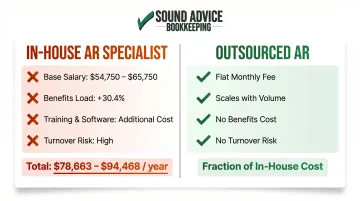
The true cost of an in-house AR specialist includes:
- Base salary: $54,750-$65,750 according to Robert Half's 2026 Salary Guide
- Benefits load: 30.4% of total compensation in private construction
- Training, software licenses, and turnover risk
- Total annual cost: $78,663-$94,468
Contrast this with outsourced AR, typically offered as a flat monthly fee or scalable pricing based on transaction volume. Small construction firms gain access to experienced AR professionals at a fraction of the cost, freeing up capital for materials, equipment, or growth investments.
Construction-Specific Billing Expertise
Unlike a generalist bookkeeper, specialized AR providers understand:
- AIA billing formats and Schedule of Values preparation
- Retainage tracking across multiple projects
- Statutory lien waiver requirements by state
- Job costing integration and change order billing
This expertise reduces billing errors that lead to payment disputes and delays. Change orders average 10-15% of total contract value, yet bottom-quartile firms only recover 54% of these costs in the billing period they occur. Proper AR management ensures you bill change orders promptly and completely.
Scalability as Project Volume Grows
Outsourced AR scales with your business:
- Busy season with 10 active projects → AR workload increases automatically
- Slower winter with 3 projects → AR workload contracts to match
- No hiring, training, or severance costs when project volume shifts
In-house staff don't flex this way. This scalability is especially valuable for growing construction companies taking on larger commercial projects with more complex billing requirements.
Freedom to Focus on Your Business
Construction owners build businesses by running job sites, winning bids, and managing crews. Billing administration pulls you away from all of that. At Sound Advice Bookkeeping, outsourcing AR means you get a clear picture of what's owed, when to expect it, and where to focus collection efforts — without spending hours a week on invoice follow-up. That's time and energy back where it belongs.
Signs Your Construction Company Is Ready to Outsource AR
Warning signs that AR is becoming a liability:
- Invoices going out late or with frequent errors
- Cash flow surprises despite a full project backlog
- Aging receivables growing without systematic follow-up
- Owner or office manager spending 10+ hours weekly on billing and collections
- Repeated payment holds due to missing or incorrect documentation
Any of these signs indicates the workload has outgrown your current process. The breaking point usually arrives when you move from 2-3 concurrent projects to 5+ or begin taking on commercial work with AIA billing requirements — at that scale, in-house AR typically can't keep up. General contractors lose an average of 65 hours per month managing payments and vendor disbursements, more than a week and a half of productive time consumed by payment administration alone.
If the same billing disputes, returned packets, or payment delays keep recurring across multiple clients, the issue is likely your AR process — not your customers. Recurring problems that follow you from job to job are systemic. Outsourcing brings the structure and consistency needed to fix them at the source.

What to Look for in an Outsourced AR Provider
Construction Industry Experience
Your AR provider should understand:
- AIA billing formats and Schedule of Values preparation
- Retainage tracking and release procedures
- Lien waiver requirements by state
- Job-cost-level reporting
Ask potential partners how many construction clients they serve and request examples of AIA document preparation or billing packet assembly. Sound Advice Bookkeeping has worked with small and mid-sized businesses since 2007, combining construction billing knowledge with deep QuickBooks proficiency across Online, Desktop, and Enterprise versions.
Technology Compatibility and QuickBooks Integration
Industry expertise only delivers value if your provider can operate inside your existing systems. Most small and mid-sized construction companies use QuickBooks or construction-specific software, and the right AR partner should work within that setup — not require you to migrate to something new.
Key questions to ask:
- Which QuickBooks versions do you support (Online, Desktop, Enterprise)?
- How do you handle data security and access controls?
- Can you integrate with our existing job costing setup?
- What's your experience with construction-specific QuickBooks configurations?
Choosing a Provider Who Acts as Your Partner
Outsourced AR works best when the provider functions as an extension of your team — not a black box. Look for providers who offer:
- Regular reporting and proactive communication
- Clear escalation protocols for disputes
- Flexibility to scale services up or down
- Transparent pricing without rigid long-term contracts
Avoid providers who lock you into inflexible arrangements. If your project volume spikes or your billing complexity increases, your AR support should be able to keep pace without renegotiating from scratch.
Frequently Asked Questions
How much does it cost to outsource bookkeeping?
Costs vary based on transaction volume, service scope, and company size. Outsourced bookkeeping typically runs as a monthly flat fee (starting around $170/month) or hourly arrangement—often less expensive than a full-time hire when factoring in salary, benefits, and training costs.
What does an outsourced bookkeeper do?
An outsourced bookkeeper handles day-to-day financial tasks including recording transactions, managing accounts receivable and payable, reconciling accounts, generating financial reports, and supporting tax preparation. You get dedicated financial support without the payroll costs of a full-time hire.
What is the best accounting program for construction?
QuickBooks is widely used by small-to-mid-sized construction firms for its flexibility and integration capabilities, while larger firms may use construction-specific platforms like Viewpoint or Foundation. Your best fit depends on company size and project complexity—when in doubt, QuickBooks is the lower-risk starting point for most small contractors.
What AR tasks can a construction company outsource?
Construction companies can outsource most or all of the following AR tasks:
- Invoice creation and AIA billing preparation
- Billing packet assembly and submission
- AR aging reviews and collections follow-up
- Payment recording and deposit management
- Dispute resolution support
You can hand off the full process or specific pieces—whatever fits your current setup.
Is outsourcing accounts receivable worth it for small construction firms?
Yes—small construction companies often benefit most from outsourcing AR because they lack dedicated billing staff. Professional AR support is a cost-effective way to improve cash flow, reduce billing errors, and free up the owner's time for core operations rather than administrative tasks.
Ready to stop running your construction business from your checking account? Sound Advice Bookkeeping has worked with over 1,000 small businesses since 2007, and our team carries 100+ years of combined QuickBooks expertise. We know the billing complexity construction companies deal with—progress invoicing, retainage tracking, AIA documentation—and we're built to handle it.
Contact us today at 303.228.8911 or info@soundadvicebookkeeping.com to discuss how we can help you get your AR under control and your cash flow moving.