
Introduction
Most early-stage startups fail not because their ideas lack merit, but because their financial infrastructure can't keep pace with how startups actually operate—irregular cash flow, rapid hiring, funding rounds, and compliance obligations that span multiple states. According to a 2026 CB Insights analysis of 431 VC-backed companies that shut down since 2023, 70% cited "ran out of capital" as the primary cause of failure.
In 2026, choosing the right accounting firm is a strategic decision that shapes your fundraising readiness, compliance obligations, and decision-making confidence. The right partner goes beyond tax filing to help founders understand cash flow, maintain investor-grade financials, and avoid the costly mistakes that derail due diligence.
This guide covers what to look for in a startup-focused accounting firm, the best options in 2026 evaluated by expertise and pricing transparency, and how to match your current stage with the right partner.
Key Takeaways
- Early-stage startups need firms with startup-specific expertise in burn rate tracking, equity structures, and investor reporting
- Top firms bundle bookkeeping, tax planning, payroll, and advisory services under transparent, predictable pricing
- Look for cloud accounting fluency, proven startup experience, fast response times, and pricing built for lean budgets
- Sound Advice Bookkeeping, Pilot, Kruze Consulting, Bench by Employer.com, and Indinero represent strong options across stages and budgets
- Clean financials from day one matter. Waiting until tax season or a funding round makes everything harder and more expensive.
Why Early-Stage Startups Need a Specialized Accounting Firm
Early-stage startups face financial challenges that general accountants aren't equipped to handle. Burn rate tracking, equity accounting under ASC 718, multi-state compliance as remote teams grow, and investor-grade reporting requirements demand specialized expertise. A CB Insights post-mortem analysis found 29% of startups failed specifically because they ran out of cash—highlighting how poor financial management contributes directly to early failure.
That risk makes specialized expertise essential — but it also has to be affordable. The median annual wage for a U.S. accountant is $81,680, while outsourced bookkeeping packages start as low as $189/month. For most early-stage companies, hiring in-house is out of reach. Outsourced or boutique firms provide the same expertise at a fraction of the cost.
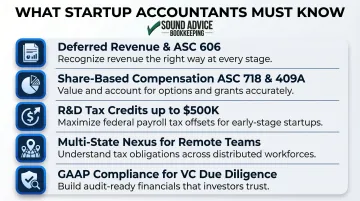
Generalist bookkeepers and startup-focused firms are fundamentally different. Startup specialists understand:
- Deferred revenue and ASC 606 revenue recognition for SaaS models
- Share-based compensation under ASC 718 and 409A valuations
- R&D tax credits (which doubled to a $500,000 payroll tax credit limit for qualified small businesses after December 31, 2022)
- Multi-state nexus triggered by remote employees
- GAAP compliance required for venture capital due diligence
When you're mid-raise and an investor requests GAAP-compliant financials, that's not the moment to discover your books need a six-month cleanup.
Best Accounting Firms for Early-Stage Startups in 2026
The firms below were selected for startup-relevant expertise, service breadth, pricing transparency, and ability to scale with a growing business—not just brand name.
Sound Advice Bookkeeping
Sound Advice Bookkeeping is a Denver-based boutique firm founded in 2007 and purpose-built for startups and small-to-midsize businesses. Since inception, the team has served over 1,000 small businesses across 30+ states, bringing a combined 100+ years of QuickBooks expertise across Online, Desktop, and Enterprise platforms.
Their 3-Phase onboarding process produces a customized flat monthly fee based on your actual transaction volume. Phase 1 (Clean up/Catch up/Set up) and Phase 2 (3-month Discovery Period) are billed hourly at $85/hour, giving the team time to understand your specific needs. Phase 3 delivers ongoing support with predictable flat-fee pricing starting at $170/month.
The team operates as a genuine extension of your business. Their philosophy centers on "thoughtfully optimized" bookkeeping—examining books through the lens of growth and efficiency, not just tax compliance. That means startups gain real clarity on cash flow, make better decisions, and build financial systems that hold up as they grow.
| Criteria | Details |
|---|---|
| Best For | Early-stage startups, small businesses, non-profits, and entrepreneurs across the U.S. needing clean books and strategic clarity |
| Core Services | Bookkeeping, QuickBooks setup and training, financial reporting, cash flow clarity, year-end prep, business consulting |
| Pricing Style | Monthly flat-fee packages starting at $170/month or hourly services at $85/hour; pricing determined by transaction volume with no hidden costs |
Pilot
Founded in 2017 and headquartered in San Francisco, Pilot focuses specifically on venture-backed and high-growth startups. The firm offers bookkeeping, tax filing, and CFO advisory with deep expertise in SaaS metrics like ARR, MRR, and churn.
Each client gets a dedicated finance expert, strong automation built into the workflow, and investor-grade reporting that maps directly to VC expectations. Pilot's pricing starts at $99/month for Essentials bookkeeping (up to $100,000 in monthly expenses), with CFO services ranging from $1,750/month to $5,250+/month for custom packages. Pilot is best suited for funded startups or those actively preparing for a seed or Series A raise.
| Criteria | Details |
|---|---|
| Best For | SaaS and tech startups preparing for seed or Series A, or already VC-backed companies |
| Core Services | Bookkeeping, tax filing, CFO advisory, ARR/MRR reporting, financial modeling, R&D credits |
| Pricing Style | Monthly subscription starting at $99/month with separate add-on tiers for tax and CFO services |
Kruze Consulting
Kruze Consulting is a specialized startup accounting firm that exclusively serves VC-backed Delaware C-Corps. Founded in 2012 and based in San Francisco, Kruze brings deep expertise in GAAP compliance, R&D tax credit optimization, and fundraising support.
Biotech, fintech, and SaaS companies are where Kruze has built its deepest track record. Pricing is tiered by funding stage, starting at $650-$850/month for Basic services and scaling to $850-$1,500/month for Founder tier. Kruze is ideal for funded startups needing advanced compliance and VC-grade financials.
| Criteria | Details |
|---|---|
| Best For | Funded startups in high-growth sectors needing advanced compliance and VC-grade financials |
| Core Services | Accounting, tax, CFO advisory, financial modeling, R&D tax credits, 409A valuations |
| Pricing Style | Tiered pricing based on funding stage and revenue level ($650-$1,500+/month) |
Bench by Employer.com
Bench is a technology-first bookkeeping platform that pairs startups with dedicated bookkeepers through an easy-to-use dashboard. Originally founded in 2017, Bench shut down abruptly in December 2024 but was acquired by Employer.com and relaunched, restoring service continuity.
Bench focuses on delivering clean monthly financial statements without burdening founders with financial admin. It's best for bootstrapped or very early-stage startups with straightforward bookkeeping needs. Pricing starts at $189/month for the Grow plan (billed annually) and scales to $599/month for Core + Tax, which includes annual income tax filing.
Note: The December 2024 shutdown highlights the importance of evaluating vendor viability and continuity when selecting accounting partners.
| Criteria | Details |
|---|---|
| Best For | Solo founders, bootstrapped startups, and early-stage companies with straightforward bookkeeping needs |
| Core Services | Monthly bookkeeping, financial statements, tax filing support |
| Pricing Style | Flat monthly subscription starting at $189/month |
Indinero
Indinero is a full-service accounting firm that combines bookkeeping, tax, payroll, and strategic forecasting in a single platform. Founded in 2009 and based in Los Angeles, it's built for startups beginning to scale that need more than basic bookkeeping.
Where Indinero earns its place is scenario modeling, multi-state compliance, and hands-on team engagement that gets founders ready for fundraising or expansion. Pricing starts at $1,250/month for the Essential package, with custom Growth packages available.
| Criteria | Details |
|---|---|
| Best For | Startups transitioning from early-stage to growth phase needing integrated financial planning |
| Core Services | Bookkeeping, taxes, payroll, forecasting, compliance management, virtual CFO services |
| Pricing Style | Bundled packages starting at $1,250/month based on service level |
Key Accounting Services Every Early-Stage Startup Needs
Every early-stage startup needs three core services locked in from day one:
- Monthly bookkeeping and bank reconciliation — the baseline that makes everything else reliable
- Tax compliance and filing — federal, state, payroll taxes, and contractor 1099s
- Payroll management — accurate, on-time, and compliant from first hire
Getting these right early prevents the costly cleanup that derails fundraising and investor due diligence.
As startups grow, the next tier becomes critical:
- Cash flow forecasting and burn rate tracking — understand runway and make hiring decisions with confidence
- Financial reporting that meets investor expectations (P&L, balance sheet, runway analysis)
- Virtual CFO advisory for strategic decisions around expansion, funding, and resource allocation
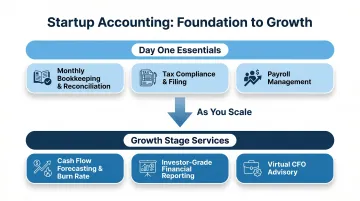
The best firms bundle these progressively so you can scale financial support without switching providers.
Two high-value areas most startups miss entirely: R&D tax credits and multi-state compliance. The Qualified Small Business payroll tax credit limit doubled to $500,000 for tax years after December 31, 2022, yet many eligible startups never claim it.
On the compliance side, even one remote employee in another state can trigger income tax and sales tax nexus — and that complexity compounds quickly as headcount grows. The right accounting partner flags both issues before they become problems.
How We Chose These Firms
Every firm on this list was evaluated on four factors: startup-relevant experience (not general accounting reputation), technology fluency (QuickBooks, Xero, cloud platforms), service breadth relative to early-stage needs, and pricing transparency.
Applying these criteria helps founders avoid two common traps: choosing on price alone, or hiring a generalist CPA who has never navigated burn rates or equity.
The factors tied directly to business outcomes include:
- Responsive communication — urgent financial questions can't wait 72 hours
- Scalability — the ability to grow from basic bookkeeping to CFO-level advisory without switching firms
- Understanding of startup realities — irregular revenue, equity compensation, investor-grade reporting
These criteria tend to favor a specific kind of firm. Boutique firms with deep client relationships and experienced teams consistently outperform large generalist firms for early-stage startups.
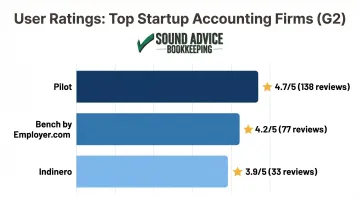
User ratings support this pattern: Pilot scores 4.7/5 on G2 based on 138 reviews, Bench scores 4.2/5 based on 77 reviews, and Indinero scores 3.9/5 based on 33 reviews.
Y Combinator notes that founders often outsource bookkeeping but fail to review monthly reports—leading to lack of runway awareness and cash flow crises. The right firm doesn't just process transactions; they flag issues early and help founders stay informed.
Conclusion
In 2026, the right accounting firm does more than handle taxes. The best ones give early-stage startups the financial clarity to raise money, manage cash, stay compliant, and make decisions with real confidence — functioning as a working partner, not just a vendor you call in April.
Start by assessing your current stage honestly. A pre-revenue startup needs clean books and cash flow clarity more than complex CFO modeling, while a post-seed company needs investor-ready financials and strategic planning. Choosing the right fit at the right stage saves time, money, and costly rework.
If you're an early-stage startup looking for a bookkeeping partner that treats your business like their own, Sound Advice Bookkeeping has served 1,000+ small businesses across 30+ states with flat-fee monthly pricing and a structured three-phase onboarding process built around your transaction volume. Reach out at 303.228.8911 or info@soundadvicebookkeeping.com to discuss a custom monthly plan.
Frequently Asked Questions
What should early-stage startups look for in an accounting firm?
Prioritize startup-specific expertise over firm size — look for experience with burn rate tracking, equity accounting, and GAAP compliance. Technology fluency and transparent, scalable pricing matter more than brand recognition. Industry experience in your sector (SaaS, biotech, etc.) is a stronger signal than firm size.
How much do accounting services typically cost for early-stage startups?
Pricing ranges from $189-$399/month for basic bookkeeping to $599-$1,500/month for accrual-basis bookkeeping with tax filing. Full CFO advisory runs $1,750-$5,250+/month. Costs vary by service scope, transaction volume, and whether strategic advisory is included.
When should a startup hire an accounting firm instead of doing it themselves?
Hire when you're spending several hours weekly on bookkeeping, approaching a funding round, or adding employees. Once payroll or multi-state tax obligations enter the picture, professional support becomes essential to avoid costly errors and penalties.
What is the difference between bookkeeping and accounting for startups?
Bookkeeping covers day-to-day transaction recording, bank reconciliation, and expense categorization. Accounting involves tax strategy, GAAP compliance, financial reporting, and advisory services. The best startup firms integrate both, giving you tactical execution and strategic guidance in one package.
Do early-stage startups need a CPA or just a bookkeeper?
Most early-stage startups benefit from a bookkeeper combined with access to CPA-level tax and compliance support. A full-time CPA is typically unnecessary until post-Series A. Outsourced firms often provide both capabilities in one package, delivering bookkeeping execution plus tax expertise when needed.
What accounting software do most startup-focused firms use?
QuickBooks Online is the most widely used platform, followed by Xero for international-friendly features and NetSuite for more complex setups as companies scale. The right firm should integrate smoothly with your existing payroll (Gusto, ADP), expense management (Expensify), and banking tools to minimize friction and maintain clean data flow.