
Key Takeaways
- Open a dedicated business bank account immediately to create clean financial records and simplify tax preparation
- Report every income stream — client payments, royalties, platform sales, and barter transactions all count as taxable income to the IRS
- Set aside 25–35% of every payment for taxes in a separate account and make quarterly estimated payments to avoid penalties
- Spend 30 minutes each week categorizing transactions and saving receipts — monthly reviews catch costly errors before they snowball
What Makes Bookkeeping Different for Creative Entrepreneurs
Creative businesses don't operate like traditional ones. Your income doesn't arrive in predictable monthly paychecks—it comes in irregular bursts tied to project completions, commission payments, seasonal sales cycles, and licensing agreements. Standard bookkeeping advice built for steady revenue falls short when your March brings $15,000 in client payments and April delivers just $2,000 in platform sales.
Three specific challenges make bookkeeping especially tricky for creative entrepreneurs.
The Multiple Revenue Layer Problem
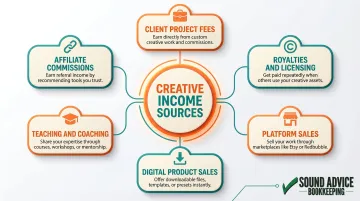
Most creative entrepreneurs manage several simultaneous income streams, each with distinct tax treatment and cost structures:
- Client project fees (invoiced work)
- Licensing fees and royalties (passive recurring income)
- Platform sales (Etsy, Gumroad, Creative Market)
- Digital product sales (templates, courses, presets)
- Teaching and coaching income
- Affiliate commissions
Lumping these into a single "income" category makes it impossible to see which streams are actually profitable—and which are eating your time for little return.
Project-Based Profitability Matters
Unlike traditional businesses that measure monthly revenue totals, creative professionals need to track profitability per project or per client. A $5,000 branding project requiring 60 hours and $800 in licensed assets nets very differently than a $5,000 website build completed in 20 hours with minimal expenses.
Without project-level tracking, you can't identify which work is worth your time—or which clients consistently undervalue it.
The Barter and In-Kind Payment Trap
Many creatives exchange services, accept digital goods, or receive gift cards as payment—and most don't realize these transactions are taxable. According to IRS Publication 525, the fair market value of anything received through barter must be included in gross income at the time of receipt.
Common examples that require reporting:
- Logo-for-photography trades: The fair market value of both services is taxable income for each party
- Client gift cards: A $500 gift card given in lieu of payment is treated the same as cash
- Formal barter exchanges: Reported on Form 1099-B, but informal trades still go on Schedule C even without a form
How to Set Up Your Bookkeeping System
Start With a Dedicated Business Bank Account
Opening a separate business checking account is the single most important financial move you'll make. The IRS explicitly recommends depositing all business receipts into a dedicated account and paying all expenses from it — even for sole proprietors.
That separation simplifies tax preparation, creates a clean audit trail, and protects personal assets. Add a business credit card to further isolate expenses and build a clear transaction history.
Choose Your Bookkeeping Software
The best bookkeeping system is the one you'll actually use consistently. Your choice depends on transaction volume and business complexity:
For beginners with low transaction volume:
- Spreadsheets: Free and fully customizable, but manual and time-consuming
- Wave: Free core bookkeeping, unlimited invoices, and mobile app; receipt capture costs $11/month
For established creatives with multiple income streams:
- QuickBooks Online: Industry standard starting at $19/month (promotional); includes automated bookkeeping, invoicing, and basic reporting
- FreshBooks: $6.90/month (promotional) for up to 5 clients; excellent for time tracking and client management
- Bonsai: $9/month (annual billing) for project management and CRM; add Essentials ($25/month) for invoicing and expense tracking
Growing businesses spend an average of 25 hours weekly on manual data entry and reconciliation alone. Software that automates transaction imports, categorization, and bank feeds quickly pays for itself in recovered time.
Implement Project-Based Tracking
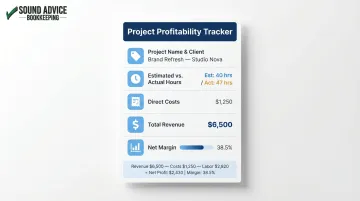
Set up your system to track profitability by project, not just by month. For each project, record:
- Project name and client
- Estimated vs. actual hours invested
- Direct costs (materials, subcontractors, software licenses, stock assets)
- Total revenue received
- Net margin (revenue minus all project costs)
Over time, that data shapes pricing decisions and reveals which client types and project categories are actually worth your time.
Create Reserve Accounts for Income Smoothing and Taxes
Creative income fluctuates dramatically. Two separate savings accounts help you manage the swings:
- Income Reserve: Set aside 20–30% of each payment. During slow months, pull a consistent "salary" from this account to flatten the feast-or-famine cycle.
- Tax Savings: Transfer 25–35% of every payment into a separate account reserved strictly for quarterly estimated tax payments — never let it mix with operating funds.
Choosing Between DIY Bookkeeping and Outsourced Help
Bookkeeping doesn't have to be all-or-nothing. Many creatives benefit from professional help at setup or after a messy stretch — without committing to full ongoing service.
A bookkeeper can establish your chart of accounts, clean up past transaction categorization, set up bank feeds, and train you on the right processes — giving you a solid foundation to maintain on your own.
Sound Advice Bookkeeping's Phase 1 service provides exactly this: one-time cleanup, catch-up, or setup work billed at $85/hour with no requirement to continue into ongoing monthly service. This approach works well for creatives who want to maintain control but need expert guidance creating a proper starting point.
Tracking Income and Expenses as a Creative Entrepreneur
Separate Income Categories Reveal Profitability
Track each income type separately to understand which revenue streams actually drive profit:
- Client/project fees: Direct service income from invoiced work
- Royalties and licensing: Passive income from intellectual property
- Platform sales: Etsy, Upwork, Fiverr, Creative Market, Gumroad
- Digital product sales: Templates, courses, presets, printables
- Teaching/coaching income: Workshops, consulting, mentorship
- Passive income: Affiliate commissions, ad revenue, interest
Mixing these categories obscures which parts of your business generate sustainable income versus which create administrative work for minimal return.
All Income Must Be Reported—Regardless of Payment Method
Every dollar you receive for business purposes is taxable income, regardless of how you received it. The IRS explicitly states that all income from selling goods or providing services must be reported on your tax return, even if you don't receive a Form 1099-K.
Form 1099-K Reporting Threshold: For 2025, third-party payment platforms only issue Form 1099-K if you exceed $20,000 in payments and 200 transactions. However, this threshold does not change your tax obligation—you must report all business income regardless of whether you receive a form.
This means payments received via PayPal, Venmo, Zelle, Cash App, or any other platform are fully taxable. Note personal transactions as "non-business" in your payment apps to avoid confusion.
Key Expense Categories for Creative Entrepreneurs
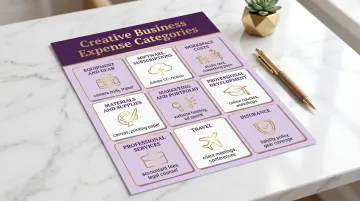
Categorizing expenses correctly from the start makes deduction time far less painful:
- Equipment and gear: Cameras, computers, tablets, monitors, microphones, lighting
- Software subscriptions: Adobe Creative Cloud, design tools, project management apps, accounting software
- Workspace costs: Home office, studio rental, coworking memberships
- Materials and supplies: Art supplies, printing costs, product inventory, packaging
- Marketing and portfolio costs: Website hosting, portfolio platforms, business cards, advertising
- Professional development: Courses, conferences, workshops, books, coaching
- Professional services: Bookkeeping, legal, contract templates, business consulting
- Travel: Client meetings, conferences, photo shoots (with proper documentation)
- Insurance: Professional liability, business property, health insurance (special deduction rules apply)
Capture Receipts Immediately
Categories only hold up under scrutiny if receipts back them up — and the IRS can request documentation years after a transaction. Photograph receipts as they happen, ideally with an app that tags them to a specific project or expense category. Expensify, Receipt Bank, or your accounting software's mobile app all work well for this. The habit takes 10 seconds per receipt and saves hours at year-end.
Tax Deductions and Obligations Every Creative Should Know
Self-Employment Tax Reality
Self-employed creative entrepreneurs pay both the employer and employee portions of Social Security and Medicare taxes. The self-employment tax rate is 15.3%—12.4% for Social Security and 2.9% for Medicare—applied to 92.35% of your net self-employment earnings. This is in addition to regular income tax.
For 2025, the Social Security portion caps at earnings of $176,100. The Medicare tax applies to all net earnings without a cap. Most first-year creatives don't budget for this—resulting in a tax bill that's 25–40% higher than they anticipated.
Quarterly Estimated Tax Payments
If you expect to owe more than $1,000 in taxes for the year, the IRS requires quarterly estimated tax payments. Missing these payments results in penalties and interest charges.
2025 Quarterly Due Dates:
- April 15, 2025
- June 16, 2025
- September 15, 2025
- January 15, 2026 (waived if you file your return by February 2, 2026, and pay the balance due)
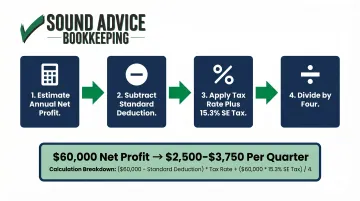
Simple Calculation Method:
- Estimate your annual net profit (income minus expenses)
- Subtract your standard deduction
- Apply your marginal tax rate plus 15.3% self-employment tax (check your bracket at IRS.gov or ask your bookkeeper)
- Divide the total by four
Example: $60,000 net profit → roughly $10,000–$15,000 annual tax liability → $2,500–$3,750 per quarter.
Most Valuable Creative-Specific Deductions
These four deductions are consistently the most impactful for self-employed creatives:
| Deduction | What Qualifies | Key Limit |
|---|---|---|
| Home Office | Dedicated space used exclusively for business (not your kitchen table) | % of rent, utilities, insurance, repairs |
| Section 179 Equipment | Cameras, computers, software placed in service this year | Up to $2.5M deduction in 2025 |
| Professional Development | Courses, workshops, conferences, coaching tied to your craft or business | Full cost if ordinary and necessary |
| Health Insurance Premiums | Health, dental, and vision for you, spouse, and dependents | Capped at net profit; not available if employer plan was accessible |
The home office deduction trips up a lot of creatives. The "exclusive use" rule is strict—a shared dining table won't qualify, but a dedicated corner of a room with clear business use typically does.
Every deduction claimed must be "ordinary and necessary" for your creative profession—meaning standard in your industry and genuinely connected to your work. When in doubt, document the business purpose at the time of purchase.
Bookkeeping Habits and Tools to Stay Financially Consistent
The Weekly 30-Minute Money Date
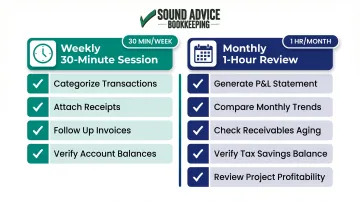
Schedule a recurring 30-minute weekly session to:
- Review and categorize new transactions in your accounting software
- Scan and attach receipts to corresponding expenses
- Follow up on any unpaid invoices
- Verify bank and credit card account balances match your records
This weekly habit prevents the overwhelming backlog that causes most creative entrepreneurs to abandon their bookkeeping routine entirely. Thirty minutes weekly is far less painful than six hours quarterly.
Monthly Financial Review Ritual
Once monthly, dedicate an hour to:
- Generate a profit and loss (P&L) statement
- Compare current month against previous months to identify trends
- Check accounts receivable aging report for overdue invoices
- Verify tax savings account balance is on track (should be 25–35% of year-to-date net income)
- Review project profitability to inform pricing and client decisions
Monthly reviews reveal patterns invisible in weekly maintenance—like a client type that's consistently low-margin or a seasonal sales dip you need to plan for.
When to Bring in a Professional Bookkeeper
DIY bookkeeping reaches its limit when:
- Annual revenue exceeds $75,000–$100,000 (SCORE recommends considering professional help once you have sufficient discretionary funds)
- You're managing multiple income streams that are difficult to categorize properly
- You're adding subcontractors, employees, or payroll
- You're consistently spending more than five hours weekly on financial tasks
- You're preparing for significant growth and need strategic financial insights
Sound Advice Bookkeeping works with creative entrepreneurs and small business owners to build accurate, decision-ready books. With over 100 combined years of QuickBooks knowledge, the team functions as an extension of your business — not just a year-end tax resource. Their three-phase process covers cleanup and setup, a discovery period to understand your specific needs, and ongoing flat-fee support based on transaction volume. Monthly packages start at $170/month.
Frequently Asked Questions
What is creative bookkeeping?
Creative bookkeeping refers to recording and organizing financial transactions for creative businesses like designers, photographers, artists, and writers. It follows standard bookkeeping principles but accounts for unique challenges including irregular income, project-based revenue, multiple income streams, and industry-specific deductions.
How often should I update my books as a creative entrepreneur?
At minimum, spend 30 minutes each week categorizing transactions and saving receipts. Reconcile monthly to catch errors early, and review estimated tax payments each quarter. Staying current prevents small mistakes from compounding into bigger problems.
What bookkeeping software is best for creative businesses?
Spreadsheets or Wave are solid starting points for beginners with simple finances. QuickBooks Online or FreshBooks work better once you're managing multiple income streams, tracking project profitability, or paying subcontractors. The right tool grows with your business.
What expenses can creative entrepreneurs deduct?
Common deductible categories include:
- Equipment and software
- Home office space
- Materials and supplies
- Professional development and education
- Business-purpose travel
- Contracted help and subcontractors
Every deduction must be ordinary and necessary for your profession — and backed by receipts.
How do I handle irregular income in my bookkeeping?
Set aside 20–30% of each payment into an income reserve account, then pay yourself a consistent amount monthly even during slow periods. Separately, transfer 25–35% of every payment into a tax savings account for quarterly estimated payments. This creates stability despite revenue fluctuations.
Do creative entrepreneurs need to pay quarterly taxes?
Yes — if you expect to owe more than $1,000 for the year, the IRS requires quarterly estimated payments due in April, June, September, and January. Missing these deadlines results in penalties, so setting aside a percentage of each payment as you receive it is the simplest way to stay on track.