
This guide breaks down typical pricing ranges for remote bookkeepers, the key factors that push costs up or down, what different price tiers actually deliver, and how to identify the right fit for your budget and business stage.
Key Takeaways
- Remote bookkeepers typically charge $300–$2,500/month or $25–$75/hour depending on service complexity and business size
- Transaction volume drives pricing more than any other factor—high-volume businesses pay considerably more each month
- Early-stage startups with simple books and low transaction counts pay the least
- Messy books, rapid growth, or DIY errors at tax time are clear signs it's worth spending more
- Legitimate remote bookkeeping is far cheaper than in-house when factoring in salary, benefits, and overhead
How Much Does a Remote Bookkeeper Cost?
Remote bookkeeper pricing is not one-size-fits-all. Costs vary based on three key variables: pricing model (hourly vs. flat monthly fee vs. project-based), scope of services, and business complexity.
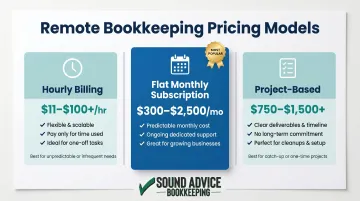
Remote bookkeepers use three main pricing models:
- Hourly billing: Common for one-off tasks, cleanup work, or early-stage businesses with unpredictable needs. Upwork reports median hourly rates between $11 and $25 for North American bookkeepers, while QuickBooks guidance cites $25 to $100+ per hour depending on experience, niche, and location.
- Flat monthly subscription: The most predictable option for ongoing needs. Monthly packages create budget certainty without hourly overages.
- Project-based: Used for cleanups, catch-up work, or one-time setups. Fees range from $750 to $1,500+ depending on how far behind the books are.
Typical Price Ranges
Entry-Level / Basic ($300–$600/month)
Best for solo founders, low transaction volume, and simple books. This tier typically includes:
- Transaction categorization
- Bank and credit card reconciliation
- Monthly profit & loss and balance sheet reports
- General ledger maintenance
Mid-Range / Growing Small Business ($600–$1,500/month)
Appropriate for moderate transaction volume, some payroll, and regular reporting needs. Scope expands to include:
- Accounts payable and receivable management
- Payroll support
- QuickBooks or accounting software management
- Weekly reconciliations (for higher-tier plans)
Full-Service / Complex ($1,500–$2,500+/month)
For businesses with multiple revenue streams, multi-entity structures, or high transaction volume. Services may include:
- Financial analysis and cash flow reporting
- Tax prep support and year-end packages
- Controller-level oversight
- Budget vs. actual reporting
What These Ranges Typically Exclude:
- Tax filing and CPA services
- Catch-up or cleanup work (priced separately)
- Specialized add-ons like inventory management
- Fractional CFO or advisory services
Not every provider follows the same structure, though. Sound Advice Bookkeeping uses a 3-phase assessment process to set a customized flat monthly fee — starting at $170 — based on actual transaction volume, not estimated hours:
- Phase 1 – Clean Up / Set Up: Cleanup and setup work billed at $85/hour
- Phase 2 – Discovery Period: A 3-month window (also $85/hour) to analyze real transaction patterns
- Phase 3 – Ongoing Support: A flat monthly fee determined by the volume identified in Phase 2
Key Factors That Drive Remote Bookkeeper Pricing
Five core variables shape what you'll pay a remote bookkeeper. Know which ones apply to your business and you can estimate costs before a single conversation with a provider.
Business Size and Transaction Volume
The single biggest pricing driver is how many transactions need processing each month. A business processing 100 transactions monthly pays significantly less than one handling 1,000+. QuickBooks Live Bookkeeping explicitly tiers pricing based on monthly expenses: $300/month for businesses with up to $10,000 in monthly expenses, $500/month for $10,000–$50,000, and $700/month for over $50,000.
High-volume or complex transactions—multiple payment methods, refunds, chargebacks—require more reconciliation time, increasing cost proportionally.
Scope of Services Required
Basic bookkeeping (categorizing transactions, bank reconciliation, monthly reports) costs far less than full-service bookkeeping that includes payroll, AP/AR management, cash flow tracking, and financial reporting.
Common add-on services that increase monthly pricing:
- Payroll processing and tax filings
- Sales tax tracking and remittance
- Multi-entity bookkeeping
- Year-end financial package preparation
- Accounts receivable collections
Bookkeeper Experience and Credentials
Credentials matter — and they show up in the price. An Intuit Rate Survey found that QuickBooks-certified professionals charge an average of $82/hour compared to $68/hour for uncertified professionals — a 21% premium.
Certifications worth knowing: Certified Bookkeeper (CB) and QuickBooks ProAdvisor both validate skills in adjustments, payroll, and complex reconciliations. Firms with dedicated teams often charge more than solo freelancers but offer greater reliability and continuity.
Cleanup and Catch-Up Work
Businesses with disorganized or months-behind books should expect a one-time cleanup fee before ongoing services begin. These fees are consistently priced separately from monthly rates.
Typical cleanup fee structures:
- Pilot: $750 one-time payment for starter setup
- Bookkeeper360: Starting at $1,000 per project
- QuickBooks Live: Starting at $150 per month of cleanup needed
- Merritt Bookkeeping: $200/month for each month behind
Budget a minimum of $750 to $1,000+ in one-time fees to bring historical records current before standard monthly pricing applies.
Business Complexity and Financial Structure
Multiple revenue streams, inventory, employees, or complex expense categories all push monthly rates higher. Multi-state operations and sales tax tracking across jurisdictions add another layer of complexity — and cost.
Geography matters less with remote bookkeepers than with in-house hires. Some local firms adjust rates by region, but transaction volume and scope drive pricing far more than zip code.
Remote Bookkeeper vs. In-House vs. Freelance: Comparing Your Options
Small business owners face three primary options for bookkeeping support, each with distinct cost structures and trade-offs.
Freelance Remote Bookkeeper
Cost: $25–$75/hour (varies widely by platform and expertise)
Pros: Flexible arrangements, lower entry cost, can scale up or down quickly
Cons: Single point of failure, limited bandwidth, may lack continuity if the freelancer becomes unavailable
Remote Bookkeeping Firm/Service
Cost: $300–$2,500/month via flat-fee packages
Pros: Team-based support, greater reliability, scalable as business grows, access to specialized expertise
Cons: Higher monthly commitment than ad-hoc freelance work
In-House Bookkeeper
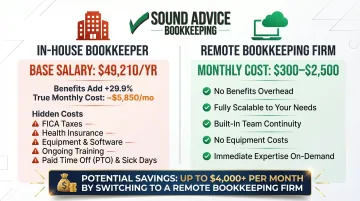
The Bureau of Labor Statistics reports a median annual wage of $49,210 for bookkeeping clerks. But base salary alone doesn't tell the full story.
BLS Employer Costs for Employee Compensation data shows benefits account for 29.9% of total compensation, pushing the true employer cost to approximately $70,200 annually, or $5,850 per month.
Hidden costs of in-house hiring include:
- Payroll taxes (7.65% FICA minimum)
- Health insurance and retirement benefits
- Equipment, software licenses, and workspace
- Management time and training overhead
- Paid time off and sick leave
For most small businesses that don't need 40 hours of bookkeeping per week, that $5,850/month figure puts in-house hiring well out of reach. A remote bookkeeping firm closes that gap — providing team continuity, multi-software expertise, and coverage when someone is out sick, at a fraction of the cost.
What's Typically Included — and What Costs Extra
Most remote bookkeeping packages split services into two tiers: what's covered in the monthly fee and what triggers an extra charge. Knowing this distinction upfront prevents billing surprises as your business grows.
Standard Services Included in Most Packages
- Bank and credit card reconciliation
- Transaction categorization and coding
- General ledger maintenance
- Monthly profit & loss and balance sheet reports
- Accounts payable and receivable management (in mid-tier and above)
- QuickBooks or accounting software management
Common Services Priced as Add-Ons
- Payroll processing and payroll tax filings
- Sales tax preparation and filing
- Year-end financial package preparation for tax filing
- Catch-up work for disorganized or backlogged books
- Budget vs. actual reporting and variance analysis
- Fractional CFO or advisory services
Warning: Vague contracts often lead to unexpected charges when needs grow. Clarify scope in writing before signing any agreement.
Key Questions to Ask Before Committing
- What specific services are covered by the monthly fee — and what falls outside it?
- Is pricing hourly, flat-rate, or based on transaction volume?
- Which accounting platforms do you support — QuickBooks Online, Desktop, Xero, FreshBooks?
- How is catch-up work scoped and priced, separate from ongoing fees?
- How often will we communicate, and who is my main point of contact?
On the software question specifically: confirm that your bookkeeper works natively in your current platform rather than requiring you to switch. Sound Advice Bookkeeping, for example, supports QuickBooks Online, Desktop, and Enterprise alongside Xero and FreshBooks — so clients rarely have to change the tools they already use.
How to Estimate the Right Remote Bookkeeping Budget for Your Business
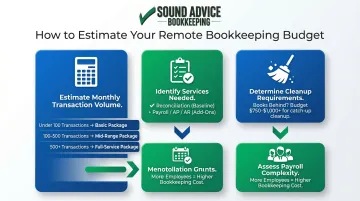
Follow this simple self-assessment to identify which pricing tier is most appropriate for your business:
Estimate monthly transaction volume. Count bank transactions, credit card charges, vendor bills, and customer invoices. Under 100 typically qualifies for basic pricing; 100–500 falls into mid-range; over 500 requires full-service support.
Identify the services you need. Monthly reconciliation and reports represent the baseline. Payroll, AP/AR management, and cash flow tracking push you into a higher tier.
Determine cleanup requirements. If your books are months behind, budget for a one-time cleanup project before calculating ongoing monthly costs.
Assess payroll complexity. Businesses with W-2 employees require payroll processing. The more employees, the more complex — and costly — that service becomes.
Flat-fee monthly pricing works well for small businesses because it creates predictability — you know exactly what you'll pay each month without worrying about hourly overages. Sound Advice Bookkeeping, for example, uses a structured discovery process to assess each client's needs before setting a flat monthly rate, so there's no guesswork on either side.
The "right" budget is not the lowest price. It's the price that matches the level of service needed to keep books accurate, tax-ready, and growth-informing. Under-investing in bookkeeping tends to cost more over time — in errors, missed deductions, and hours spent untangling financial confusion.
What Most Small Business Owners Get Wrong About Remote Bookkeeping Costs
Focusing Only on the Monthly Fee
The real cost comparison should include the time you spend managing finances yourself (opportunity cost), the risk of errors that lead to tax penalties or poor decisions, and the cost of cleaning up messy books later—all of which are rarely accounted for when evaluating bookkeeping spend.
The IRS imposes a Failure to File penalty of 5% of unpaid taxes for each month a tax return is late, which compounds quickly. Accurate, timely bookkeeping prevents these penalties and positions you to claim all available deductions.
Choosing the Cheapest Option Without Vetting
Those hidden costs make the temptation to go cheap even riskier. A low price tag can signal limited expertise, overloaded client rosters, or no familiarity with your industry. A 2024 Journal of Accountancy report notes that 30% of surveyed CPA firms outsource domestically and 25% offshore—proof that remote financial talent is mainstream, but quality still varies widely.
Before committing to any remote bookkeeper, vet them on these points:
- Pricing transparency: Can they clearly explain what's included and what costs extra?
- Responsiveness: Do they answer questions promptly and in plain language?
- Credentials and reviews: Do they have verifiable client histories and a track record?
- Industry fit: Have they worked with businesses like yours before?

Sound Advice Bookkeeping, for example, walks every prospective client through a structured discovery process before setting a flat monthly fee—so there are no surprises after the first invoice.
Frequently Asked Questions
How much does remote bookkeeping cost?
Remote bookkeeping typically costs between $300 and $2,500 per month depending on business complexity and scope of services. Basic packages for low-volume businesses start around $300/month, while full-service support for complex or multi-entity businesses can exceed $2,000/month. Hourly options are also available for one-time or catch-up work, with market rates generally ranging from $25–$75/hour depending on the provider.
Is remote bookkeeping legitimate?
Remote bookkeeping is a legitimate and widely adopted model used by over 324,000 businesses in the U.S. alone. Vet providers by checking credentials (such as QuickBooks ProAdvisor or Certified Bookkeeper certifications), reading client reviews, and confirming pricing transparency.
Is remote bookkeeping cheaper than hiring in-house?
Yes, remote bookkeeping is far less expensive than hiring in-house when factoring in salary, benefits, payroll taxes, and equipment. An in-house bookkeeper costs approximately $5,850/month including benefits, while remote services range from $300–$2,500/month and scale with your business needs without the overhead of a full-time employee.
What does a remote bookkeeper actually do?
A remote bookkeeper handles your core financial operations digitally, including:
- Recording transactions and reconciling bank and credit card accounts
- Managing accounts payable and receivable
- Maintaining the general ledger and producing monthly financial reports
Many providers also handle payroll, sales tax payments, and year-end tax preparation support depending on the service tier.
When should a small business hire a remote bookkeeper?
Hire a remote bookkeeper when you're falling behind on books, making errors, or spending more than 5–10 hours per week on finances. Tax season prep and growth phases are also common trigger points. Xero recommends hiring when transaction volume exceeds 50–100 transactions per month or when you add W-2 employees.
What should I ask before hiring a remote bookkeeper?
Ask: What's included in the monthly fee? How is pricing determined? What software do you use, and do you support my current platform? How do you handle catch-up work? What's your communication process and response time? Can you provide client references or case studies from my industry?
Ready to explore remote bookkeeping for your business? Sound Advice Bookkeeping offers a transparent 3-phase process starting with cleanup and discovery, followed by a customized flat monthly fee based on your actual transaction volume—not estimates. Contact us at 303.228.8911 or info@soundadvicebookkeeping.com to schedule a consultation.