

Introduction
Most small business owners know they need clean books—but few understand what outsourced bookkeeping actually costs, and even fewer budget for it correctly. Without clear benchmarks, it's easy to overpay, underfund a critical function, or choose a provider on price alone—then face categorization errors, missed deductions, and tax-season chaos.
2026 pricing has shifted considerably. AI-assisted tools and virtual platforms have driven down the cost of basic tasks, while demand for strategic financial insight has grown. Monthly flat-fee models have largely replaced hourly billing, and providers who clearly state what's included—and what isn't—have become the easier choice to trust.
This guide breaks down realistic pricing ranges for 2026, the key cost drivers behind those numbers, what's included versus what costs extra, how outsourcing compares to hiring in-house, and how to set a budget that fits your business without sacrificing quality.
Key Takeaways
- Outsourced bookkeeping for small businesses typically costs $300–$1,500+ per month in 2026, with hourly options ranging from $40–$100/hour
- Cost varies based on transaction volume, business complexity, number of accounts, and scope of services
- Startups and lean operations pay toward the low end; add payroll, multiple accounts, or catch-up work and costs climb quickly
- Outsourcing saves 40–60% compared to hiring a full-time in-house bookkeeper when total employment costs are factored in
- Flat-fee pricing based on transaction volume (not hours) gives small businesses the most predictable monthly cost
How Much Does Outsourced Bookkeeping Cost in 2026?
Outsourced bookkeeping does not have a fixed price. Costs vary based on business size, scope of services, and the pricing model the provider uses. Misunderstanding this leads to budget surprises, choosing an under-resourced provider, or overpaying for services you don't need.
Pricing Models: Hourly, Monthly, and Project-Based
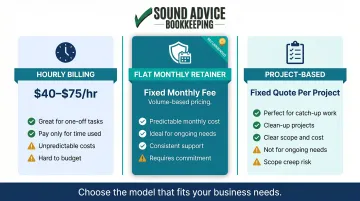
Three main pricing structures dominate the outsourced bookkeeping market:
Hourly billing offers flexibility but creates unpredictable costs. Rates typically range from $40–$75 per hour for US-based bookkeepers, though global freelance platforms show median rates as low as $15/hour (often reflecting offshore talent).
Hourly billing works best for one-off tasks like tax prep cleanup or system setup. For ongoing needs, it creates billing surprises and a built-in disincentive for efficiency — the faster your bookkeeper works, the less they earn.
Flat monthly retainer is the most common and predictable model, ideal for ongoing bookkeeping needs. Providers charge a fixed monthly fee based on transaction volume and scope. No billing surprises, and your bookkeeper has every reason to work efficiently. This is the recommended structure for small businesses that need consistent monthly support.
Project-based pricing is used for catch-up or clean-up bookkeeping where scope is defined upfront. Providers quote a fixed price to organize backlogged records or correct errors from previous bookkeepers. This works well when you have a finite project but need to transition to ongoing support afterward.
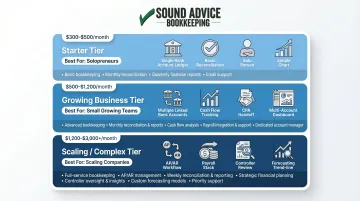
Starter Tier: $300–$500/month
What's typically included:
- Basic bank and credit card reconciliation
- Transaction categorization
- Monthly financial statements (P&L, balance sheet)
- QuickBooks or similar software support
Best for: Solopreneurs, freelancers, and early-stage startups with low transaction volume (under 100 transactions/month) and a single bank account. If your business is simple and you need reliable monthly reporting without advanced features, this tier covers the essentials.
Growing Business Tier: $500–$1,200/month
What's typically included:
- Everything in the starter tier
- Multiple account reconciliations
- Monthly reporting with P&L, balance sheet, and cash flow tracking
- Year-end CPA handoff support
Best for: Established small businesses with multiple revenue streams, moderate transaction volume, and a need for consistent monthly reporting to inform decisions. This tier supports businesses that have outgrown basic bookkeeping but don't yet need controller-level oversight.
Scaling/Complex Tier: $1,200–$3,000+/month
What's typically included:
- Full accounts payable/receivable management
- Payroll coordination
- Controller-level review
- Financial analysis
- Budgeting or forecasting support
Best for: Businesses preparing to hire, seek investment, or manage multi-entity or multi-state complexity — where financial accuracy has direct strategic consequences. At this level, accurate books don't just satisfy the tax man; they drive hiring decisions, funding conversations, and cash flow planning.
Key Factors That Drive the Cost of Outsourced Bookkeeping
Pricing depends on operational, technical, and service-level factors. Understanding these helps you accurately evaluate quotes and avoid underfunding a critical function.
Transaction Volume
The number of monthly transactions is the single biggest cost driver. More invoices, receipts, payments, and reconciliations mean more bookkeeping hours. Providers often gate pricing tiers based on transaction thresholds. For example, businesses with under 100 transactions per month pay far less than those processing 300+ transactions. Some providers use per-transaction pricing ranging from $0.50 to $2.00 per transaction for high-volume, highly automated operations.
Number of Accounts and Integrations
Each additional bank account, credit card, payment processor, or sales platform adds reconciliation complexity. A business with a single checking account is simpler and cheaper to service than one with five accounts across Stripe, PayPal, and multiple banks.
Business Complexity and Industry
Certain industries require specialized bookkeeping practices that command higher fees:
- E-commerce: Multi-channel sales (Amazon, Shopify) require tracking landed costs, reconciling complex settlement reports, and managing multi-state sales tax nexus
- Construction: Job costing tracks labor, materials, and overhead against specific projects to measure profitability—a requirement that demands specialized knowledge
- Nonprofits: Fund accounting requires separate tracking for each restricted fund or grant, with distinct reporting and reconciliation requirements
- Franchises: Multi-unit operators need multi-entity structures, inter-company transaction tracking, and consolidated reporting
Cash versus accrual accounting also matters. Accrual-based bookkeeping requires more detailed tracking and typically costs more than cash-basis accounting.
Scope of Services Required
Scope, not just size, determines price. Consider what you actually need:
- Basic bookkeeping (categorization and reconciliation) sits at the lower end
- Add payroll oversight, AP/AR management, or financial KPI reporting and costs rise accordingly
- Weekly reporting cadences cost more than monthly, regardless of business size
Experience and Expertise of the Provider
A junior freelance bookkeeper will charge less than a senior controller or a firm with decades of QuickBooks expertise and industry-specific knowledge. However, expertise gaps can be costly. Missed deductions, audit triggers, or inaccurate books are far more expensive than the premium for a qualified provider.
That transparency around pricing matters. Sound Advice Bookkeeping, for example, runs a three-phase onboarding process that includes a three-month discovery period to assess actual transaction volume before locking in a flat monthly fee. Clients know exactly what they'll pay going forward — no scope creep, no billing surprises.
Outsourced vs. In-House: The Real Cost Comparison
Many small business owners compare outsourced bookkeeping fees to a freelance hourly rate and assume in-house is cheaper. But the true cost of in-house bookkeeping includes far more than salary.
The Full Cost of a Full-Time In-House Bookkeeper
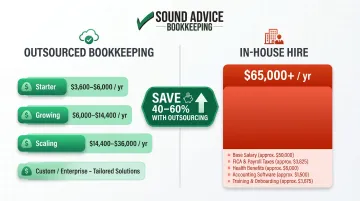
The median annual wage for bookkeeping, accounting, and auditing clerks is $49,210 according to the Bureau of Labor Statistics. But that's just base salary. Add mandatory costs:
- Employer payroll taxes: 7.65% FICA (Social Security and Medicare)
- Benefits: 29.9% of total compensation costs for private industry workers, covering health insurance, PTO, retirement contributions, and other benefits
- Software and equipment: QuickBooks licenses, computers, office space
- Training costs: Ongoing education, certifications, and professional development
- Supervising, reviewing work, and covering gaps when the employee is unavailable
When you factor in these costs, the all-in annual cost of an in-house bookkeeper exceeds $65,000.
Annual Cost Comparison: Outsourced vs. In-House
| Service Tier | Monthly Cost | Annual Cost |
|---|---|---|
| Starter | $300–$500/month | $3,600–$6,000 |
| Growing business | $500–$1,200/month | $6,000–$14,400 |
| Scaling/complex | $1,200–$3,000/month | $14,400–$36,000 |
| Full-time in-house bookkeeper | ~$5,400+/month | $65,000+ (all-in) |
Even at the high end of outsourced pricing, you're paying roughly half of what a full-time in-house bookkeeper costs. Industry analyses show that outsourcing saves 40–60% compared to hiring internally when total employment costs are factored in.
Flexibility and Risk Advantages of Outsourcing
The financial savings are only part of the picture. Outsourcing also removes several operational risks that in-house hiring creates:
- Continuity holds when staff leave or fall ill — no scrambling for temp coverage
- Built-in quality control through team-based review, rather than a single point of failure
- Access to specialists across QuickBooks versions, industry-specific accounting, and compliance — not just a single generalist
- Service levels scale up or down without recruiting, onboarding, or layoffs, which matters most for seasonal or variable transaction volumes
What's Included (and What's Not) in Your Monthly Bookkeeping Fee
Standard monthly bookkeeping packages typically include:
- Bank and credit card reconciliation
- Transaction categorization
- Monthly financial statements (P&L, balance sheet, cash flow)
- Year-end CPA coordination
That's the standard core. Where things get complicated is that providers don't always define scope the same way, so two quotes at the same price can cover very different work.
Services Commonly Excluded from the Base Monthly Fee
Many services are billed separately as add-ons:
- Tax preparation and filing — most bookkeepers coordinate with your CPA but don't file returns themselves
- Payroll processing — often $50–$150/month extra, depending on employee count
- Accounts payable/receivable management — full AP/AR may be a separate engagement or bundled into higher tiers
- Catch-up or clean-up bookkeeping — backlogged records often run $500–$1,000+ as a one-time project
- Software setup or migration — QuickBooks configuration and data migration are typically billed hourly
- Special projects — financial modeling, audit support, or budgeting are usually scoped and priced separately
Red Flags to Watch For
When comparing quotes, watch for:
- Vague "starting from" pricing — if a quote doesn't specify transaction limits or included services, you're likely looking at surprise fees later
- Hourly billing with no cap — open-ended arrangements make it impossible to budget month to month
- No monthly reports included — some providers categorize transactions but never deliver a usable P&L or balance sheet
- Overage fees buried in the fine print — exceeding a monthly transaction cap can quietly inflate your bill
Before signing with any provider, ask for a written scope of work. If they can't tell you exactly what's included at your price point, that's your answer.
What Most Small Business Owners Get Wrong About Bookkeeping Costs
Focusing Only on the Upfront Price
The cheapest option rarely accounts for the full cost. Providers offering very low rates may deliver basic automation-only services without human review, leading to categorization errors, missed deductions, and messy books come tax season. These mistakes are expensive to fix after the fact—often costing more than the premium for quality service upfront.
Ignoring the Cost of Not Outsourcing Sooner
Small business owners spend more than 20 hours per month on financial tasks including accounting and invoicing. At a conservative valuation of $150 per hour, DIY bookkeeping creates a $3,000 monthly opportunity cost—or $36,000 annually. Those hours belong in client acquisition, operations, or strategic planning instead of categorizing receipts.

Treating Bookkeeping as a Compliance Expense Rather Than a Business Intelligence Tool
Quality bookkeeping provides real-time insight into cash flow, profitability by product or service line, and expense trends—data that directly informs growth decisions. Sound Advice Bookkeeping's approach of examining books "through the eyes of growth and efficiency" reflects this philosophy.
When your books are accurate and current, you can spot a cash flow squeeze before it becomes a crisis, identify which service lines are actually profitable, and make hiring or spending decisions from facts rather than gut feel. That's the difference between bookkeeping as a compliance checkbox and bookkeeping as a management tool.
Frequently Asked Questions
How much does it cost to outsource bookkeeping per month for a small business in 2026?
Typical monthly costs range from $300 to $1,500+ depending on business size, transaction volume, and scope. Pricing varies significantly by provider type (freelancer, online service, or boutique firm) and level of service included.
What should a small business expect to pay a bookkeeper per month?
Most small businesses under $1M in revenue pay approximately $300–$800/month for standard bookkeeping services. Growing businesses with more complex needs should budget toward the $800–$1,500 range.
What is a reasonable hourly rate for a bookkeeper in 2026?
Experienced US-based bookkeepers typically charge $40–$75 per hour. Hourly rates work well for one-off projects like catch-up work. For ongoing needs, flat monthly pricing is better — costs stay predictable and providers stay focused on results, not hours billed.
How many small businesses outsource bookkeeping?
37% of small businesses outsource their accounting or IT services, and the trend is accelerating. An Intuit QuickBooks survey found that 80% of accountants reported their firm outsourced services in the past year, driven largely by talent shortages and growing demand for efficiency.
Is AI replacing bookkeepers, and is bookkeeping still in demand?
AI handles routine tasks like transaction categorization, but it doesn't replace the judgment, compliance knowledge, and business insight skilled bookkeepers provide. The BLS projects a 6% decline in bookkeeping clerks by 2034 due to automation — yet 79% of accountants expect strategic advisory services to grow, keeping professional bookkeeping in strong demand for growing businesses.