
Introduction
Picture this: You're leading a startup, wearing every hat imaginable. Product roadmap meetings at 9 a.m., investor pitch rehearsals at noon, team check-ins at 3 p.m. Somewhere in there, you promised yourself you'd reconcile last month's bank statements before tax season.
But here you are at 11 p.m., staring at a spreadsheet that doesn't balance — or worse, fielding a panicked email from an investor asking for financials you don't have ready.
This scenario plays out constantly in the startup world. DIY spreadsheets, sporadic CPA visits, and manual tracking create a fragile financial foundation. Cleaning up messy books later costs significantly more than getting it right from the start — catch-up bookkeeping runs $300–$500 for 1–3 months of backlog, and $3,500–$8,000+ for over a year of neglected records.
This guide walks you through what outsourced bookkeeping actually is, the concrete benefits for startups, the right timing triggers, and how to choose the right partner for your stage.
Key Takeaways
- Startups pay only for what they need—outsourced bookkeeping cuts overhead while keeping financials accurate and audit-ready
- Outsource before the mess: key triggers include fundraising prep, growing transaction volume, and founders spending hours weekly on financial admin
- Expect 60%+ cost savings versus in-house hiring and real-time cash flow visibility from day one
- Investor-ready financials and reduced compliance risk come standard with the right provider
- Choose a provider with startup experience, flat-fee pricing, and software that fits your existing stack
What Is Outsourced Bookkeeping (and What Does It Include)?
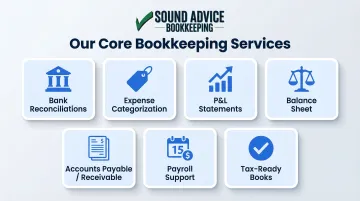
Outsourced bookkeeping means hiring a third-party provider to manage your financial records, transaction categorization, bank reconciliations, and reporting—without building or managing a finance department in-house. Instead of recruiting, onboarding, and supervising an internal bookkeeper, you get professional expertise on demand.
Core services typically included:
- Monthly bank and credit card reconciliations
- Expense and income categorization
- Profit and loss (P&L) statement preparation
- Balance sheet preparation
- Accounts payable and receivable management
- Payroll support and processing
- Tax-ready books with organized documentation
Bookkeeping vs. Accounting: What's the Difference?
Bookkeeping focuses on accurate record-keeping and monthly reporting, maintaining clean, organized financial data. Accounting adds strategic advisory, forecasting, and CFO-level guidance. Bookkeeping captures what happened financially. Accounting interprets those numbers to inform what should happen next.
When you might need just bookkeeping: Early-stage startups with straightforward revenue models, limited transactions, and no immediate fundraising plans often benefit most from solid bookkeeping alone.
When you need fuller accounting engagement: As you approach a funding round, scale transaction complexity, or require strategic cash flow modeling and KPI frameworks, accounting or CFO advisory becomes critical.
Sound Advice Bookkeeping bridges this gap through managerial bookkeeping services that treat your books as a business tool, not just a compliance requirement—identifying where money is moving, where it's leaking, and what the numbers mean for your next stage of growth.
Why Startups Struggle to Manage Books In-House
Founders Wear Too Many Hats
Every hour spent reconciling accounts or categorizing transactions in QuickBooks is an hour not spent on product development, sales outreach, or fundraising. Small business owners report their businesses spend an average of 25 hours per week on manual data entry and reconciliation. Without dedicated focus, bookkeeping consistently falls to the bottom of the priority list—until a missed deadline or messy records force it to the top.
The Patchwork Problem
Most early-stage startups rely on a fragile system: a basic bookkeeper who records transactions but can't interpret the numbers, DIY spreadsheets with outdated formulas, and a CPA who only surfaces at tax time. 51% of small businesses still use spreadsheets for financial management, creating compounding inaccuracies as the business grows. Each piece of the patchwork operates in isolation, leading to disconnected records and missed insights.
The Hidden Cost of Disorganized Books
Messy books don't just create extra work — they cost real money. The most common consequences include:
- Poor cash flow decisions driven by inaccurate or incomplete records
- Delayed investor due diligence, sometimes stretching the process by months
- Missed deductions that represent dollars left on the table at tax time
According to the Federal Reserve's 2025 Report on Employer Firms, 51% of firms cited uneven cash flows as a financial challenge, and 56% cited paying operating expenses.
Disorganized books also create fraud exposure. Organizations with fewer than 100 employees suffer a median loss of $141,000 per fraud case — a loss that can wipe out months of operating capital for an early-stage company.
The Real Benefits of Outsourcing Your Startup's Books
Cost Savings Versus In-House Hiring
The median annual wage for bookkeeping clerks in the United States was $49,210 in May 2024. Add 29.9% in employer benefit costs and an average $4,700 in hiring costs, and you're looking at over $65,000 annually for one full-time bookkeeper.
By contrast, outsourced bookkeeping pricing for startups typically ranges from $200 to $900+ monthly, depending on transaction complexity and sales volume. That translates to $2,400–$10,800 annually—a fraction of the in-house cost. Sound Advice Bookkeeping offers monthly packages starting at $170 per month, with a unique 3-Phase Process that produces a customized flat fee based on your transaction volume, ensuring you always know what to expect.
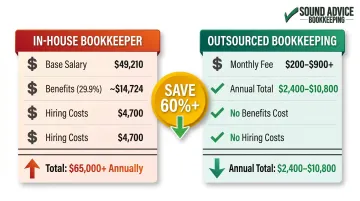
Startups pay only for what they need and can scale up or down as transaction volume changes—no payroll, benefits, or replacement costs to manage.
Investor-Ready Financials at Every Stage
Clean, organized, and accurate books speed up investor due diligence and signal operational maturity. Messy books can delay or derail deals, push out close dates, or force haircuts on metrics like ARR or gross margin.
When third-party quality of earnings firms encounter inconsistent ledgers or unclear cap tables, they downgrade confidence in your numbers—often translating into a repriced deal or a quiet no.
By Series A, investors expect accrual-based books, monthly closes, and a consistent KPI framework. Outsourced bookkeeping keeps those records audit-ready year-round, so founders enter due diligence with confidence instead of scrambling to clean up the ledger.
Real-Time Cash Flow Clarity and Smarter Decisions
Monthly financial reports give founders genuine visibility into the numbers that drive decisions. 49% of business owners say payment processing delays create critical or moderate cash flow gaps—professional bookkeeping eliminates those blind spots.
Accurate records mean founders stop running the business from their checking account and start making decisions backed by real data:
- Burn rate — know exactly how fast you're spending
- Runway — see how many months of cash remain
- True expense breakdown — identify where money is actually going
- Profitability by period — spot trends before they become problems
Fraud Prevention and Compliance Confidence
Having expert eyes consistently reviewing transactions reduces the risk of errors and internal fraud. Companies with active detection methods like management review and account reconciliation experience 50% or greater reductions in both fraud losses and fraud duration.
Professional bookkeepers also stay current with tax regulations and filing requirements, reducing the risk of penalties. IRS penalties for late information returns add up fast:
- Up to 30 days late: $60 per return
- 31 days late through August 1: $130 per return
- After August 1 or not filed: $330 per return
- Intentional disregard: $680 per return
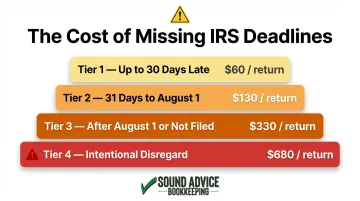
All of these are costs easily avoided with proper support.
Scalable, Growth-Oriented Support
A strong outsourced bookkeeping team functions as a business partner, not just a compliance vendor. They examine books through the lens of growth and efficiency, identify issues before they become problems, and scale services as transaction volume and complexity increase.
Sound Advice Bookkeeping is built around this model. With over 100 years of combined QuickBooks and management accounting experience, the team has served more than 1,000 small businesses across 30+ states—working as an integrated part of each client's operation, not a distant vendor processing transactions.
When Is the Right Time to Outsource?
At Launch or First Revenue
Establishing clean books from day one is far easier and less expensive than cleaning up a backlog later. The earlier a startup builds sound financial habits, the stronger the foundation for fundraising, hiring, and tax compliance. Practitioners advise that DIY catch-up bookkeeping is only reasonable if a business is 1-3 months behind, has under 100 transactions per month, and has no employees or payroll.
When Preparing to Raise Capital
Investors and lenders expect accurate, organized financial records. Disorganized or incomplete books can stall or derail a funding round. In one documented case, a startup faced a 4-month delay and $350,000 in burned runway due to cash accounting distortions.
Outsourcing before the raise means you enter due diligence with clean financials — and no scrambling to answer investor questions on the spot.
When Transaction Volume Is Growing
More customers and vendors mean more transactions — and manual tracking breaks down fast. Once a startup starts hiring, three issues tend to outpace DIY bookkeeping almost immediately:
- Payroll tax calculations and filings
- Expense tracking across multiple accounts and team members
- Sales tax nexus obligations as the business crosses state lines
When Bookkeeping Is Consuming Founder Time
If you or a team member are spending several hours each week on financial admin, calculate the true opportunity cost. 33% of small business owners work more than 50 hours per week—time spent categorizing expenses is time not spent building the business.
Practical rule of thumb: If bookkeeping takes more than 2-3 hours weekly, delegate it.
When Deadlines Have Been Missed or Nearly Missed
A delayed tax filing, a missed quarterly deadline, or an overlooked deduction are clear signals that the current approach isn't sustainable. At that point, the cost of outsourcing is almost always lower than the penalties, interest, and catch-up fees that accumulate when filings slip.
How to Choose the Right Outsourced Bookkeeping Partner
Startup Experience and Industry Fit
Not all bookkeeping firms understand startup-specific realities: burn rate, investor reporting, equity transactions, and rapid growth. Choosing a provider with genuine startup experience avoids costly mismatches. Before committing, ask prospective providers:
- Whether they've worked with venture-backed or founder-led companies
- How they handle accrual accounting and equity transactions
- Whether they can prepare financials for investor due diligence
Transparent, Flexible Pricing
Prioritize firms with predictable flat monthly fees or clearly tiered packages with no hidden costs. Many providers advertise low base rates but charge separately for onboarding, payroll, tax prep, or CFO services. Pilot charges a mandatory onboarding fee equal to one month of bookkeeping, and S-Corps and partnerships cost 30-50% more to catch up due to payroll and capital accounts.
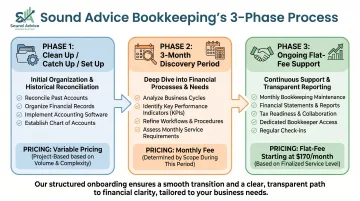
Sound Advice Bookkeeping offers affordable monthly packages built around a 3-Phase Process:
- Clean Up/Catch Up/Set Up (Phase 1): Hourly work at $85/hour to organize and correct existing records
- 3-Month Discovery Period (Phase 2): Hourly at $85/hour while learning your transaction patterns and operational needs
- Ongoing Support (Phase 3): Customized flat fee starting at $170/month, scaled to your transaction volume
Software Compatibility and Setup
Ensure the provider can work within your existing tech stack—QuickBooks, Xero, Stripe, Gusto, and similar tools—and verify they can properly configure or optimize a chart of accounts tailored to your business model. Providers that work within standard platforms ensure you own your historical data if you decide to leave, whereas proprietary software creates data lock-in.
Sound Advice Bookkeeping works within your existing stack—QuickBooks Online, Desktop, and Enterprise, Xero, Gusto, ADP, Bill.com, and more—so your data stays yours.
Communication, Accessibility, and Partnership Mentality
Good software fit only matters if the people using it communicate well. Look for a team that delivers regular monthly reports, stays reachable between reporting periods, and brings proactive insight—not just reactive data entry. The best partners identify inefficiencies, recommend process improvements, and help founders actually understand what their numbers mean.
Red Flags to Watch For
- Generic pricing with no clear deliverables
- No access to a real human advisor
- Inability to scale services as your business grows
- Poor data security practices (always verify encryption, secure cloud storage, and multi-factor authentication)
- No demonstrated experience with early-stage or founder-led companies
Frequently Asked Questions
How much does it cost to outsource bookkeeping for startups?
Monthly pricing typically ranges from $200 to $900+, depending on transaction volume, number of accounts, and the scope of services included. Early-stage startups with straightforward needs pay less; more complex operations cost more.
What should I expect to pay per hour for outsourced bookkeeping for startups?
Freelance bookkeepers charge $25–$75 per hour, with the national average around $24–$28 per hour for standard bookkeeping. Rates vary based on provider experience and service scope — more seasoned firms typically charge more. Many providers also offer monthly flat-fee packages, which are more cost-predictable than hourly billing for ongoing needs.
What does an outsourced bookkeeper actually do for a startup?
An outsourced bookkeeper keeps your financials organized, accurate, and tax-ready. Core tasks typically include:
- Monthly reconciliations and expense/income categorization
- Financial statement preparation (P&L, balance sheet, cash flow)
- Payroll processing and accounts payable/receivable management
When is the right time for a startup to outsource its bookkeeping?
The most common triggers include approaching a fundraise, growing transaction volume, spending too much founder time on financial admin, or facing disorganized records ahead of tax season. Outsourcing before books get messy saves time and money long-term.
Is outsourced bookkeeping safe for my financial data?
Reputable providers use data encryption, secure cloud storage, and multi-factor authentication to protect sensitive information. Always verify a provider's specific security protocols, SOC 2 compliance status, and data handling policies before signing.
What is the difference between outsourced bookkeeping and hiring an in-house bookkeeper?
In-house requires a full-time hire with salary, benefits, and management overhead — typically over $65,000 annually. Outsourcing gives access to an experienced team at a fraction of that cost (often starting around $2,000–$10,800 annually), with the flexibility to scale as your business grows.