
Introduction
Many small business owners struggle with bookkeeping budgets—either drastically underspending and ending up with messy books that lead to expensive cleanup work, or overpaying for services they don't actually need. According to the U.S. Bureau of Labor Statistics, the median annual wage for bookkeepers is $49,210 ($23.66/hour), yet small businesses typically spend around $300 per month for professional bookkeeping services—a fraction of what a full-time hire would cost once you factor in benefits and payroll taxes.
That gap explains why so many owners get the pricing wrong. In 2026, bookkeeping costs vary widely based on transaction volume, business complexity, and the specific services you need. This guide covers what small businesses are actually paying, what drives prices up or down, and how to compare pricing models so you can budget with confidence.
Key Takeaways
- Most small businesses pay $300–$900/month for standard bookkeeping
- Complex businesses typically run $1,000–$2,000+ per month
- Hourly rates span $30–$85/hour depending on experience and location
- Transaction volume and business complexity drive price more than anything else
- Outsourced bookkeeping costs far less than a full-time hire
- Going with the cheapest option often means paying for a costly cleanup down the road
How Much Does Bookkeeping Cost for a Small Business in 2026?
Bookkeeping has no universal price tag. Costs vary based on business size, financial complexity, service provider type, and scope of work. Skipping professional bookkeeping or underbudgeting often leads to expensive cleanup work, missed deductions, or tax penalties down the line.
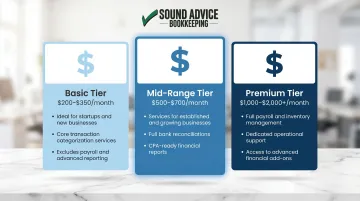
Three General Pricing Tiers
Based on current market data, bookkeeping services fall into three broad pricing bands:
Basic tier ($200–$350/month):
- Suited for lean startups, solopreneurs, and businesses with very low transaction volume
- Typically covers transaction categorization and basic reconciliations
- Often excludes month-end close or detailed reporting
Mid-range tier ($500–$700/month):
- Ideal for established small businesses with moderate transaction volume
- Includes reconciliations, monthly P&L, balance sheet, and basic cash flow reporting
- Standard monthly close and CPA-ready reports
Premium tier ($1,000–$2,000+/month):
- Designed for businesses with payroll, inventory, multi-entity structures, or AP/AR management needs
- Hands-on operational support with specialized reporting
- Includes advanced add-on services
Revenue-Band Benchmarks
Industry guidance suggests that total finance and accounting costs should represent 1% to 4% of annual revenue, scaling down as your business grows.
| Annual Revenue | Target Accounting Cost | Estimated Monthly Budget |
|---|---|---|
| Under $500k | $5,000–$20,000/year | $400–$1,700/month |
| $500k–$1M | $10,000–$40,000/year | $800–$3,300/month |
| $1M–$3M | $30,000–$120,000/year | $2,500–$10,000/month |
Businesses spending well below 1% may be underinvesting in financial infrastructure, while those spending over 4% may have inefficient processes.
What's Typically Included (and What's Not)
Standard monthly bookkeeping packages typically cover:
- Transaction categorization and coding
- Bank and credit card reconciliations
- Monthly financial statements (P&L, balance sheet)
- Cash-basis or accrual accounting
Commonly excluded or billed separately:
- Historical cleanup or catch-up work (often $1,000+ as a one-time project)
- Payroll processing ($200+/month additional)
- Tax preparation and filing
- Software subscriptions (QuickBooks, Bill.com, etc.)
- CFO advisory or strategic planning
Sound Advice Bookkeeping, for example, uses a customized flat-fee monthly model starting at $170/month based on transaction volume, so clients pay only for what they actually need. A 3-phase onboarding process assesses each client's specific situation before locking in the ongoing flat fee.
Key Factors That Affect Bookkeeping Prices
Price is shaped by operational, geographic, and service-scope factors. Understanding these helps business owners compare quotes accurately.
Transaction Volume and Account Complexity
Monthly transaction count is one of the biggest cost drivers. A consulting firm with 30 transactions has very different needs than a retail shop with 500. Managing multiple bank accounts, credit cards, payment processors (Stripe, PayPal, Square), or merchant platforms adds reconciliation time and increases cost.
Each additional account or payment feed adds reconciliation hours — and that time gets reflected in your monthly rate.
Business Complexity and Industry Type
Certain operational factors push bookkeeping costs higher:
- Payroll processing: employee tax withholdings and quarterly filings
- Inventory/COGS tracking: specialized costing methods (FIFO, LIFO) and real-time syncing
- Job costing: tracking costs by project or phase (common in construction)
- Sales tax nexus filings: multi-state compliance adds meaningful complexity
- Multi-entity structures: separate P&Ls, intercompany eliminations, consolidated reporting
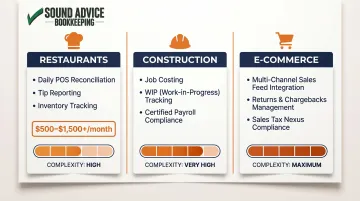
Industry-specific complexity:
- Restaurants: Daily POS reconciliation, perishable inventory, tip reporting (IRS Form 8027), thin margins—often pay $500–$1,500+/month
- Construction: Job costing, WIP tracking, certified payroll
- E-commerce: Multi-channel sales feeds (Amazon, Shopify), returns/chargebacks, sales tax nexus
Geographic Location
BLS wage data shows significant regional variations:
- Highest rates: District of Columbia ($30.96/hr), Massachusetts ($27.35/hr), California ($27.23/hr)
- Lower rates: South Dakota ($20.16/hr), Kansas ($21.06/hr)
Remote and online services help businesses in any region access competitive rates regardless of local market costs.
Scope of Services and Reporting Frequency
Where you're located shapes your local market rate — but what you actually need done has an equally direct impact on price. Basic bookkeeping (categorization + reconciliation) costs less than full back-office scope:
- AP/AR management
- Payroll oversight
- Cash flow analysis
- Budgeting and forecasting
- KPI dashboards
Weekly reporting or check-ins cost more than standard monthly close.
Bookkeeper Experience, Credentials, and Service Model
A newer freelancer charges less than a credentialed bookkeeper or accounting firm — but the gap in output can be significant. Certifications from organizations like the National Association of Certified Bookkeepers or the QuickBooks ProAdvisor program reflect a higher standard of accuracy and software fluency. A credentialed bookkeeper who catches a $3,000 misclassification in month one has already covered their fee.
Bookkeeping Pricing Models: Hourly, Monthly, and Project-Based
The pricing model matters as much as the dollar amount when evaluating cost.
Hourly Pricing
Hourly rates typically range from $30–$85/hour depending on experience and market. The BLS median is $23.66/hour for employed bookkeepers, while freelance marketplace rates on Upwork average $15/hour (median), with typical rates of $11–$25/hour. More experienced freelancers and firms charge $60–$80+/hour.
Best for: One-off tasks like cleanup projects, but results in unpredictable monthly costs for ongoing work.
Monthly Flat-Fee (Subscription) Pricing
Flat monthly packages are the most common model for ongoing small business bookkeeping. According to a 2024 Ignition survey, 79% of accounting firms now use fixed-fee or value-based pricing for bookkeeping services.
Typical inclusions:
- Monthly reconciliations
- Month-end close
- Financial statements (P&L, balance sheet)
- CPA-ready reports
Why it's recommended: Predictable costs and consistent financial oversight — you always know what you're paying.
Sound Advice Bookkeeping uses a customized flat-fee model based on transaction volume rather than time spent. After an initial assessment and 3-month discovery period, clients receive a tailored flat fee starting at $170/month that matches their actual needs—not a generic package.
Project-Based Pricing
Project-based pricing covers one-time engagements like catch-up bookkeeping, which means bringing months or years of disorganized records current. This work is always scoped and priced separately from ongoing monthly fees.
Before committing to any ongoing plan, account for this cost upfront. Key things to know:
- Pricing ranges from a few hundred to several thousand dollars depending on how far behind the books are
- Most providers charge hourly (Sound Advice bills at $85/hour during setup) or quote a flat project fee after reviewing the scope
- Cleanup typically happens during Phase 1, before a monthly engagement begins
In-House, Freelancer, or Online Bookkeeping Service: What Will It Cost?
The right choice depends on your business size, transaction volume, and how much hands-on oversight you need.
Annual Cost Comparison
In-house bookkeeper:
- Base salary: $49,210/year median
- Benefits burden: +29.9% of total compensation
- Payroll taxes: +7.65% FICA, +FUTA
- Total annual cost: $65,000–$72,000+
Freelance/virtual bookkeeper:
- Hourly rate × estimated monthly hours
- Highly variable ($11–$80/hour depending on experience)
- Annual cost: $5,000–$25,000+ (depends on hours worked)
Outsourced/online service:
- Monthly fees: $300–$1,500/month
- Annual cost: $3,600–$18,000/year
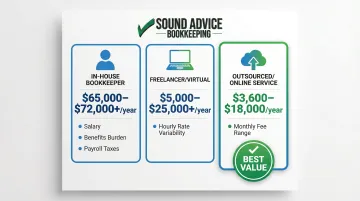
Outsourced options deliver similar or better value for most small businesses that don't need full-time support.
Key Trade-Offs Beyond Cost
Cost alone doesn't tell the full story — each model comes with structural strengths and real limitations.
| Model | Strengths | Watch Out For |
|---|---|---|
| In-house | Daily proximity, deep operational familiarity | Recruitment overhead, single point of failure |
| Freelancer | Flexibility, lower commitment | Variable reliability, limited scalability |
| Outsourced/online | Team coverage, built-in software integration, specialized expertise | Requires clear communication protocols and defined deliverables |
For most small businesses, outsourced services offer the best balance of cost, coverage, and scalability — without the overhead of a full-time hire.
How to Estimate the Right Bookkeeping Budget—And What Most Owners Get Wrong
Self-Assess Before Getting Quotes
Estimate these factors before requesting proposals:
- Monthly transaction volume (bank, credit card, cash transactions)
- Number of accounts to reconcile (bank accounts, credit cards, payment processors)
- Payroll or sales tax support needs
- Reporting frequency (weekly, monthly, quarterly)
- Current state of books (current or requiring catch-up work)
This self-audit helps compare provider quotes on equal footing.
Most Common Budgeting Mistakes
- Monthly fee tunnel vision — Add-ons like payroll processing, AP/AR management, software subscriptions, and cleanup fees can significantly change what you actually pay.
- Hiring on price alone — A bookkeeper without experience in your industry or software creates errors that cost more to fix than you saved upfront.
- Ignoring your own time — Spending 10 hours a month correcting bad books costs more than hiring someone competent to do it right.
The Right Budget Isn't the Lowest One
The right budget delivers accurate, timely financials your business can actually use. Good bookkeeping should:
- Show your true cash position at any time
- Help you understand where money is going
- Have you ready for tax season without scrambling
- Provide insights for business decisions
Sound Advice Bookkeeping's 3-phase process reflects this directly. Phase 1 handles cleanup and setup at $85/hour. Phase 2 is a 3-month discovery period, also at $85/hour. Phase 3 locks in a flat monthly fee based on what was actually found—so you're paying for your real scope, not an estimate someone made before seeing your books.
Frequently Asked Questions
How much should monthly bookkeeping services cost in 2026?
Most small businesses pay $300–$900/month for standard services, with complex businesses (payroll, inventory, multi-entity) paying $1,000–$2,000+. The right cost depends heavily on transaction volume, scope of services, and business complexity—there's no one-size-fits-all answer.
What hourly rate should a bookkeeper charge?
Freelance bookkeepers typically charge $30–$85/hour. The BLS median for employed bookkeepers is lower (~$23–$24/hour), but freelancers and firms command higher rates based on experience and credentials. Hourly is best for one-off projects rather than ongoing work.
How much should I pay someone to do my QuickBooks?
QuickBooks management is typically bundled into monthly bookkeeping packages ($300–$900+/month) or charged hourly ($40–$80/hour) for specific tasks like setup, cleanup, or training. Look for bookkeepers with hands-on QuickBooks experience—setup errors are costly to fix later.
Are bookkeepers cheaper than accountants?
Yes. Bookkeepers earn a median $49,210/year ($23.66/hour), while accountants and auditors earn $81,680/year ($39.27/hour). Bookkeepers handle day-to-day transaction recording and reconciliation; accountants handle tax planning, analysis, and compliance. Many small businesses use both—bookkeepers maintain the records that accountants use for taxes and strategic decisions.
Do restaurants need bookkeepers?
Yes. Restaurants especially benefit from professional bookkeeping given the complexity of inventory/COGS tracking, tip reporting, sales tax, multiple revenue streams, and thin margins (3–5% net). Restaurants typically pay on the higher end of the range ($1,000–$2,000+/month) due to this complexity.
What are the three types of bookkeeping?
Single-entry records each transaction once (revenues and expenses only)—simple but incomplete. Double-entry is the GAAP standard, logging every transaction as both a debit and credit for accuracy and error detection. Virtual/outsourced bookkeeping isn't a methodology—it's a delivery model where services are handled remotely rather than in-house.