Introduction
It's Friday afternoon and Dr. Sarah Chen is still at her dental practice — not treating patients, but reconciling lab invoices from the past month. She's trying to remember if she already paid that $1,247 invoice from her dental supply distributor. Meanwhile, her office manager is fielding calls from an equipment leasing company about a payment that's three weeks overdue, despite the practice having plenty of cash. This plays out in dental offices across the country, costing thousands of dollars and hours every year.
This is an accounts payable problem, not a billing problem. Most dental practice owners don't realize how much it's costing them until they examine the numbers. While insurance billing and patient collections get plenty of attention in dental practice management, the money flowing OUT of the practice receives far less scrutiny.
Accounts payable covers lab fees, dental supply invoices, equipment leases, rent, utilities, and vendor payments. When these obligations are managed reactively rather than systematically, practices lose money through missed early-payment discounts, duplicate payments, late fees, and — most seriously — internal fraud.
TLDR
- Dental practices face unique AP obligations — lab invoices that must match case logs, supply vendor contracts prone to price creep, and equipment service renewals — that require specialized expertise most office managers don't have time to provide
- Outsourcing AP transfers responsibility to a dedicated team that verifies invoices, codes expenses correctly, schedules payments strategically, and reconciles vendor accounts monthly
- The typical cost of outsourced AP ($250–$1,500/month) is substantially lower than the hidden cost of in-house management when you factor in staff time, payment errors, missed discounts, and fraud risk
- The right partner integrates with QuickBooks, fits alongside your existing systems, and delivers monthly AP aging reports with minimal disruption
What Is Accounts Payable in a Dental Practice?
Accounts payable (AP) is the money your practice owes to outside vendors and suppliers—tracking every incoming bill and ensuring those obligations are paid accurately and on time. This is distinct from accounts receivable (AR), which is the money patients and insurance companies owe you for services rendered.
That distinction matters more than it sounds. Confusion between the two leads many dental practices to overlook AP entirely, pouring resources into collections while bills quietly pile up unpaid.
Dental-Specific AP Obligations
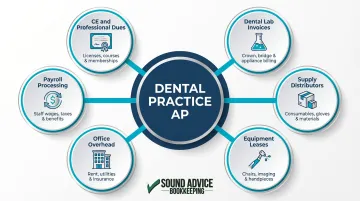
What makes AP management in dental practices more complex than typical small businesses? Consider these vendor categories:
- Dental lab invoices - Variable costs based on case volume, often arriving in batches that must be reconciled against case logs to verify quantities and pricing
- Dental supply distributors - Standing accounts with negotiated pricing that's vulnerable to "price creep" (10-20% cost increases through small incremental changes without notice)
- Equipment lease and service contracts - Monthly payments with auto-renewal terms requiring proactive monitoring to avoid unexpected charges
- Office overhead - Rent, utilities, insurance premiums, OSHA/HIPAA compliance subscriptions
- Payroll processing fees - If using external payroll services
- Continuing education and professional dues - State licensing fees, CE course registrations, professional organization memberships
According to industry research, dental practices and Dental Service Organizations process a greater volume of invoices and payments than non-healthcare businesses, with 13% of healthcare-related AP teams processing over 2,000 payments per month compared to just 6% of non-healthcare organizations.
Why AP Falls Through the Cracks
In most small-to-mid-sized dental practices, AP responsibility defaults to the office manager or front desk staff who are already juggling patient scheduling, insurance verification, and treatment coordination. Research from the ADA shows that dentists' time spent on non-clinical office tasks increased by 1.2 hours per week from 2021-2024, with owner dentists working an average of 5 hours more per week than associate dentists.
When AP becomes one more item on an overloaded schedule, it turns into a reactive scramble. Bills get paid when someone notices them—not on a strategic schedule designed to optimize cash flow and capture early-payment discounts.
Why Managing AP In-House Is Costing Your Dental Practice More Than You Think
The Staff Time Cost
Manual AP processes consume significant administrative hours. Research from Ardent Partners shows that 43% of AP teams spend six hours or more per month just responding to vendors' payment-related inquiries, with 17% spending 11 or more hours on this single activity alone. Factor in invoice sorting, data entry, payment processing, and vendor reconciliation, and total AP time can easily reach 15–20 hours monthly.
Consider the opportunity cost: dental practice managers earned an average of $34.21/hour in 2023, representing a 16.4% wage increase from the prior year. At that rate, 20 hours of AP work costs your practice $684 monthly in pure labor—before accounting for the revenue-generating activities your office manager could be doing instead, such as treatment presentation support, recall system optimization, or patient experience improvement.
Payment Errors and Financial Leakage
Manual AP processes create payment errors that often go undetected until year-end reconciliation or a vendor audit. Research from Xelix shows healthcare companies lose 0.52% of their annual spend to duplicate payments and missing credit notes, while cross-industry data from APQC indicates organizations see 0.8%–2% of total disbursements as duplicate or erroneous payments.
For a dental practice spending $400,000 annually on lab fees, supplies, and overhead, a 0.5% error rate alone represents $2,000 in lost money each year. Common errors include:
- Duplicate payments to supply vendors when invoices are submitted multiple times
- Missed lab invoices that result in late fees or strained vendor relationships
- Incorrect payment amounts applied to vendor accounts, creating reconciliation nightmares
- Failure to capture negotiated discounts or early-payment terms
- Paying inflated prices due to unnoticed "price creep" in supply invoices
Embezzlement and Fraud Vulnerability
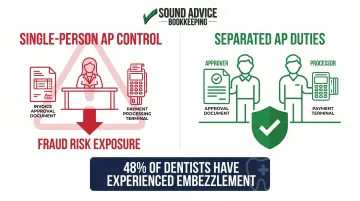
Dental practices are well-documented targets for internal embezzlement, and AP represents one of the highest-risk areas. ADA research reveals that 48% of dentists have already been victims of embezzlement, many of them multiple times. The Association of Certified Fraud Examiners' 2024 Report to the Nations shows that small businesses with fewer than 100 employees suffer a median loss of $141,000 per fraud case, with asset misappropriation accounting for 89% of cases.
When one person controls both approving invoices and processing payments without oversight, small amounts can disappear for months. Common schemes include creating fictitious vendors, inflating invoice amounts, or processing duplicate payments and pocketing the refund.
The lack of separation of duties in typical single-office-manager setups is the core vulnerability. Without checks and balances, fraud has room to grow well before anyone notices.
Cash Flow Visibility Problems
Fraud risk isn't the only consequence of weak AP controls—reactive AP management also distorts your financial picture. When payments go untracked, practice owners can't accurately see their true cash position. You may believe you have $50,000 in operating cash based on your checking account balance, not realizing you have $18,000 in unpaid vendor obligations due within the next 10 days. This distorted picture leads to poor purchasing decisions, difficulty covering payroll during slow periods, and missed opportunities to negotiate early-payment discounts with vendors.
Clean AP management produces a real-time picture of what you owe, when payments are due, and how much true operating cash you have available. This visibility is essential for strategic decisions like timing equipment purchases or negotiating bulk supply discounts.
Year-End Tax Preparation Burden
Disorganized AP records compound costs well beyond day-to-day operations. When your CPA or tax preparer sits down to prepare year-end returns, they must reconstruct expense records, categorize payments correctly, and reconcile discrepancies between what was paid and what was recorded. This adds billable hours to your tax preparation invoice and increases the risk of missed deductions or categorization errors that could trigger audits.
What Outsourced AP for Dental Practices Actually Covers
Outsourced AP covers far more than bill payment. A complete AP service manages the full cycle of outgoing payments — tracking, verifying, processing, and reporting — while maintaining the financial controls your practice needs.
Full-Cycle AP Management
A qualified AP partner handles the complete invoice-to-payment cycle:
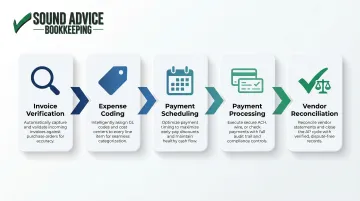
- Invoice verification — Confirms each invoice matches what was ordered, including quantities, unit prices, and terms. For dental practices, this means matching lab invoices against case logs and checking supply invoices against negotiated pricing.
- Expense coding — Categorizes each charge to the correct account (lab fees, dental supplies, equipment maintenance, rent, etc.) for accurate financial statements and tax reporting.
- Payment scheduling — Times payments to vendor terms, capturing early-payment discounts and protecting cash flow without paying ahead of schedule.
- Payment processing — Executes payments via check, ACH, or credit card through platforms like Bill.com, with proper documentation and controls.
- Vendor reconciliation — Monthly verification that vendor statements match internal records, surfacing discrepancies, missing credits, or billing errors.
Authoritative guidance from the AICPA outlines that a complete AP process includes maintaining an approved vendor list reviewed quarterly, requiring dual signatures for checks above specific thresholds, and marking invoices "Paid" with check numbers to prevent double payment. Additionally, 3-way matching—comparing purchase orders, invoices, and receiving reports—ensures everything aligns before payment is issued.
Dental-Specific Workflow Expertise
Generic bookkeepers frequently miss the nuances of dental practice AP. A dental-specialized provider understands:
Lab invoice reconciliation - Lab fees typically represent the second-largest variable cost in a dental practice after staff salaries, averaging 8-12% of collections. Proper management requires pulling lab invoices monthly, calculating total spend, determining cost per unit by procedure type, and reconciling against case logs.
Supply pricing vigilance - Dental practices commonly experience 10-20% cost increases through "price creep" alone—steady incremental price increases often implemented without written or verbal notice. A 3-way match process identifies these discrepancies, preventing payment until offsetting credits are issued.
Equipment contract monitoring - Service contracts often have auto-renewal terms requiring proactive review to avoid unexpected charges or unfavorable renewals.
Reporting Deliverables
Quality outsourced AP provides monthly reporting that transforms your financial visibility:
- AP Aging Reports - What you owe, to whom, organized by due date, allowing you to prioritize payments and avoid late fees
- Cash Flow Projections - Forward-looking analysis incorporating upcoming AP obligations alongside expected revenue
- Vendor Spend Analysis - Detailed breakdown of where practice money is going, categorized by expense type (lab costs, supplies, overhead), enabling benchmarking against industry standards
Software Integration
A qualified outsourced AP provider works directly within your existing accounting software — most commonly QuickBooks Online, Desktop, or Enterprise — without requiring system changes or new tools. When needed, they pull data from practice management systems like Dentrix or Eaglesoft. For enhanced payment functionality, they can integrate Bill.com while keeping QuickBooks as the primary accounting system.
What Outsourced AP Does NOT Replace
A few clarifications worth noting:
- Your CPA — Tax preparation and advisory services stay with your tax professional. Clean AP records simply reduce the time (and cost) your CPA spends sorting through the books.
- Revenue cycle functions — Collecting patient payments, posting insurance payments, and verifying benefits remain front-desk responsibilities.
- Clinical decisions — Equipment purchases, lab selection, and supply vendor choices stay with practice leadership.
Outsourced AP takes on the administrative workload of paying and tracking — so your team stays focused on patient care and practice growth.
The Real Benefits of Outsourcing AP for Your Dental Practice
Improved Cash Flow Control
Strategic Payment Timing
When AP is managed on a defined schedule rather than reactively, you gain a clear, forward-looking picture of outgoing cash. This lets you time major purchases strategically, maintain consistent vendor relationships, and avoid short-term cash crunches. One often-overlooked upside: early payment discounts (such as 2/10 net 30—taking a 2% discount by paying within 10 days instead of 30) can produce a risk-free, annualized return of 37%.
Yet research from the Institute of Finance and Management shows that while most companies receive invoices with early payment offers, only 27% fully utilize these discounts. According to the Hackett Group, best-in-class accounts payable organizations that adopt automation capture seven times more early-payment discounts compared to their peers. For a practice spending $30,000 monthly with vendors offering 2/10 terms, capturing these discounts saves $7,200 annually.
Vendor Relationship Benefits
Vendors who are paid consistently and on time are more likely to extend favorable credit terms, hold negotiated pricing, or prioritize your practice during supply shortages. This relationship capital becomes particularly valuable during periods of supply chain disruption or when negotiating annual pricing agreements.
Cost and Risk Reduction
True Cost Comparison
Compare the real cost of in-house AP management against outsourcing:
In-House Costs:
- Staff time: 15-20 hours monthly × $34.21/hour (average practice manager wage) = $513–$684
- Error correction time: 2-4 hours monthly = $68–$137
- Potential late fees: $50–$200 monthly
- Missed early-payment discounts: $200–$600 monthly
- Year-end reconciliation cost: $500–$1,000 annually = $42–$83 monthly
- Total monthly cost: $873–$1,704
Outsourced Costs:
Outsourced bookkeeping and AP services for dental practices typically range from $250–$1,500+ monthly, depending on transaction volume and complexity:
| Service Level | Practice Size | Monthly Cost | What's Included |
|---|---|---|---|
| Basic | Startup/low volume | $250–$450 | Core bookkeeping, bank reconciliation, cash-basis P&L |
| Mid-Level | Established practices | $450–$800 | Full AP (vendor bill pay), 2-3 credit cards |
| Full-Service | High volume/growth | $800–$1,500+ | Accrual accounting, 4+ cards, KPI tracking |
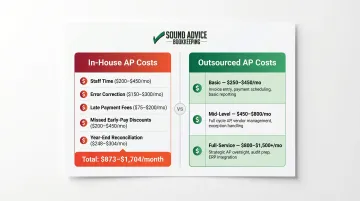
For most small-to-mid-sized dental practices, outsourcing costs less than the true in-house expense — especially when staff time shifts from administrative tasks to patient-facing work.
Fraud Prevention Through Separation of Duties
The ADA advises having one employee process only accounts payable and another process only accounts receivable, with neither involved in the other side of the money trail. When an outside party handles AP processing and reconciliation, it creates natural separation of duties that reduces embezzlement risk. The outsourced bookkeeper acts as an independent check on every payment — making it much harder for internal staff to manipulate vendor transactions without detection.
More Time for Patient Care
Reclaiming Clinical and Strategic Focus
Dentists attend years of specialized education to practice dentistry, not to reconcile vendor invoices. When AP is handled by a dedicated external team, dentists and office managers recover hours each month that can be redirected to:
- Patient care and treatment presentation
- Staff management and training
- Practice growth initiatives
- Marketing and patient experience improvement
Sound Advice Bookkeeping takes this approach with dental and small business clients alike. Their team functions as an extension of your practice's operations — handling AP through a structured 3-Phase process: Phase 1 (Clean Up/Catch Up/Set Up) organizes existing records; Phase 2 (3-month Discovery Period) analyzes transaction patterns to set accurate service levels; and Phase 3 (Ongoing Support) locks in a predictable flat monthly fee starting at $170.
The result: you know exactly what you're paying each month, your books stay current, and your team stays focused on patients — not paperwork.
How to Choose the Right AP Partner for Your Dental Practice
Non-Negotiable Requirements
Before signing with any AP provider, verify they meet these essential criteria:
Documented dental experience — Generic bookkeepers miss dental-specific nuances like lab fee reconciliation, insurance payment handling, and supply contract price verification.
Software compatibility — They should work directly in QuickBooks (or your existing platform) without requiring data exports or system changes.
Clear, predictable pricing — Confirm exactly what's included — monthly AP aging reports, vendor reconciliation, invoice discrepancy flags — before you sign anything.
Structured onboarding — Look for a defined setup process with clear phases, not a vague "we'll figure it out" approach.
Red Flags to Avoid
These warning signs indicate you should look elsewhere:
- Vague pricing — Constant deflection to "it depends" signals an unstructured service model — expect surprises on your invoice
- No dental-specific knowledge — Any provider worth hiring should explain their approach to lab invoice reconciliation and supply contract monitoring without hesitation
- No defined onboarding — Absence of a clear setup process suggests disorganized service delivery
- Automated-only communication — No named contact and ticket-only support means slow responses precisely when you need fast answers
- Evasiveness during sales — How a provider communicates before you sign is a reliable preview of how they'll communicate after

Critical Questions to Ask
Before signing a contract, get clear answers to these questions:
Process Questions:
- How do you handle invoice discrepancies with vendors?
- What does your onboarding process look like and how long does it take?
- Who will be my primary contact?
- How do you report back to me on AP status each month?
Compliance Questions:
- Do you sign a Business Associate Agreement (BAA) if any vendor-related data involves patient information? (A BAA is required under HIPAA when services involve protected health information, though vendors with no PHI access or only incidental exposure are generally exempt.)
Service Scope Questions:
- What's included in your AP service versus what costs extra?
- Do you provide vendor spend analysis and benchmarking?
- How do you handle payment approvals—do I review before payments go out?
Frequently Asked Questions
Can accounts payable be outsourced for dental practices?
Yes, AP can be fully outsourced for dental practices of any size. This is distinct from outsourcing dental billing—AP covers vendor payments and outgoing expenses (money you owe), while billing covers insurance claims and patient collections (money owed to you). Many practices successfully outsource both functions to different specialized providers.
How much does it cost to outsource accounts payable for dental practices?
Costs typically range from $200–$2,500 monthly for small business bookkeeping services. For dental practices specifically: basic services for startups run $250–$450/month, mid-level services including full AP bill pay cost $450–$800/month, and full-service accrual accounting for high-volume practices ranges from $800–$1,500+ monthly. This is substantially less than dedicating equivalent in-house staff time at current practice manager wage rates ($34.21/hour average).
What is BPO in dentistry?
BPO (Business Process Outsourcing) in dentistry refers to delegating non-clinical administrative functions—such as insurance billing, AP management, payroll, and bookkeeping—to external specialists. This allows practices to focus internal resources on patient care while accessing specialized expertise for administrative processes that don't require clinical staff.
What tasks are included in outsourced accounts payable for a dental practice?
Comprehensive outsourced AP typically covers:
- Invoice receipt and verification (confirming amounts match contracts)
- Expense coding to the correct chart-of-accounts categories
- Payment scheduling according to vendor terms
- Payment processing via check, ACH, or card
- Vendor account reconciliation and monthly AP aging reports
How does outsourcing AP differ from outsourcing dental billing?
Dental billing outsourcing focuses on the revenue side—submitting insurance claims, posting payments, following up on denials, and managing patient payment plans. AP outsourcing focuses on the expense side—tracking and paying what the practice owes to vendors and suppliers. Both can be outsourced simultaneously, but they require different expertise and serve entirely different functions.
Is outsourced accounts payable safe for a dental practice?
Yes, when working with a reputable provider. Quality AP partners use secure, access-controlled systems with encryption, do not require access to clinical patient records, and actually reduce fraud risk by creating separation of duties between whoever approves expenses and whoever processes payments—making internal embezzlement significantly harder than with single-person AP management.