
Introduction
Small business owners face mounting tax compliance requirements in 2026. The IRS assessed 15.3 million estimated tax penalties totaling $4.82 billion in FY 2024, and another 22.4 million failure-to-pay penalties worth $7.82 billion. New reporting thresholds—including the $2,000 1099-NEC reporting limit for tax years beginning after 2025—create fresh compliance hurdles.
Those numbers aren't abstract risks — they reflect what happens when compliance gaps go unchecked. That's where choosing the right tax professional becomes a practical, not just financial, decision.
Only licensed CPAs, Enrolled Agents, and attorneys can represent your business before the IRS during audits. Basic preparers have no representation rights for returns filed after 2015 — meaning if the IRS comes calling, you're on your own.
Key Takeaways
- The best CPA firm matches your industry, entity complexity, and growth stage—not just the lowest price.
- Tax compliance in 2026 is year-round work: quarterly estimates, payroll deadlines, and multi-state filings all require ongoing support.
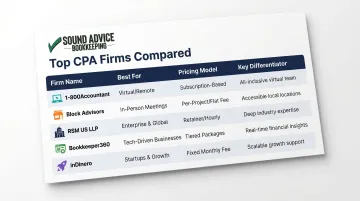
- Top firms blend virtual convenience with deep expertise; 1-800Accountant, Block Advisors, RSM, Bookkeeper360, and inDinero each fit different business profiles.
- Flat-fee or monthly retainer models prevent billing surprises; avoid open-ended hourly CPA arrangements for routine compliance.
- Clean books cut CPA costs significantly; pairing a CPA with a dedicated bookkeeping service consistently delivers the best ROI.
What Small Businesses Actually Need from a CPA Firm in 2026
Tax compliance is no longer a once-a-year scramble. Small businesses must navigate quarterly estimated taxes, updated 1099-NEC thresholds, payroll obligations, and entity-level filings throughout the year. According to the 2024 NFIB Tax Survey, 90% of small business owners use a professional tax preparer—yet many still face penalties due to missed deadlines or filing errors.
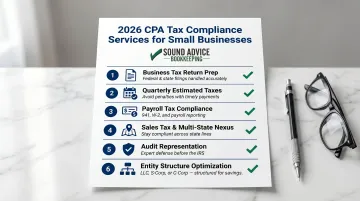
Core tax compliance services every CPA firm should offer in 2026:
- Business income tax return preparation (1120, 1120-S, 1065, Schedule C)
- Quarterly estimated tax planning and payment coordination
- Payroll tax compliance and deposit management
- Sales tax filings and multi-state nexus analysis
- Audit representation and IRS correspondence handling
- Entity structure optimization (LLC vs. S-Corp vs. C-Corp tax implications)
CPA vs. Tax Preparer: What the Difference Costs You
Not every tax professional carries the same authority. When evaluating firms, understand what each credential actually allows:
- Licensed CPA: Can represent your business before the IRS during audits, provide forward-looking tax strategy, and advise on entity structure decisions
- PTIN-only preparer: Limited to form filing — no authority to represent clients in IRS disputes or audit proceedings
When issues arise, that distinction matters. Verify you're working with credentialed professionals who can defend your business, not just file its returns.
Best CPA Firms for Small Business Tax Compliance in 2026
These firms were evaluated across five criteria to help you find the right fit:
- Breadth of small business tax compliance services
- Pricing transparency and predictability
- Technology infrastructure
- Client satisfaction ratings
- Ability to serve multiple states and entity types
1-800Accountant
Full-service virtual CPA firm built specifically for small businesses. Offers dedicated CPAs and Enrolled Agents matched by state and industry, covering business tax preparation, quarterly estimated taxes, payroll, bookkeeping, and audit defense—all under one platform.
Flat-rate, tax-deductible pricing is a key draw, and the firm claims an average client tax savings of over $12,000 annually. Trustpilot rating: 4.4 stars from 11,433 reviews.
| Category | Details |
|---|---|
| Best For | Entrepreneurs and small business owners seeking a single virtual platform for all tax compliance needs |
| Pricing Model | Tax Advisory: $209/month; Core Accounting: $249/month; Core Accounting+: $419/month (billed annually) |
| Key Differentiator | Dedicated CPA/EA assigned per client; maximum refund guarantee; audit defense included |
Block Advisors (H&R Block Small Business Division)
H&R Block's dedicated small business arm offers both virtual and in-person CPA access. Services span business tax prep, payroll, entity formation, and year-round tax advisory—providing the reliability of a nationally recognized brand with a small business focus.
What sets it apart is flexibility: clients can meet with a tax advisor in person at a local office or work entirely online, making it a strong choice for business owners who value face-to-face support alongside digital convenience.
| Category | Details |
|---|---|
| Best For | Small businesses wanting in-person + virtual flexibility from a trusted national brand |
| Pricing Model | File with a tax pro starting at $250 + $75 per state; per-service and bundled plans available |
| Key Differentiator | Nationwide office presence combined with dedicated small business advisors; brand credibility with optional audit support ($75 add-on) |
RSM US LLP
One of the largest national CPA and advisory firms focused on the middle market. Serves small-to-growing businesses with audit, tax compliance, and strategic advisory services across industries including technology, healthcare, and manufacturing.
The key differentiator is industry-specific depth: RSM assigns teams with sector expertise, making it a strong choice for businesses with complex compliance needs—multi-state filing, R&D credits, or those planning for significant growth or acquisition. The firm serves 125,000 middle-market businesses through over 16,600 professionals across nearly 100 offices.
| Category | Details |
|---|---|
| Best For | Growing small businesses with complex multi-state or industry-specific tax compliance requirements |
| Pricing Model | Project-based and engagement-based; pricing varies by scope—contact RSM directly for estimates |
| Key Differentiator | Middle-market focus with Big-Four-level technical resources; strong audit and assurance capabilities |
Bookkeeper360
A full-service accounting and advisory platform that bundles bookkeeping, tax filing, payroll, and CFO-level consulting. Particularly strong for small businesses that want integrated financial management rather than separate services from multiple providers.
Clients particularly value the real-time financial dashboards and performance reporting that sit alongside tax compliance work—giving small business owners both compliance accuracy and actionable business insights in one place.
| Category | Details |
|---|---|
| Best For | Small businesses that want bookkeeping and tax compliance integrated under one roof with advisory support |
| Pricing Model | Bookkeeping from $399/month; Business Tax from $1,000/year; Fractional CFO from $2,000/month |
| Key Differentiator | Combines bookkeeping, tax, payroll, and CFO advisory; live performance metrics alongside compliance work |
inDinero
A tech-driven accounting firm offering integrated tax management, CFO services, and entity-level compliance in a single platform. Built with startups and fast-growing small businesses in mind, particularly those with investors or complex ownership structures.
Its strongest differentiator: investor-ready financial reports delivered alongside ongoing tax compliance management—making it the top pick for venture-backed or scaling companies with more sophisticated financial needs.
| Category | Details |
|---|---|
| Best For | Tech startups, venture-backed businesses, and fast-growing small companies with complex entity structures |
| Pricing Model | Custom monthly pricing starting at $750/month; Essential plan starting at $1,250/month |
| Key Differentiator | Combines tax compliance with CFO-level strategy and investor-ready reporting; strong technology integration |
How to Choose the Right CPA Firm for Your Small Business
Start by defining your actual compliance needs before shopping for firms. A single-state LLC filing simple returns has different needs than a business with employees, contractors, multi-state nexus, or an S-Corp election. Clarifying this upfront prevents overpaying for services you don't need or leaving dangerous gaps in coverage.
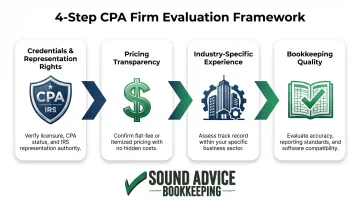
Once you've mapped your needs, evaluate firms across four areas:
- Credentials and representation rights: Confirm the firm employs licensed CPAs or Enrolled Agents who can represent your business before the IRS during audits or notices—not just preparers with a PTIN. This distinction matters if you face correspondence audits or payment disputes.
- Pricing transparency: Flat-fee or monthly retainer models are far preferable to open-ended hourly billing. According to the AICPA's 2025 MAP Survey, median CPA hourly rates now reach $170, with equity partners at $275/hour. Get a written scope of services and total annual cost estimate before signing anything.
- Industry-specific experience: A CPA familiar with your sector—restaurant, tech, non-profit, franchise—knows the deductions, credits, and regulatory quirks that apply. Ask for examples of similar clients and how they handled sector-specific compliance issues.
- Bookkeeping quality: A CPA firm works only as efficiently as the records it receives. Disorganized books force CPAs to spend billable time on cleanup rather than strategy. Pairing your CPA with a bookkeeping service that delivers tax-ready monthly records—Sound Advice Bookkeeping has handled this for 1,000+ small businesses across 30+ states since 2009—reduces your overall compliance cost and eliminates year-end scrambles.
How Much Does a CPA Cost for a Small Business?
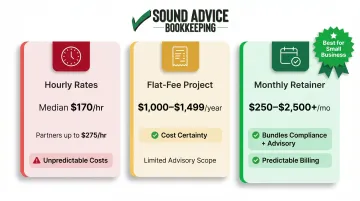
Small businesses encounter three common pricing structures:
Hourly rates: Median CPA hourly rates now stand at $170, with equity partners charging $275, directors $263, managers $198, and associates $127. Hourly billing creates unpredictability and incentivizes time spent rather than results delivered.
Flat-fee project pricing: Most business tax returns range from $1,000 to $1,499 annually, with Form 1120 averaging $750-$1,250. Individual 1040 itemized returns typically cost $400-$599. Flat fees provide cost certainty but may not cover mid-year advisory work.
Monthly retainer plans: Most firms charge $250-$499/month for bookkeeping, with comprehensive tax advisory and CFO services exceeding $2,500/month. Monthly retainers bundle ongoing compliance, quarterly tax planning, and strategic advisory into predictable costs.
Key factors affecting what you pay:
- Entity type (sole proprietor vs. S-Corp vs. C-Corp)
- Number of states with filing obligations
- Payroll and contractor volume
- Transaction volume and complexity
- Quality of financial records when delivered to the CPA
Professional CPA guidance is better understood as an investment than an expense. 1-800Accountant's self-reported data puts average client tax savings above $12,000 annually — well above the $2,500-$5,000 most small businesses pay for comprehensive annual service. Businesses with clean monthly books consistently pay less in CPA fees because your CPA spends less time on financial reconstruction and more time on strategy.
Conclusion
The right CPA firm for your small business does more than file returns — it understands your entity structure, keeps you compliant across all tax obligations, and helps you make better financial decisions throughout the year. The best fit depends on your business size, industry, and where you're headed.
That said, no CPA relationship works well without clean books underneath it. Disorganized records mean your CPA spends billable hours catching up instead of advising you — and you pay for it. Getting your bookkeeping in order before tax season is one of the highest-leverage moves a small business owner can make.
Sound Advice Bookkeeping has helped over 1,000 small businesses across 30+ states build the financial foundation their CPAs rely on. Contact Sound Advice Bookkeeping at 303.228.8911 or schedule a consultation at soundadvicebookkeeping.com to get your books ready before tax season hits.
Frequently Asked Questions
What is the average cost of a CPA for a small business?
Most small businesses pay $1,000–$1,499 annually for business tax return preparation on a flat-fee basis. Monthly retainer arrangements range from $250–$2,500+ depending on services included (bookkeeping, payroll, advisory). Costs vary significantly by entity type, multi-state obligations, and whether books are organized before the CPA begins work.
How to choose a CPA for a small business?
Define your compliance needs first, then verify CPA or EA credentials and IRS representation rights. Check for industry-specific experience and compare pricing models—prioritize flat-fee or retainer arrangements over hourly billing. Choose firms offering year-round support rather than tax-season-only service.
Is a CPA worth it for a small business?
For most small businesses, yes. A CPA's ability to identify deductions, prevent IRS penalties, advise on entity structure, and represent the business during audits typically delivers returns that exceed their fees. Professional guidance often saves businesses $10,000+ annually through legitimate tax strategies and error prevention.
What is the difference between a CPA and a bookkeeper for a small business?
A bookkeeper maintains day-to-day financial records—recording income, expenses, and reconciliations. A CPA applies those records to prepare tax filings, provide tax strategy, and represent the business legally before the IRS. In practice, many small businesses use both: a bookkeeper to keep records clean year-round and a CPA to handle filing and strategy.
Do I need a CPA year-round or just at tax time?
Most small businesses benefit from year-round CPA engagement. Quarterly estimated tax payments, payroll tax deadlines, and mid-year planning windows all create compliance obligations that can't wait until April—and missing them often costs more than year-round professional support would.
What records should I give my CPA to prepare my business taxes?
Your CPA will typically need:
- Profit and loss statements and balance sheets
- Bank and credit card statements
- Payroll records and 1099s issued and received
- Receipts for major deductions
- Prior-year tax returns
Organized, reconciled books reduce the time your CPA spends on preparation — which directly lowers your bill. A professional bookkeeper keeps these records clean throughout the year so tax season requires minimal scrambling.