This guide walks through everything a catering business owner needs to know: how to track costs accurately for each event, which financial metrics separate profitable caterers from struggling ones, tax considerations specific to the industry, and when to bring in professional support. We'll cover the unique accounting challenges catering presents—deposit management, fluctuating seasonal demand, and event-based revenue recognition—and give you practical frameworks to price profitably and maintain healthy cash flow year-round.
Key Takeaways
- Use accrual accounting and record deposits as liabilities until the event is delivered
- Track food cost %, labor cost %, and prime cost monthly and per-event as your three essential financial health indicators
- Calculate event costs by totaling food, labor, equipment, and overhead allocation before quoting
- Major catering tax write-offs include ingredients, equipment purchases (with Section 179 expensing), vehicle expenses, permits, and uniforms
- Hire professional bookkeeping support once you exceed 5-10 monthly events or lose clear visibility into profitability
Core Financial Metrics Every Catering Business Must Track
Catering businesses live and die by their margins. Unlike restaurants that average performance across hundreds of daily transactions, caterers must understand profitability at the individual event level. Tracking the right metrics consistently separates businesses that grow from those that guess. Review these numbers monthly at minimum. Ideally, calculate them for each completed event to identify which client types, menu packages, and event sizes actually generate profit.
Food Cost Percentage
Formula: Food Cost % = (Cost of Food Sold ÷ Food Sales) × 100
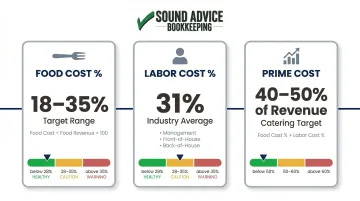
High food cost percentage means you're wasting ingredients, over-ordering, or underpricing menus. The healthy target range shifts based on your service model: the International Caterers Association's 2023 Operations Budgeting report benchmarks 18-25% for leaner formats, while the Curate 2025 Catering Industry Report finds successful full-service caterers running 28-35%.
Service style drives that gap. Family-style service minimizes waste, while buffets require 10-20% overages to keep platters full. If your food cost percentage creeps above 35% regardless of format, you're likely underpricing events, absorbing supplier increases without adjusting rates, or losing product to waste.
Labor Cost Percentage
Formula: Labor Cost % = (Total Labor Cost ÷ Total Sales) × 100
For caterers, total labor includes far more than kitchen prep time. You must account for event staff, delivery drivers, setup crews, and breakdown teams—all of which scale directly with event size. According to the ICA's budgeting guidance, catering labor costs break down as:
- Kitchen labor (hourly): 12-20% of revenue
- Warehouse labor: 3-5% of revenue
- Event labor: Up to 50% of direct event costs
- Management/admin (fixed): Up to 10% of revenue
The U.S. Economic Census data shows the catering industry average for total payroll is just under 31% of revenue. Exceeding 30-31% signals you're either overstaffed, underpriced, or paying above-market wages without corresponding premium pricing. Catering labor costs fluctuate with bookings—quiet months may show 15% labor costs while peak wedding season pushes to 35%.
Prime Cost
Definition: Prime Cost = Cost of Goods Sold (COGS) + Total Labor Cost
Prime cost, expressed as a percentage of total sales, is the single most useful indicator of operational health. While full-service restaurants typically target 60-65% prime cost, catering operations focus on "direct costs" (food, labor, rentals, delivery, beverages) of 40-50% of revenue according to ICA benchmarks.
Prime cost tells you immediately whether an event type is sustainable. A corporate lunch with 48% prime cost leaves room for overhead and profit. A wedding with 62% prime cost means you're losing money after covering fixed expenses, even if the event felt successful.
Gross Profit Margin and Break-Even Per Event
Formula: Gross Profit Margin = (Gross Profit ÷ Sales) × 100
Caterers targeting 50-60% gross profit margins position themselves to cover overhead and generate net profit margins of 10-15%. This margin calculation happens before company expenses like rent, insurance, and marketing are factored in.
Break-even analysis at the event level answers a critical question: what's the minimum price I can accept for this booking? The SBA break-even formula is:
Break-Even Point = Fixed Costs ÷ (Price - Variable Costs)
For catering, allocate a portion of monthly fixed overhead to each event. If your monthly overhead is $10,000 and you typically book 20 events monthly, each event must cover at least $500 in overhead just to break even—before food, labor, or profit enter the picture. That figure sets your pricing floor, informs minimum headcount requirements, and tells you quickly whether accepting a low-ball booking will actually cost you money.
How to Calculate Costs for a Catering Event
Calculating true event costs before submitting a quote is the single most important financial skill a caterer can develop. Underpricing events is one of the top reasons catering businesses fail to turn a profit despite staying busy. A $5 per-person pricing error on a 150-person wedding costs you $750 in lost profit—and most caterers make errors larger than $5 per head.
Food and Ingredient Costs
Calculate per-person food cost using detailed ingredient breakdowns, not "what I usually spend" estimates. Follow this process:
- Recipe costing per dish: List every ingredient with precise quantities
- Calculate unit prices: Quantity × current supplier unit price for each ingredient
- Add waste buffer: Include 10-20% for waste, over-preparation, and spoilage depending on service style
- Review seasonally: Ingredient prices fluctuate; recalculate before each new season
The Culinary Institute of America's standard methodology recommends calculating Yield Percentage:
- Yield % = Edible Portion Quantity / As-Purchased Quantity × 100
- Edible Portion Cost = As-Purchased Cost / Yield %
For guest count estimates, build in a 5-10% buffer for last-minute additions. This protects against running short while keeping waste manageable.
Labor Costs for the Event
Event labor has more moving parts than most caterers account for. Break it into four distinct categories:
- Prep time: Hours spent shopping, prepping, and cooking before the event
- Service hours: Event staff, servers, bartenders (industry standard is 1 server per 10 guests)
- Delivery and setup: Drivers, setup crew, equipment installation
- Post-event breakdown: Cleanup, teardown, and equipment return
Calculate total labor dollars per event, then divide by guest count or total revenue to benchmark efficiency. Labor is the most variable cost in catering—and the most consistently underestimated when pricing. A 6-hour wedding requiring 8 staff members at $20/hour costs $960 in labor alone—before factoring in prep work or overtime.
Equipment, Rentals, and Overhead Allocation
These costs are easy to overlook until you're absorbing them out of your margin. Include all of them in every quote:
- Equipment costs: Owned equipment depreciation or rental fees for chafing dishes, tables, linens
- Transportation and fuel: Vehicle costs, mileage, delivery time
- Packaging and disposables: Plates, utensils, napkins, takeaway containers
- Fixed overhead allocation: Proportional share of insurance, kitchen rental, storage, utilities
Simple overhead allocation method: Divide monthly fixed costs by projected monthly events. If you budget $12,000 monthly overhead and expect 15 events, allocate $800 per event. Adjust this number by event size or complexity if needed (larger events may absorb more overhead than small corporate lunches).
Building in Your Profit Margin
With all costs accounted for, the final step is applying your target profit margin. Most caterers skip a key distinction here—markup and margin are not the same thing, and mixing them up guarantees you'll underprice:
| Method | Formula | Use When |
|---|---|---|
| Markup (on cost) | Selling Price = Total Cost + (Total Cost × Markup %) | You know your cost and want to add a percentage on top |
| Margin (on revenue) | Price = Total Cost ÷ (1 − Desired Margin %) | You want your profit to represent a specific percentage of revenue |
A caterer targeting a 55% margin who accidentally applies 55% markup ends up quoting $1,000 less than intended on a mid-size event.
Example Event Calculation:
| Cost Category | Amount |
|---|---|
| Food & ingredients | $1,200 |
| Event labor (8 staff × 6 hours × $20) | $960 |
| Equipment rental | $300 |
| Transportation & fuel | $150 |
| Overhead allocation | $800 |
| Total Direct Costs | $3,410 |
| Target gross profit margin (55%) | $4,155 |
| Minimum Quote Price | $7,565 |
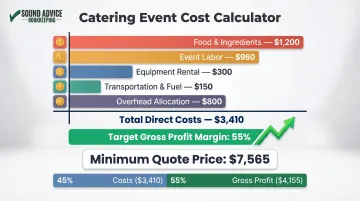
At this price, you've covered all costs and built in a 55% gross margin. Pricing below this guarantees you lose money on the event, no matter how busy your calendar looks.
Managing Cash Flow and Budgeting for Seasonal Catering Revenue
Catering cash flow is lumpy: income arrives in deposit surges while expenses accumulate steadily. Most caterers collect 50% deposits to secure bookings, but these deposits represent obligations, not profit. Understanding accrual accounting and planning for seasonal fluctuations separates sustainable operations from businesses that run out of cash during slow months.
Accrual Accounting vs. Cash Accounting
Cash accounting records revenue when money hits your bank account. A $5,000 deposit received in March shows as March revenue, even if the event isn't until June.
Accrual accounting matches revenue to the period when you deliver services. Under GAAP (ASC 606) revenue recognition standards, nonrefundable deposits must be recorded as contract liability (deferred revenue), not income, until you fulfill the performance obligation by delivering the event.
A cash-basis caterer who collects $20,000 in October deposits for December weddings will show strong October revenue, then face a profit crash in December when labor and food costs hit without corresponding revenue. Accrual accounting gives you accurate monthly profitability and prevents tax overpayment on deposits that aren't truly income yet.
Building a Catering-Specific Budget
With accrual accounting as your foundation, you can build a budget that reflects when revenue is actually earned — not just when deposits land. Project monthly performance using this framework:
- Estimate monthly events: Based on historical booking patterns and seasonal trends
- Calculate average order value: Review past 12 months to determine typical revenue per event by type
- Map expected expenses: Food costs, labor, and overhead by month
- Identify cash-tight months: Typically winter and early spring for wedding caterers
Seasonal revenue reality: 41% of U.S. weddings occur September-November, with October (17%) and September (15%) as peak months. January and February account for just 2% of weddings each. Corporate catering follows different patterns, with summer slowdowns when offices close.
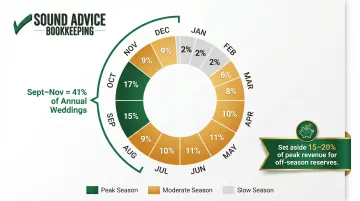
That concentration of revenue makes an off-season reserve essential. Set aside 15-20% of peak-season revenue into a separate savings account to cover off-season operating costs — a self-funded buffer that prevents cash shortages without resorting to expensive external financing.
Weekly Cash Flow Monitoring
Poor timing between income and expenses — not lack of business — is what sinks most catering operations. Monitor these elements weekly or at a minimum biweekly:
- Deposits received: Track which events are secured with deposits
- Outstanding balances: Follow up on invoices due from completed events
- Accounts payable: Review upcoming vendor payments, especially large food orders
- Payroll timing: Ensure sufficient cash for payroll processing dates
Weekly cash flow reviews take 30 minutes but prevent the crisis of facing an $8,000 food order without cash to pay the supplier, despite having $30,000 in receivables from past events.
Tax Deductions and Compliance for Catering Businesses
Catering businesses qualify for significant tax write-offs, but only with proper documentation and understanding of industry-specific compliance requirements. Missing deductions costs you money; incorrect sales tax collection exposes you to penalties.
Common Tax Write-Offs for Catering Businesses
Major deductible expenses:
- Food and ingredients: All business-use purchases with receipts
- Commercial kitchen rental: Monthly facility fees
- Equipment purchases: With Section 179 expensing for immediate deduction (see below)
- Vehicle expenses: Actual expenses or standard mileage rate for delivery and event transportation
- Uniforms and branded apparel: Staff clothing required for work
- Marketing and advertising: Website, social media ads, print materials
- Business insurance: Liability, property, vehicle coverage
- Professional services: Bookkeeping, accounting, legal fees
Section 179 expensing lets businesses deduct the full purchase price of qualifying equipment in the year it's placed in service, rather than depreciating it over time. For 2025, the maximum deduction is $2,500,000, reduced if total equipment purchases exceed $4,000,000. For 2026, the limit increases to $2,560,000.
This makes purchasing ovens, refrigeration units, or delivery vehicles more affordable from day one.
De minimis safe harbor: Businesses can deduct items costing $5,000 or less per item or invoice (with applicable financial statement) or $2,500 (without), avoiding depreciation schedules for smaller equipment purchases.
Catering-Specific Tax Compliance
Sales tax rules vary by state—and getting them wrong is one of the costlier mistakes a catering business can make.
| State | What's Taxable | Source |
|---|---|---|
| Washington | Total charge including meals, equipment, decorations, and service | WA Dept. of Revenue |
| New York | All charges related to event: food, beverages, room rentals, mandatory service charges (voluntary gratuities exempt) | NY Tax Dept. |
| Florida | 6% state sales tax plus surtax on service; gratuities exempt if separately itemized and distributed to employees | FL Dept. of Revenue |
| California | Charges for preparation, serving, tableware, linens, and tables | CA Tax & Fee Admin |
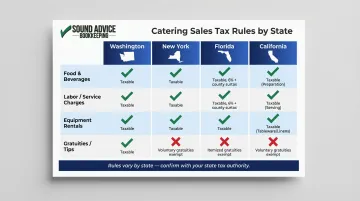
Some states tax only food; others tax the entire invoice including labor and rentals. Confirm your state's rules and configure your invoicing system to collect and remit accordingly.
Payroll tax obligations: Event staff must be properly classified as employees or independent contractors. The IRS uses common-law rules (behavioral control, financial control, type of relationship) to determine status. Misclassifying employees as contractors triggers back taxes, penalties, and potential legal liability. File Form SS-8 if you're uncertain about a worker's classification.
Quarterly estimated taxes: Self-employed caterers or LLC/S-Corp owners must make quarterly estimated tax payments if they expect to owe $1,000 or more when filing. Use Form 1040-ES and pay quarterly to avoid underpayment penalties. Good bookkeeping throughout the year makes estimating these payments accurate and tax season far less stressful.
Accounting Tools and When to Call in a Professional
QuickBooks holds a dominant 62.23% market share in small business accounting software, far ahead of competitors like ADP (14.30%) and Sage 50 (10.30%). For catering businesses, QuickBooks Online or Desktop offers the right balance of invoicing, expense tracking, payroll integration, and profit & loss reporting—especially when configured with a chart of accounts tailored to event-based revenue and cost categories.
Accounting Software for Catering Operations
QuickBooks is the most widely used platform for small-to-mid catering operations because it:
- Handles event-based revenue recognition and deferred revenue from deposits
- Integrates with payroll platforms (Gusto, ADP) for seamless labor cost tracking
- Supports vendor bill payment and 1099 contractor management
- Generates P&L statements by event, month, or menu type with proper class tracking
- Connects with payment processors for automated deposit recording
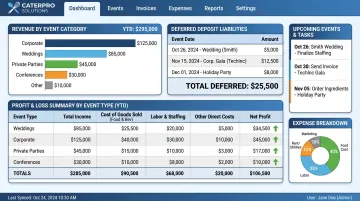
Catering-specific platforms like HoneyBook or Caterease handle event management, quoting, and client communication, then integrate with QuickBooks Online to automatically sync invoices, payments, and transaction fees. This dual-platform approach separates event operations from accounting while keeping financial records accurate.
A bookkeeper experienced with food service businesses—like Sound Advice Bookkeeping, which works with clients such as Sage Catering—can configure these accounts to track per-event profitability and manage deposit liabilities correctly from the start.
Signs DIY Bookkeeping Is No Longer Enough
Bring in professional support when you experience:
- More than 5-10 events per month: Volume overwhelms manual tracking
- Growing payroll complexity: Multiple event staff, varying pay rates, contractor vs. employee questions
- Inconsistent or confusing financials: You can't quickly answer "did we make money last month?"
- Tax filing errors or missed deadlines: Penalties and interest eat into profit
- Too many owner-hours on books: Time spent reconciling transactions would be better spent booking events
Professional bookkeepers don't just maintain records—they identify which event types, menu options, and client segments generate profit versus which drain cash. A survey of 302 small businesses found 45% employ neither an accountant nor bookkeeper, often because owners underestimate the strategic value of accurate financials.
What to Look for in a Bookkeeping Partner
Choose a bookkeeping service that:
- Understands food and event business needs—inventory costing, labor allocation, and sales tax rules
- Goes beyond basic data entry with deep QuickBooks platform knowledge
- Sets up a chart of accounts structured around event-based revenue and cost categories
- Works as part of your team rather than a remote, once-a-month vendor
Sound Advice Bookkeeping has worked with catering businesses since 2009, with clients across 30+ states. Their flat-fee monthly pricing starts at $170/month based on transaction volume. A three-phase process—cleanup/setup, a 3-month discovery period, then ongoing support—ensures books reflect the actual cash flow and profitability patterns of event-based work.
Matt Glick, CEO of Sage Catering, describes their experience: "We have been working with Sound Advice for almost two years. The bookkeepers are knowledgeable and work with us daily to keep things in order. If you are looking for competent bookkeepers to become an extension of your team, I highly recommend Sound Advice."
If your catering books aren't giving you a clear picture of which events and menus actually make money, that's the right time to bring in support. Contact Sound Advice Bookkeeping at 303.228.8911 or visit their website to schedule a consultation.
Frequently Asked Questions
How do you calculate costs for a catering event?
Calculate total event cost by adding food/ingredient costs per head, labor (prep, service, delivery), equipment and rentals, plus a proportional share of monthly fixed overhead. Apply your target profit margin on top of this total to arrive at your minimum quote price.
What are common tax write-offs for a catering business?
Common deductible expenses include:
- Food and ingredient costs
- Commercial kitchen rental
- Equipment purchases (Section 179 expensing applies)
- Vehicle mileage or actual vehicle expenses for deliveries
- Staff uniforms, marketing, business insurance, and professional bookkeeping
Proper documentation is required for all deductions.
What type of accounting is used in a catering business?
Most catering businesses use either cash or accrual accounting. Accrual is more accurate for event-based businesses collecting deposits because it records revenue when the event is delivered, not when the deposit is received.
What accounting software do catering businesses use?
QuickBooks is the most widely used accounting platform for catering businesses, holding over 62% market share. Event-specific tools like HoneyBook or Caterease handle quoting and event management, then integrate with QuickBooks to sync financial data automatically.
Why is accounting important for a catering business?
Without accurate accounting, caterers can't determine whether individual events are profitable, often underprice services, and risk cash flow shortfalls during slow seasons. Accurate books reveal true profitability by event type and client segment — giving you the data to price confidently and grow sustainably.