
Here's the reality: hospitality skills open the doors, but financial clarity keeps them open. In 2025, 42% of restaurant operators reported their businesses weren't profitable, and 60% said business conditions deteriorated. Cash flow problems drive 82% of all business failures—and restaurants, with their razor-thin margins and daily transaction chaos, are especially vulnerable.
This guide covers what makes restaurant bookkeeping uniquely complex, the core tasks you must track, essential financial reports to review regularly, and how to decide whether to manage books yourself or bring in professional help.
TLDR:
- Restaurant bookkeeping is more complex than most industries due to high daily transactions, tipped payroll, fluctuating food costs, and multiple revenue streams
- Core tasks include daily sales recording, food cost tracking (target 30%), labor cost management (36.5% median), vendor payments, and weekly reconciliation
- Review your P&L weekly, not monthly—prime cost (food + labor) should stay between 60-65% for financial health
- Outsourcing typically costs $30,000-$60,000 annually versus $70,000+ for an in-house bookkeeper
What Is Restaurant Bookkeeping (and Why Is It More Complex Than Other Industries)
Restaurant bookkeeping is the ongoing process of recording, organizing, and tracking every financial transaction flowing through your restaurant—sales, expenses, payroll, vendor payments, tips, and more. It forms the foundation for all financial reporting and decision-making.
The Bookkeeping vs. Accounting Distinction
Bookkeeping is the day-to-day recording of transactions. Accounting interprets those records to produce financial statements, tax filings, and strategic insights. Without accurate books, accounting becomes unreliable — bookkeeping captures what happened; accounting explains what it means.
Why Restaurant Bookkeeping Is More Complex
Most small businesses deal with predictable monthly transactions. Restaurants don't have that luxury — the operational realities stack up fast:
- High daily transaction volume across multiple payment types (cash, credit, debit, delivery platforms like DoorDash and Uber Eats)
- Tipped employee payroll with complex tax rules—the IRS requires Form 8027 tip reporting for establishments with more than 10 employees on a typical business day
- Fluctuating food costs that change weekly based on seasonality, supplier pricing, and waste
- Seasonal revenue swings that make cash flow forecasting difficult
- Near-daily financial visibility requirements rather than monthly—small discrepancies compound quickly
- Granular revenue tracking for loyalty program credits, comps and voids, tip pooling, and split streams (food vs. alcohol vs. catering)
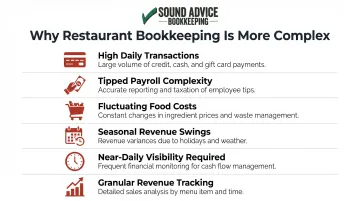
Each of these adds a layer that most small businesses never encounter — which is why restaurant owners so often find their books falling behind.
Core Restaurant Bookkeeping Tasks to Track
Daily Sales Recording
Every shift's sales must be logged daily, broken down by payment type (cash, credit, delivery apps) and revenue category (food, beverage, alcohol, tips).
Small discrepancies compound fast. Daily recording catches errors before they multiply and flags theft, portion inconsistency, or pricing problems early. Cash usage has dropped to 16% of consumer payments in 2024, while credit cards account for 32% and debit cards 30%—so every payment method needs its own trail.
Inventory and Food Cost Tracking
Track food and beverage purchases, monitor usage against what was sold, and calculate your food cost percentage (food costs ÷ sales). Full-service restaurants maintained a median food cost of 32.0% in 2024.
Critical realities:
- Employee theft accounts for 75% of inventory shrinkage
- Weekly physical inventory counts are the industry standard
- Track your 10-15 key items (which account for 50% of food purchases) daily to reduce shrinkage
Spoilage, waste, and portion inconsistency all hit your bottom line. Without accurate tracking, you lose visibility into one of your two largest cost centers.
Payroll and Labor Cost Management
Restaurant payroll is unusually complex:
- Hourly and salaried workers tracked separately
- Tip declarations and tracking
- Overtime calculations
- Tax withholdings for tipped employees
- FLSA compliance for tip credit (maximum $5.12/hour federal tip credit with minimum $2.13/hour direct wage)
Labor costs represented a median of 36.5% of sales for full-service restaurants and 31.7% for limited-service operations in 2024. Errors here result in costly penalties, unhappy staff, and potential DOL violations.
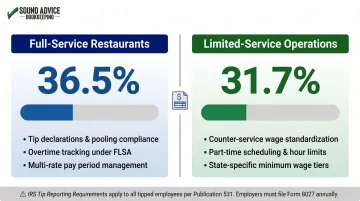
IRS requirements: Employees receiving $20 or more monthly in cash tips must report 100% to the employer. Employers must maintain records of hours worked in tipped vs. non-tipped roles and weekly/monthly tip amounts reported.
Accounts Payable (Vendor Payments)
Payroll complexity doesn't end your vendor obligations. Invoices from food suppliers, beverage distributors, cleaning companies, and equipment vendors each arrive with different payment terms and delivery schedules—all requiring active management.
Three-way matching prevents overpayments and fraudulent invoices:
| Document | Purpose |
|---|---|
| Purchase Order (PO) | Specifies goods, quantity, price, and terms |
| Receiving Report | Confirms condition and quantity upon delivery |
| Supplier Invoice | Requests payment |
Pay vendors on time to preserve supplier relationships and avoid late fees. Small restaurants can't afford to lose reliable suppliers over an avoidable billing dispute.
Account Reconciliation
Reconciliation verifies that your books match your actual bank account, credit card statements, and payroll liabilities.
Frequency recommendations:
- Minimum: Monthly reconciliation
- Better: Weekly reconciliation
- Best: Daily for high-transaction-volume operations
Weekly reconciliation is realistic for most restaurants. Consistent daily sales recording and organized AP tracking make the process significantly faster when that weekly review comes around.
Expense Logging and Categorization
Categorize all expenses correctly in your chart of accounts: kitchen supplies, linen, marketing, rent, utilities, licenses, insurance.
Proper categorization means your financial reports actually reveal something useful. Mislabeled or uncategorized expenses muddy your cost picture and make it harder for your accountant to find savings at tax time.
Key Financial Reports Every Restaurant Owner Should Review
Profit and Loss (P&L) Statement
The P&L is your most essential operational report. It shows total revenue minus total expenses to reveal net profit over a specific period.
Formula: Net Income = Total Revenue – Total Expenses
Review frequency: Weekly, minimum monthly. Prime cost (food + labor) is your most volatile expense area—weekly feedback allows immediate course corrections before small problems become financial disasters.
The P&L highlights whether food costs, labor, or overhead line items are spiraling out of control.
Balance Sheet
The balance sheet captures your restaurant's financial position at a specific point in time:
- Assets: Cash, equipment, and inventory you own
- Liabilities: Loans, unpaid invoices, and deferred taxes you owe
- Owner's Equity: What remains after liabilities are subtracted from assets
This report is critical for securing financing, evaluating your business's financial health, and understanding your true net worth beyond daily operations.
Cash Flow Statement
Profitability ≠ Cash Flow. Your P&L might show profit, but if customers pay in 30 days and your suppliers demand payment in 7, you'll run out of cash.
The cash flow statement tracks actual money movement across three categories:
- Operating Activities: Revenue collected, vendor payments made, and payroll processed
- Investing Activities: Equipment purchases, property acquisition, or asset sales
- Financing Activities: Loan draws, owner capital injections, and debt repayments
Essential for managing payroll timing, vendor payments, and surviving slow seasons.
Daily Sales Report
Your most immediate financial tool: a daily summary of sales by category, payment method, tip amounts, discounts, and voids.
Review it at end of service to catch errors before they compound, track inventory usage patterns, and spot potential theft or operational issues. This daily report feeds into weekly and monthly reporting.
The 30-30-30 Rule: Your Restaurant's Financial Benchmark
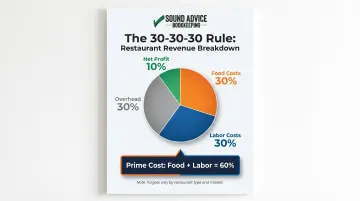
The 30-30-30 rule suggests restaurants target approximately:
- 30% of revenue for food costs
- 30% for labor costs
- 30% for overhead (rent, utilities, insurance, supplies)
- Leaving roughly 10% as net profit
This is a guideline, not gospel. Actual targets vary by restaurant type (fine dining vs. fast casual), market (Manhattan vs. rural Kansas), and concept. But it provides a useful framework for evaluating financial health.
Prime Cost: Your Most Critical Indicator
Prime Cost = Food Cost + Labor Cost
Modern benchmarks target a combined prime cost of 60-65%. Industry averages currently sit at 58-62%.
When prime cost runs high, focus on two levers:
- Standardize portions, track inventory in real time, renegotiate supplier contracts, and cut waste to bring food costs down
- Schedule with data, cross-train staff, tighten shift coverage, and watch overtime to reduce labor costs
Without accurate food cost tracking, labor cost logging, and expense categorization, you cannot know whether you're hitting these benchmarks. Weekly reconciliation — not monthly — is what catches prime cost drift before it compounds.
Restaurant Bookkeeping Best Practices for 2026
Build a Consistent Rhythm
Daily: Enter sales and expenses Weekly: Reconcile accounts, review P&L Monthly: Close books, review full financial statements Quarterly: Analyze trends, adjust pricing or costs
Consistency prevents small errors from compounding into costly discrepancies—and makes year-end tax prep far less painful. Sound Advice Bookkeeping takes a "thoughtfully optimized" approach: your books should give you real answers about what's working, not just a clean report for the tax man.
Choose the Right Accounting Method
Cash-Basis Accounting:
- Records income when received, expenses when paid
- Simpler, better for cash flow visibility
- Allowed for businesses with average annual gross receipts of $26 million or less
- Best for smaller restaurants
Accrual-Basis Accounting:
- Records income when earned, expenses when incurred
- More accurate financial picture
- Required under GAAP for publicly traded companies
- Better for larger operations, franchises, or restaurants seeking financing
Not sure which fits your situation? If you're an independent restaurant focused on day-to-day cash flow, cash-basis is usually the right starting point. If you're seeking financing or managing multiple locations, accrual gives lenders and investors the picture they need.
Leverage the Right Software Tools
Once your accounting method is set, the right software stack does the heavy lifting. Cloud-based platforms like QuickBooks, connected directly to your POS, automate daily sales entries and reduce manual reconciliation to minutes instead of hours.
What to prioritize:
- POS system integration with accounting software
- Automated bank feed connections
- Payroll system integration
- Inventory management compatibility
In 2024, 52% of operators planned to invest in back-office technology for payroll, finance, tax compliance, and inventory management. For high-transaction restaurants, that investment directly reduces data entry errors and frees up time for actual management decisions.
Sound Advice Bookkeeping brings 100+ years of combined QuickBooks expertise, helping restaurants set up systems that connect their POS, payroll, and accounting into a single, accurate picture of the business.
Should You DIY, Hire In-House, or Outsource Your Restaurant Bookkeeping?
Three Options Compared
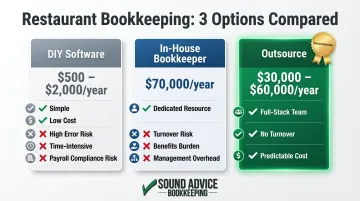
1. DIY Using Accounting Software
- Manageable for very small, simple operations
- Time-intensive and risky without financial expertise
- High error risk, especially with payroll compliance
2. Hire an In-House Bookkeeper
- Good for larger restaurants with consistent high transaction volume
- Adds payroll cost ($49,210 median wage) plus 29.9% benefits burden = approximately $70,000 annually
- Management overhead and turnover risk
3. Outsource to Professional Bookkeeping Service
- Most cost-effective for small-to-mid-sized independent restaurants
- Full-stack team (bookkeeper, staff accountant, controller) costs $30,000-$60,000 annually
- No turnover risk, benefits, or management overhead
Warning Signs You Need Professional Help
- Running the business from your checking account balance
- Not knowing true food or labor cost percentages
- Dreading tax season or scrambling at year-end
- Falling behind on reconciliation
- Making menu, pricing, or staffing decisions without financial data
- Paying vendors late or losing track of invoices
What to Look For in a Bookkeeping Partner
The right bookkeeping partner for a restaurant isn't just someone who can balance accounts — they need to understand how your operation actually works. Look for:
- Restaurant-specific experience: Daily transactions, tipped payroll, tip credit compliance, and high-volume vendor management require more than generalist bookkeeping knowledge.
- Expert-level QuickBooks skills: Most restaurants run on QuickBooks. Competent isn't enough — your partner should know the platform inside and out.
- Flat-fee pricing: Monthly flat fees give you predictable costs. Hourly billing creates uncertainty you don't need.
- A team that acts like your team: You want someone functioning as an extension of your business, not a data-entry vendor you hear from once a month.
Sound Advice Bookkeeping serves food service businesses (including Sage Catering) alongside restaurants, retail, and professional services clients across 30+ states. Their 3-phase process — cleanup and setup, a 3-month discovery period, then ongoing flat-fee support — determines your monthly rate based on actual transaction volume rather than guesswork. Flat-fee support starts at $170/month.
Frequently Asked Questions
What is the best accounting method for restaurants?
Smaller restaurants typically use cash-basis accounting for its simplicity and clear cash flow visibility. Larger operations often use accrual-basis accounting for a more accurate financial picture. Accrual is required under GAAP for publicly traded restaurant companies.
What is the best accounting software for bars and restaurants?
QuickBooks is widely used and highly flexible for small-to-mid-sized restaurants, offering strong POS integration options. Evaluate software based on POS integration capabilities, ease of reconciliation, inventory tracking features, and payroll compatibility with your specific operation.
Is bookkeeping for a restaurant hard?
Yes, restaurant bookkeeping is more complex than most industries due to daily transaction volume, tip reporting requirements, fluctuating food costs, and payroll complexity. With the right systems, consistent habits, or a professional partner experienced in food service, it becomes very manageable.
What is the 30-30-30 rule for restaurants?
The 30-30-30 rule targets approximately 30% food costs, 30% labor costs, and 30% overhead, leaving roughly 10% net profit. Actual targets vary by restaurant type and market, so treat it as a starting benchmark rather than a fixed rule.
What are the 5 basic principles of bookkeeping?
The five core principles are:
- Accuracy — record every transaction correctly
- Consistency — use the same methods period to period
- Completeness — record all transactions without gaps
- Timeliness — record transactions when they occur
- Documentation — maintain supporting records for every entry
How much should I pay my bookkeeper per hour?
Bookkeeper hourly rates vary by region, experience, and scope — the national median is $23.66/hour ($49,210 annually). Many restaurants find flat monthly packages from outsourced bookkeeping services more predictable and cost-effective than hourly billing or in-house hiring, with pricing typically based on transaction volume.