
Introduction
According to the IRS Taxpayer Advocate Service, small businesses spend roughly 82 hours and $2,900 annually on federal tax compliance. For founders already stretched thin, that's a painful baseline — before you even factor in professional prep fees, which range from $500 to $8,000+ depending on complexity.
Two startups with similar revenue can receive wildly different quotes. The real cost drivers aren't just entity type or transaction volume. They're the quality of your bookkeeping, whether you operate in multiple states, and how tax-ready your records are when you hand them to a preparer.
This guide breaks down real pricing ranges by entity type and startup stage, the key factors that drive costs up or down, what's actually included in a tax prep bill, and how to reduce what you pay without cutting corners.
Key Takeaways
- Startup tax prep costs range from $500 for simple sole proprietors to $5,000+ for multi-state C-Corps
- Your entity type, bookkeeping quality, and transaction volume determine your bill more than revenue alone
- Keeping clean, reconciled books is the single most effective way to reduce CPA fees at tax time
- Pre-revenue startups still must file returns, and missing deadlines triggers severe per-shareholder penalties
How Much Does Startup Tax Preparation Cost?
There is no single fixed price for startup tax preparation. Costs vary based on your entity type, business complexity, and how tax-ready your books are when you hand them over to a preparer. A simple sole proprietor might pay $500, while a Delaware C-Corp with multi-state operations can easily exceed $5,000.
What goes wrong when founders underestimate cost:
- Sticker shock at filing time when the CPA invoice arrives 3X higher than expected
- Underbudgeting for the service in annual operating expenses, leaving no room for compliance
- Disorganized records trigger cleanup fees before preparation even begins — adding significant costs
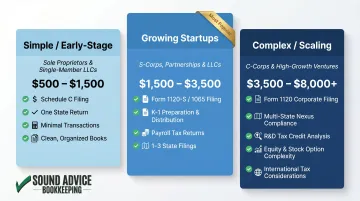
Here's how costs break down across three tiers, based on where your startup currently stands.
Simple / Early-Stage Startups: $500–$1,500
According to the National Society of Accountants, Schedule C (sole proprietor) preparation averages $221 nationally, though most sole proprietors pay closer to $500 when combined with a basic Form 1040 and one state return.
What's typically included:
- Federal tax return (Schedule C or single-member LLC treated as a disregarded entity)
- One state filing
- Minimal transaction review for straightforward income and expenses
- Clean bookkeeping records already in place (no cleanup required)
Best for: Pre-revenue startups, freelancers, or single-founder LLCs in one state with no employees and simple income streams.
Growing Startups: $1,500–$3,500
Form 1120-S (S-Corp) preparation averages $970, while partnerships (Form 1065) average $815. However, these baseline fees rarely tell the full story.
What's typically included:
- S-Corp (Form 1120-S) or multi-member LLC/partnership filing
- K-1 preparation for partners or shareholders
- Payroll return coordination (Forms 940/941)
- One to three state filings
Best for: Funded startups with multiple owners, a small payroll, or a formal corporate structure that's outgrown a basic LLC filing.
Complex or Scaling Startups: $3,500–$8,000+
C-Corp (Form 1120) preparation averages $1,004, but this baseline rarely applies to VC-backed startups with equity complexity and multi-state operations.
What's typically included:
- C-Corp (Form 1120) filing
- Multi-state nexus filings (corporate income/franchise taxes)
- International transaction reporting
- R&D tax credit documentation
- High contractor volume (1099-NEC preparation)
- Equity or cap table complexity
Best for: VC-backed startups and Delaware C-Corps with remote employees across multiple states, complex equity structures, or significant assets.
Key Factors That Affect Your Startup's Tax Prep Costs
Two startups with similar revenue can receive wildly different tax prep quotes. Pricing is driven by operational, structural, and organizational factors — not just total revenue.
Entity Type and Business Structure
Your entity type sets the baseline complexity and cost. A sole proprietor filing Schedule C requires far less preparation work than an S-Corp requiring Form 1120-S plus K-1s for multiple shareholders and payroll tax returns. C-Corps face additional complexity from double taxation rules, more rigorous reporting requirements, and specialized compliance.
Many startups incorporate as Delaware C-Corps to attract investors. That structure adds Delaware franchise tax filings (minimum $400 annually, due March 1st) on top of federal and home-state returns — a real cost that catches founders off guard.
Bookkeeping Quality and Record Organization
CPAs price based on how much cleanup they expect before preparation can even begin. According to the NSA, 78% of tax preparers charge additional fees for disorganized or incomplete files, averaging a $165 surcharge.
Cost impact:
- Reconciled, categorized monthly books: Baseline pricing
- Shoebox records or catch-up bookkeeping needs: Bill can multiply by 2X–3X
- Late document submission (within 16 days of deadline): Additional $117 average expediting fee
Multi-State Operations and Remote Teams
Each state where a startup has employees, customers above a sales threshold, or physical presence may trigger a separate state tax filing requirement — each adding $300–$1,000+ to the bill.
A single remote employee creates physical presence nexus for corporate income tax purposes in most states. Startups with remote teams across multiple states face payroll compliance complexity across different jurisdictions, which adds to both bookkeeping and tax prep workload.
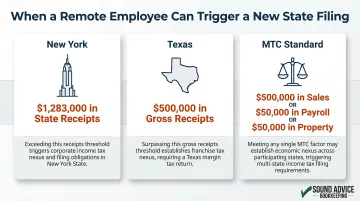
Economic nexus thresholds vary dramatically:
- New York: $1,283,000 in state receipts
- Texas: $500,000 in gross receipts
- Multistate Tax Commission standard: $500,000 sales, $50,000 payroll, or $50,000 property
Transaction Volume and Revenue Complexity
Higher transaction volume — from SaaS subscriptions, marketplace sales, or high contractor usage — means more data for a CPA to review and reconcile, which increases time-based fees.
Startup-specific complexity that typical small businesses don't face:
- R&D tax credit documentation (Section 41)
- Stock option exercises and equity grants
- SAFE note conversions
- Cap table changes during the year
- Multi-currency transactions
Each item above extends the time your CPA spends on your return — and that time shows up directly in the final invoice.
Billing Structure: Hourly vs. Flat Fee
CPAs typically use two primary billing models:
Hourly billing averages $174–$180/hour nationally, ranging up to $400/hour at larger or specialized firms. The risk: costs can climb unpredictably if your records need cleanup or scope expands mid-engagement.
Flat/fixed fees are tied to return scope and give you budget certainty upfront. 30% of CPA firms now use value-based billing, moving away from hourly models entirely. Whichever structure you choose, get a written fee agreement that spells out what's included, what triggers extra charges, and how scope changes are handled.
What's Included in Your Startup Tax Prep Bill
A base tax prep quote typically covers the federal return for your entity type and one state filing: but many line items founders assume are included will actually trigger separate fees. Knowing what's in and out of that base quote is the fastest way to avoid a surprise invoice.
Core Services Usually Included in Base Fees
Standard tax prep packages typically cover:
- Federal income tax return preparation (Form 1040 Schedule C, 1120, 1120-S, or 1065 depending on entity)
- K-1 preparation for partnerships and S-corps
- One state return filing
- Transaction review and data entry — assuming your records are organized before handoff
Common Add-Ons That Cost Extra
Before signing any engagement letter, ask your CPA which of these apply to your situation — each carries its own fee:
- Additional state returns ($300–$1,000 per state)
- Payroll tax filings (Forms 940/941)
- 1099-NEC preparation for contractors ($5–$15 per form)
- Amended returns ($200–$800 depending on complexity)
- Delaware franchise tax filing ($200–$400)
- Sales tax return preparation
- R&D tax credit studies ($2,000–$10,000+)
- Audit representation
- Multi-year catch-up bookkeeping
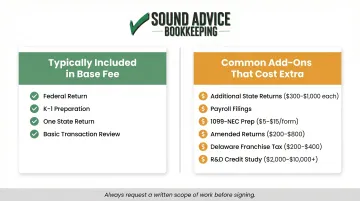
If several of these apply to your startup, your total can climb well past the base quote. Getting a written scope of work before the engagement starts is the simplest way to know what you're actually paying for.
How to Lower Your Startup's Tax Preparation Costs
The biggest lever founders have for controlling tax prep costs is what happens throughout the year — not just in March or April. Staying organized year-round costs far less than scrambling to fix it in filing season.
Keep Your Books Clean and Current Year-Round
Monthly, reconciled books handed to a CPA in good order eliminate the cleanup phase that inflates tax prep bills. CPAs spend the least time — and charge the least — when income and expenses are already categorized and bank accounts are reconciled.
Working with a dedicated bookkeeping service like Sound Advice Bookkeeping addresses this directly. Their ongoing monthly bookkeeping keeps your records organized and tax-ready before filing season starts, cutting the hours — and fees — your CPA needs to invest.
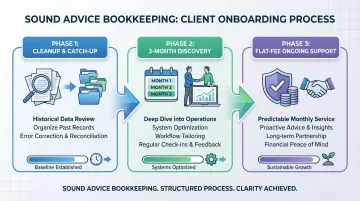
Monthly packages start at $170/month, priced by transaction volume rather than billable hours, and include reconciliation, expense coding, sales tax payments, and tax preparation support. Their structured onboarding moves books from disorganized to tax-ready in three phases:
- Phase 1: Clean up or catch up past bookkeeping
- Phase 2: A 3-month discovery period to assess your ongoing needs
- Phase 3: Predictable flat-fee ongoing support
Get Quotes from Multiple Preparers and Know What You're Comparing
Tax prep pricing varies widely even in the same market. Getting 2–3 quotes allows founders to benchmark and spot outliers. Price alone isn't the metric to optimize for.
When comparing quotes, understand:
- Whether state filings are included or priced separately
- What triggers additional fees (amendments, multi-state filings, 1099s)
- Whether the preparer has startup-specific experience (R&D credits, equity events, SAFE notes)
- Billing structure (hourly vs. flat fee) and how scope changes are handled
A $1,200 quote that includes two state returns and payroll filing coordination often is a better value than a $900 quote that excludes everything beyond the federal return.
File On Time and Avoid Amendments
Extensions and amended returns add to your tax prep cost — CPAs charge for the additional work. Staying organized throughout the year and responding promptly to CPA requests reduces the chance of errors that trigger costly amendments.
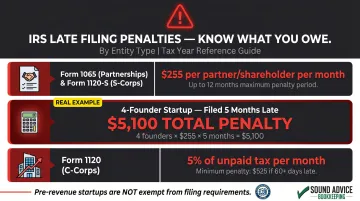
Late filing penalties are severe, even for zero-revenue startups:
- Form 1065 (partnerships) and Form 1120-S (S-Corps): $255 per partner/shareholder per month, up to 12 months
- A 4-founder pre-revenue startup that files 5 months late faces a $5,100 penalty
- Form 1120 (C-Corps): 5% of unpaid tax per month, minimum $525 if more than 60 days late
What Most Founders Miss When Budgeting for Tax Prep
Most startup founders budget for tax prep based on last year's bill — and get caught off guard by costs they never saw coming. These four blind spots account for the majority of budget surprises.
Multi-state compliance adds up fast. Hiring a remote employee in a new state mid-year triggers a new state tax filing obligation — and the $300–$1,000+ per-state cost that comes with it. Build that into your hiring budget, not your April panic.
R&D credits go unclaimed without year-round tracking. Startups can apply up to $500,000 in R&D tax credits against payroll taxes, even pre-revenue, under the Inflation Reduction Act. But capturing them means documenting qualifying expenses throughout the year. Founders who wait until filing typically recover nothing.
CPA fees aren't static. 61% of CPA firms raise fees annually, and billing rates climbed 10.8% year-over-year heading into the 2026 busy season. Assume your bill will increase — and plan for it.
Tax prep costs reflect how you managed the year. Founders who treat bookkeeping and tax prep as separate, once-a-year tasks consistently pay more for both. Disorganized records mean more billable hours for your CPA. Staying organized throughout the year is often the highest-ROI move you can make at tax time.
Conclusion
Startup tax preparation costs vary significantly — from a few hundred dollars for a simple early-stage return to several thousand for complex C-Corps with multi-state operations. The biggest driver of cost is rarely the size of the company; it's the quality of its financial records and the complexity of its structure.
A reasonable tax prep cost reflects your startup's actual compliance needs and comes from a preparer who understands startup-specific issues: R&D credits, equity events, and cap table complexity. Organized books are the foundation of that. Investing in year-round financial organization is the most reliable way to keep costs manageable as your company grows.
Sound Advice Bookkeeping's monthly packages start at $170/month and include reconciliation, expense coding, and tax preparation support — so your books stay clean all year, not just at filing time.
Schedule a consultation: call 303.228.8911 or email info@soundadvicebookkeeping.com.
Frequently Asked Questions
What is a reasonable price for tax preparation?
Reasonable tax prep fees for startups range from $500 to $5,000+ depending on entity type, state complexity, and bookkeeping quality. Any quote within market benchmarks for your entity type (for example, $1,500–$3,500 for an S-Corp) should be evaluated on scope and what's included, not price alone.
What is the tax loophole for startups?
The most significant startup-specific tax advantage is the R&D tax credit, which pre-revenue startups can apply against payroll taxes (up to $500,000/year under the Inflation Reduction Act). It's a legitimate credit designed to encourage innovation — and capturing it requires clean expense tracking throughout the year, not just at filing time.
Do startups need to file taxes if they have no revenue?
Yes, most business entities — including corporations and partnerships — are required to file a federal tax return regardless of whether they generated revenue. Failing to file can result in penalties even for inactive or pre-revenue startups, with late fees of $255 per shareholder/partner per month.
How much does a CPA charge per hour for startup taxes?
CPA hourly rates for startup tax work typically range from $150 to $400 per hour depending on the firm's size, specialization, and geographic location. Many firms offer flat-fee arrangements for standard returns, which provides more budget certainty for founders.
What is the cheapest way to file taxes for a startup?
DIY tax software can work for very simple sole proprietors under $50,000 in revenue, but most startups with employees, multiple owners, or investor funding benefit from professional preparation. Either way, maintaining clean, organized books throughout the year — not just at tax time — is the single most effective way to keep professional fees in check.
How does poor bookkeeping affect tax preparation costs?
Disorganized records force CPAs to spend billable hours sorting and reconciling transactions before they can even begin preparing the return. 78% of preparers charge a surcharge for incomplete or disorganized paperwork, which can increase the total bill by $165 or more on average.