Introduction
The IRS closed over 505,000 tax return audits in FY 2024 — and most of those businesses weren't expecting the scrutiny. Between tracking down receipts, decoding forms, and hitting deadlines, tax season can feel like a second full-time job.
Most of that stress is preventable. A clear, step-by-step checklist turns tax season from panic mode into a predictable process.
This guide covers the documents to gather, deductions to claim, deadlines to meet, and the most common — and costly — mistakes to avoid.
TL;DR
- Your business structure determines which forms you file and when—sole proprietors file Schedule C by April 15; partnerships and S-Corps file by March 17
- Gather income records, expense receipts, payroll documents, and asset records at least 60 days before filing
- Most small businesses miss legitimate deductions—home office, self-employed health insurance, and retirement contributions are frequently overlooked
- Clean, reconciled books prevent errors and audit flags; disorganized records are the #1 cause of filing problems
- Filing extensions grant more time to file, not to pay: taxes owed are still due by the original deadline
Know Your Business Structure and Tax Obligations
Your business structure dictates which IRS forms apply, what tax rates are used, and when returns are due. Getting this wrong creates filing errors — triggering penalties and interest.
Five Tax Types Small Businesses May Face
Not every business owes all five, but understanding which apply to you is critical:
- Federal and state income tax — Tax on business profits
- Estimated quarterly taxes — Required if you expect to owe $1,000+ ($500+ for C-Corps)
- Self-employment tax — Social Security and Medicare for self-employed individuals
- Employment/payroll taxes — Required if you have employees
- Excise or sales tax — Industry-specific or transaction-based taxes
Which IRS Forms Apply to Your Business?
Entity structure determines your filing form:
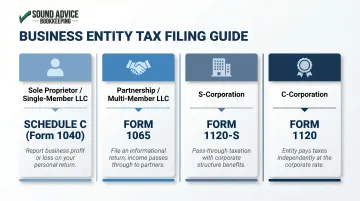
- Sole proprietors and single-member LLCs: Schedule C (Form 1040)
- Partnerships and multi-member LLCs: Form 1065
- S-Corporations: Form 1120-S
- C-Corporations: Form 1120
Pass-Through vs. Entity-Level Taxation
Pass-through entities (sole proprietorships, partnerships, S-Corps) don't pay federal income tax at the business level. Instead, profits and losses pass through to the owners' personal returns. C-Corporations pay tax at the corporate level, then shareholders pay tax again on dividends — the so-called "double taxation."
If you're unsure which category your business falls into, confirm with your CPA before calculating estimated quarterly payments.
Your Small Business Tax Preparation Checklist: Documents to Gather
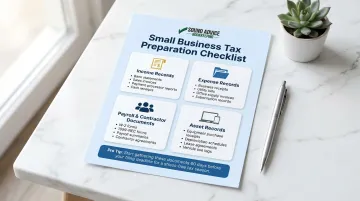
Document gathering is the most time-consuming part of tax prep. Start at least 60 days before your filing deadline to prevent last-minute scrambling. Missing documents are the most common reason small businesses file late or incorrectly.
Income Records
Gather these income documents for the full tax year:
- Total gross revenue from accounting software or bank deposits
- 1099-NEC forms from clients who paid $600 or more for services
- 1099-K forms from payment processors (Stripe, PayPal, Square)—note that for tax years 2024 and 2025, the threshold is $20,000 and 200 transactions
- Any 1099-MISC for royalties or other income
Critical reminder: You must report all income, even if you never received a 1099. The IRS requires reporting of all gig economy or sharing economy earnings regardless of whether forms were issued.
Once income records are sorted, turn your attention to expenses—where the largest deductions often hide.
Expense and Asset Records
Organize expense documentation by category:
- 12 months of business bank and credit card statements
- Receipts organized by category (rent, utilities, insurance, advertising, professional services, meals, software, travel)
- Mileage logs with dates, destinations, and business purpose
- Prior year depreciation schedules
The IRS requires receipts for expenses over $75, but best practice is keeping all receipts. Working with a bookkeeping service that categorizes expenses throughout the year—like the ongoing support Sound Advice Bookkeeping provides—eliminates most of this year-end scramble.
Asset records needed:
- Track equipment, computers, furniture, or vehicles purchased or sold during the year
- Record the purchase date, cost, sale date, and sale price for each asset
- Document significant equipment purchases that may qualify for Section 179 expensing (up to $1,220,000 for 2024) or bonus depreciation (60% for 2024)
Payroll and Contractor Documents
For businesses with employees:
- W-2s issued to all employees
- Quarterly payroll tax returns (Form 941)
- State unemployment filings
- Records of employee benefits provided
For businesses using contractors:
- Issue 1099-NEC forms to any individual or unincorporated business paid $600 or more for services
- Collect current W-9 forms from each contractor before payment
- Note that payments to corporations generally don't require 1099-NEC (with exceptions like legal services)
Sound Advice Bookkeeping offers a dedicated 1099 filing service that handles end-of-year contractor reporting, so your team isn't buried in end-of-year paperwork.
Small Business Tax Deductions and Credits Checklist
Deductions reduce your taxable income, while credits directly reduce the tax you owe dollar-for-dollar. Both are legal tax-reduction strategies — and most small businesses leave money on the table by missing them.
Common Small Business Deductions
Track these throughout the year so nothing slips through at filing time:
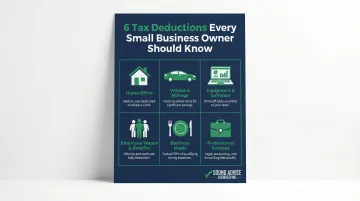
- Home office: Deduct the portion of your home used exclusively for business (square footage method or simplified $5/sq ft)
- Vehicle and mileage: Business-use miles at the IRS standard rate (67 cents/mile in 2024) or actual vehicle expenses
- Equipment and software: Section 179 allows full first-year expensing on qualifying purchases
- Employee wages and benefits: Salaries, health insurance premiums, and retirement contributions are generally fully deductible
- Business meals: 50% deductible when directly related to business activity
- Professional services: Fees paid to bookkeepers, accountants, attorneys, and consultants
Tax Credits Worth Knowing
Credits are more valuable than deductions — a $1,000 credit cuts your tax bill by $1,000 outright:
- Small Business Health Care Tax Credit: Up to 50% of premiums paid if you have fewer than 25 full-time employees
- Work Opportunity Tax Credit (WOTC): For hiring employees from targeted groups (veterans, long-term unemployed)
- Disabled Access Credit: Up to $5,000 for making your business accessible under the ADA
- R&D Tax Credit: Available to businesses developing new products, processes, or software — often overlooked by small firms
Keeping clean, categorized records year-round is what makes these deductions and credits claimable. If your books aren't organized by the time your tax professional asks, you risk missing legitimate write-offs entirely.