Introduction
If you're running your small business from your checking account, losing receipts in the glove box, or dreading tax season, you're not alone. Disorganized expenses are one of the most common and costly financial mistakes small businesses make. According to QuickBooks research, 45% of small businesses struggle with cash flow problems, and 46% say poor financial or resource management is holding them back.
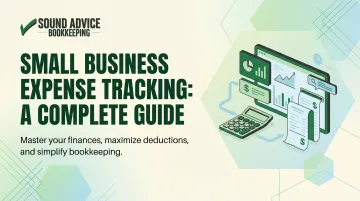
The good news: fixing your expense tracking fixes most of those problems. This guide walks through what qualifies as a business expense, how to categorize and track spending, which expenses are deductible, and how to stop the chaos that leads to missed deductions and cash flow surprises.
TLDR:
- Proper expense tracking impacts tax deductions, cash flow visibility, and business decisions
- The IRS requires substantiation for all deductions — missing documentation can trigger disallowance in an audit
- Separate business accounts, consistent categorization, and monthly reconciliation are non-negotiable
- Accounting software reduces errors, but professional oversight catches what software misses
- Most small businesses miss valuable deductions like home office, mileage, and retirement contributions
Why Small Businesses Must Track Expenses
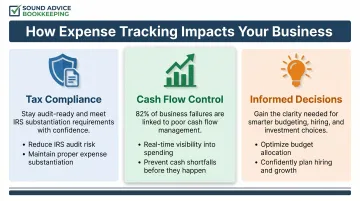
Expense tracking directly impacts three critical areas of your business:
- Tax compliance: The IRS Data Book for 2024 shows 77.9% of audits are now conducted by mail, generating over $6.0 billion in additional recommended tax. Schedule C filers who can't substantiate expenses lose legitimate deductions — with no chance to explain records in person.
- Cash flow control: You can't manage what you don't measure. Knowing where money goes in real time — not three months later — lets you catch problems before they become crises. Research shows 82% of small business failures stem from poor cash flow management.
- Informed decisions: Tracking expenses lets you budget accurately, evaluate whether you can afford to hire, and invest with confidence. Without organized data, every business decision is built on guesswork.
The IRS requires businesses to maintain records that substantiate expense deductions, as outlined in Publication 583 (Starting a Business and Keeping Records) and Publication 463 (Travel, Gift, and Car Expenses). Without proper documentation, legitimate deductions can be disallowed — and there's no opportunity to explain yourself after the fact.
Common Small Business Expense Categories
To be deductible, the IRS requires expenses to be both "ordinary" and "necessary" under IRC § 162. An ordinary expense is common and accepted in your industry. A necessary expense is helpful and appropriate for your business operations—it doesn't have to be indispensable. Personal expenses mixed in are a red flag for audits.
Everyday Operating Expenses
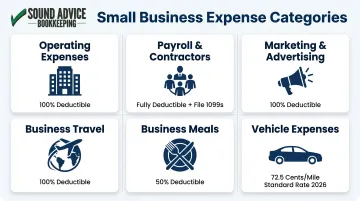
Most small businesses share the same core operating costs. These are typically 100% deductible when used primarily for business:
- Rent or home office costs — deductible when the space is used exclusively and regularly for business
- Utilities (phone, internet, electricity, water) for your business premises
- Office supplies such as paper, printer ink, and similar consumables
- Software subscriptions — accounting tools, CRMs, project management platforms, and similar services
Payroll, Contractors, and Professional Services
Track employment and contractor costs separately from general operating expenses — they're fully deductible and carry their own reporting requirements:
- Employee wages, including salaries, bonuses, and benefits
- Freelancer and contractor payments, reported via 1099-NEC forms at year-end
- Professional fees for legal services, bookkeeping, and business consulting
Marketing, Travel, and Other Key Categories
Beyond operations and payroll, several other categories add up quickly and deserve their own tracking:
- Marketing and advertising — online ads, website hosting, SEO services, print materials, and promotional costs
- Business travel — flights, hotels, car rentals, and parking for business trips (keep personal travel clearly separated)
- Business meals — generally 50% deductible (the temporary 100% restaurant meal deduction expired January 1, 2023)
- Vehicle expenses — the 2026 standard mileage rate is 72.5 cents per mile, up 2.5 cents from 2025
- Education and training — courses, conferences, and professional development directly related to your business
- Business insurance — liability, property, and professional liability policies
A few additional notes worth keeping in mind:
- For product-based businesses, Cost of Goods Sold (COGS) is calculated separately on Schedule C Part III
- Use a miscellaneous category sparingly — if an expense type recurs, it needs its own dedicated category
How to Track Small Business Expenses: A Step-by-Step System
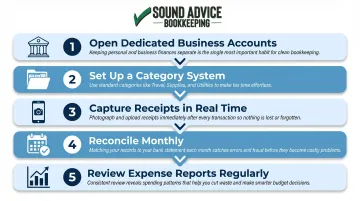
Step 1: Open a dedicated business bank account and business credit card immediately
Commingling personal and business funds is the single biggest bookkeeping mistake small businesses make. While 97% of small business owners report having a separate business bank account, 70% admit to using a personal credit card for business expenses. This contradiction creates chaos at tax time.
Separation simplifies tracking, protects personal assets from business liabilities, and makes tax preparation significantly easier. Open both accounts before you process another transaction.
Step 2: Set up a consistent category system from the start
Use the same expense categories across the entire year, aligned with your tax form (Schedule C for sole proprietors and single-member LLCs, Form 1065 for partnerships, Form 1120-S for S-Corps). This prevents reclassification headaches at year-end and generates meaningful data for budgeting throughout the year.
Step 3: Capture receipts and documentation in real time
Digital tools are far more reliable than saving paper receipts. Apps that photograph receipts, cloud storage systems, or accounting software integrations allow you to capture documentation the moment expenses occur. The IRS accepts electronic records under Revenue Procedure 98-25, provided they contain sufficient information to verify entries.
For each expense, do three things before you move on:
- Photograph the receipt immediately after purchase
- Categorize the expense in your accounting software
- Store it digitally — paper receipts fade, get lost, and create clutter
Step 4: Reconcile accounts monthly
Reconciliation means comparing your recorded transactions to bank and credit card statements to ensure they match. This monthly habit catches errors, fraud, and duplicate charges early—before they compound into overwhelming backlogs at year-end.
Set a recurring calendar reminder on the same day each month (ideally within the first week after month-end) and reconcile every account. This 30-60 minute process prevents hours of cleanup later.
Step 5: Review expense reports and generate financial summaries regularly
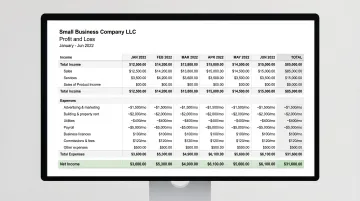
Monthly or quarterly expense reviews allow you to compare actual spending against budget, identify cost-cutting opportunities, and make informed decisions about growth investments. Generate a profit and loss statement monthly and review trends with these questions in mind:
- Are any categories running significantly over budget?
- Are there unexpected spending spikes this period?
- Where can you reduce waste without affecting operations?
A bookkeeper like Sound Advice Bookkeeping can set up this review process in QuickBooks from day one — so your category system, reconciliation, and monthly reporting all stay accurate without you having to manage it alone.
Manual Tracking vs. Expense Management Software
Manual tracking using spreadsheets makes sense only for sole proprietors with very low transaction volume—typically fewer than 20 transactions per month. Beyond that threshold, manual methods break down quickly due to:
- Time consumption: Small businesses spend up to 25 hours a week on manual data entry and reconciliation
- Human error: Typos, transposed numbers, and miscategorizations accumulate
- No real-time visibility: Spreadsheets require manual updates, meaning your data is always outdated
- Difficulty scaling: As transaction volume grows, manual tracking becomes unmanageable
When choosing expense tracking software, look for:
- Automatic transaction downloads from bank and credit card accounts (eliminates manual entry)
- AI-powered categorization that learns from your spending patterns over time
- Mobile receipt capture that attaches photos directly to transactions
- Integration with QuickBooks or your bookkeeper's preferred accounting platform
- One-click reports for profit and loss, expense summaries, and tax prep
QuickBooks holds 62.23% of the U.S. market share with $8 billion in online revenue (2023), making it the default choice for most small to mid-sized businesses—and the platform most bookkeepers already know. That said, the right tool still depends on your transaction volume and how you work. Xero handles multi-currency needs well, Wave is free for micro-businesses, and FreshBooks suits service-based businesses with premium invoicing needs.
Software handles the data—a bookkeeper handles the judgment calls. Automated categorization can misfile a business meal as a travel expense or miss a deductible that doesn't fit neatly into a dropdown. Regular human review is what catches those gaps before they affect your taxes.
Expense Tracking and Tax Deductions: What You Need to Know
Which Expenses Are 100% Deductible vs. Limited
100% deductible expenses include ordinary and necessary operating costs:
- Operating expenses (rent, utilities, office supplies)
- Business insurance premiums
- Professional fees (legal, accounting, consulting)
- Advertising and marketing
- Employee wages and contractor payments
- Software subscriptions
Expenses with limitations:
- Meals: 50% deductible (the temporary 100% deduction for restaurant meals expired December 31, 2022)
- Home office: Must be used "exclusively and regularly" for business
- Vehicle expenses: Choose between standard mileage rate (70 cents/mile in 2025, with the 2026 rate to be announced by the IRS) or actual expenses method
What Expenses Can an LLC Write Off?
LLCs taxed as sole proprietorships, partnerships, or S-corps each have slightly different treatment, but generally the same categories apply:
- Operating costs
- Payroll and contractor payments
- Marketing and advertising
- Business travel
- Professional services
- Startup costs (up to $5,000 in the first year)
An LLC's tax classification drastically alters expense reporting. A default single-member LLC deducts expenses on Schedule C. Electing S-Corp status via Form 2553 changes how owner compensation and greater-than-2% shareholder health insurance premiums are deducted.
The $75 Receipt Rule
The IRS does not require a formal receipt for business expenses under $75 (except lodging), per Publication 463. However, a written record of the amount, date, place, and business purpose is still required for deductibility. This doesn't mean skipping documentation—it means formal receipts aren't mandatory below that threshold.
Most Overlooked Tax Deductions for Small Businesses
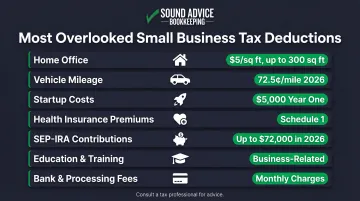
Tax professionals commonly cite these missed deductions:
- Home office deduction – Using the simplified $5/sq ft method up to 300 square feet
- Vehicle mileage and parking fees – Most business owners undertrack mileage
- Startup costs – Up to $5,000 deductible in year one (amounts over $50,000 reduce this limit)
- Self-employed health insurance premiums – Claimed on Schedule 1 (Form 1040), line 17
- Retirement plan contributions – SEP-IRA contributions up to $72,000 in 2026 (up from $70,000 in 2025)
- Education and professional training – Courses and conferences that improve business skills
- Bank fees and processing fees – Monthly account fees and credit card processing charges
Claiming these deductions requires documentation — which is exactly where IRS record-keeping rules come in.
IRS Record-Keeping Requirements
How long should you keep expense records?
| Scenario | Retention Requirement |
|---|---|
| Standard tax returns | 3 years from filing date |
| Income underreported by >25% | 6 years |
| Fraudulent return or no return filed | Indefinitely |
| Employment tax records | 4 years after tax is due/paid |
While the standard audit window is 3 years, businesses should maintain records for at least 6 years if there's any risk of substantial income omission. Clean, organized books make an audit far less stressful.
Frequently Asked Questions
How do I keep track of my small business expenses?
Open a dedicated business bank account and credit card immediately. Use accounting software like QuickBooks or maintain a consistent spreadsheet. Capture receipts digitally in real time using mobile apps or cloud storage. Reconcile all accounts monthly to catch errors early and maintain accuracy.
What is the best small business expense tracker?
The best tool depends on your business size, transaction volume, and complexity. QuickBooks dominates the U.S. market and connects easily with most bookkeepers; FreshBooks suits service businesses; Wave offers free core features for solopreneurs. Any software works best when paired with consistent habits and professional bookkeeper oversight.
What business expenses are 100% tax-deductible?
Operating costs (rent, utilities, office supplies), professional fees (legal, accounting), advertising and marketing, business insurance, employee wages, and contractor payments are fully deductible. Meals are only 50% deductible, and home office and vehicle expenses have specific documentation requirements.
What expenses can an LLC write off?
LLCs can generally write off the same ordinary and necessary business expenses as other structures: operating costs, payroll, marketing, travel, professional services, and startup costs. Tax treatment depends on how the LLC is classified—sole proprietorship (Schedule C), partnership (Form 1065), or S-corporation (Form 1120-S).
What is the most overlooked tax break for small businesses?
The home office deduction, self-employed health insurance premiums, vehicle mileage, and retirement plan contributions are commonly missed. So are startup costs (up to $5,000 deductible in year one), professional development, and bank and processing fees. A bookkeeper or tax professional can make sure you're not leaving money on the table.
What is the $75 rule for receipts?
The IRS does not require a formal receipt for business expenses under $75 (except lodging). You must still maintain a written record of the amount, date, business purpose, and location for the expense to be deductible.
Ready to stop running your business from your checking account? Sound Advice Bookkeeping helps small businesses across the U.S. build expense tracking systems that work—from initial cleanup to ongoing monthly support. With over 1,000 clients served since 2007 and 100+ years of combined QuickBooks expertise, we ensure your books are accurate, your deductions are maximized, and your financial data supports confident business decisions. Contact us at 303.228.8911 or schedule a consultation at calendly.com/soundadvicebk.