Outsourcing accounts receivable is no longer exclusively an enterprise strategy. Small and mid-sized manufacturers are increasingly delegating invoicing, collections, and payment tracking to specialized external teams and seeing measurable improvements in cash flow and operational focus. The shift addresses a fundamental challenge: in-house teams rarely have the bandwidth, systematic processes, or specialized expertise to manage AR with the speed and precision that manufacturing operations demand.
This guide covers what AR outsourcing is, why manufacturing AR is uniquely complex compared to other industries, the tangible benefits of delegating AR functions, how to transition without disrupting existing operations, and how to choose the right partner equipped to handle manufacturing-specific billing requirements.
Key Takeaways
- Specialized AR teams handle invoicing, collections, and payment tracking while internal staff focus on production and growth
- Manufacturing AR is uniquely complex — custom pricing, milestone billing, Net-60/Net-90 terms, and multi-channel distribution all compound collection challenges
- 43% of B2B sales are currently overdue, and top performers collect 18 days faster than median companies
- Phased transitions maintain continuity while establishing systematic AR processes aligned with production cycles
- The right outsourcing partner brings manufacturing-specific experience, ERP integration, and clear reporting — not just generic AR support
What Is Accounts Receivable Outsourcing for Manufacturing?
Accounts receivable outsourcing is the practice of hiring an external team or firm to handle invoicing, payment collection, follow-up, and reconciliation processes that would otherwise be managed by internal staff. The arrangement delegates time-consuming financial operations to specialists who manage AR as their core function, not as one task among many.
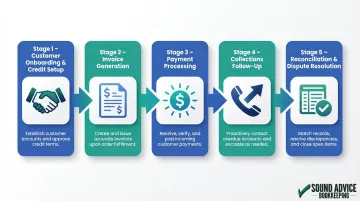
The core AR process in manufacturing involves specific steps that differ from simpler business models:
- Customer onboarding and credit terms setup based on order volume and payment history
- Invoice generation tied to shipments, production milestones, or contract deliverables
- Payment processing and application to correct accounts and line items
- Collections follow-up for overdue accounts using systematic escalation protocols
- Payment reconciliation against the general ledger and resolution of partial payments or disputed line items
Outsourcing partners take over some or all of these steps, depending on the manufacturer's internal capabilities and resource constraints. Reputable providers operate under contractual obligations, maintain data security standards, and provide transparent reporting that keeps manufacturers fully informed on payment status and account health.
Small and mid-sized manufacturers in particular have adopted this approach to compete without building out large internal finance teams. It's a practical, well-supported strategy — backed by formal service agreements and standard data security practices.
Why Manufacturing AR Is More Complex Than Most Business Owners Realize
Manufacturing companies face AR challenges that simply don't exist in service businesses or simpler B2B operations. High invoice volumes, complex pricing structures, volume discounts, and contract terms that vary by product line or distribution agreement make in-house management burdensome for small teams.
A single customer might have multiple pricing tiers, regional billing addresses, and varying payment terms depending on order type—complexity that scales fast as the customer base grows.
Extended payment terms create persistent cash flow gaps
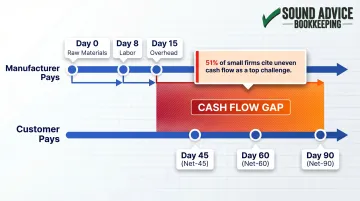
Average payment terms in B2B manufacturing stand at 45 days, with buyers frequently negotiating Net-60 or even Net-90 terms while manufacturers face immediate raw material, labor, and overhead costs. This timing mismatch is one of the core reasons manufacturers struggle with liquidity even when sales are strong. According to the Federal Reserve's 2025 Small Business Credit Survey, 51% of small firms cite uneven cash flow as a top financial challenge—a direct consequence of the gap between when manufacturers must pay suppliers and when customers actually remit payment.
Multi-location and multi-product billing compounds the problem. Manufacturers selling through distribution channels, dealer networks, and direct accounts must track different invoicing requirements for each relationship. One partner might require electronic invoicing with specific data fields; another demands PDF invoices routed to multiple approval contacts. Research shows that invoice disputes cause 23% of late payments, meaning errors cost manufacturers time they should be spending on collections.
Seasonal production spikes stretch small AR teams beyond capacity. During high-output periods, invoice volumes and collections calls routinely exceed what internal staff can manage, leading to delayed follow-ups, aging receivables, and cash shortfalls. The NACM Credit Managers' Index for April 2025 reported that accounts placed for collection had been in contraction for 32 consecutive months—collection volumes rising month after month while internal teams struggled to keep pace.
Regulatory compliance is where many manufacturers quietly lose money. Federal contracts fall under FAR Subpart 32.9 requirements, which mandate specific "proper invoice" contents—and missing even one required data point resets the entire payment clock. Common omissions include:
- Contract line item number
- EFT banking information
- Contractor's Tax ID or DUNS number
International transactions carry their own standards, including PEPPOL BIS Billing 3.0 and UBL formats. Specialized AR partners handle these requirements systematically; most internal bookkeepers lack the training to catch every required field before an invoice goes out.
Key Benefits of Outsourcing AR Services for Manufacturing Companies
Faster collections improve cash flow predictability
Outsourced AR teams focus exclusively on timely invoicing and systematic follow-up, reducing the average time between invoice issuance and payment receipt. The Hackett Group's 2025 research shows the median Days Sales Outstanding (DSO) sits at 46 days, but top-performing companies collect 18 days faster at 28 days. For manufacturing specifically, typical DSO ranges from 45 to 60 days due to milestone-based invoicing. Dedicated AR teams use proven workflows and technology to close this gap, converting receivables to cash weeks faster than ad-hoc internal processes.
Cost savings versus maintaining in-house AR staff
The true cost of in-house AR management extends far beyond base salaries. The median annual wage for bookkeeping and accounting clerks is $49,210, but the BLS reports that benefits account for 29.9% of total compensation—pushing fully loaded costs to approximately $64,000 annually before factoring in software subscriptions, training, management overhead, and facility costs.
Cost Comparison: In-House AR Clerk vs. Outsourced AR
| Cost Component | In-House AR Clerk | Outsourced AR Service |
|---|---|---|
| Base Salary | $49,210/year | N/A |
| Benefits (29.9%) | $14,710/year | N/A |
| Software & Tools | $2,400–$4,800/year | Included |
| Training & Onboarding | $1,500–$3,000/year | Included |
| Management Overhead | 15–20% of salary | N/A |
| Total Annual Cost | $68,000–$75,000 | $24,000–$36,000 (flat fee model) |
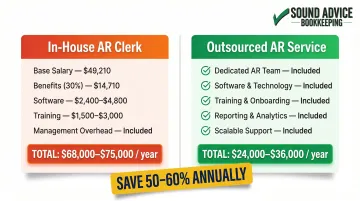
For a small manufacturer processing 200–400 invoices monthly, outsourcing typically costs $2,000–$3,000 per month through flat-fee pricing models—representing 50–60% cost savings compared to maintaining a dedicated in-house position.
Fewer billing errors, faster dispute resolution
Specialized AR providers use trained professionals and systematic processes that minimize invoice mistakes. Fewer errors mean fewer disputes, faster collections, and stronger customer relationships. In manufacturing, where billing disputes can stall large orders and damage long-term partnerships, this directly protects revenue.
Studies indicate organizations typically see 0.8% to 2% of total disbursements as duplicate or erroneous payments, with manual processing error rates in manufacturing contexts sometimes reaching 12–15%. Professional AR teams cut these rates significantly through automated validation checks and quality review processes.
The Institute of Finance & Management reports that the median cycle time to resolve deductions and disputes is 14 days. Outsourced teams with dedicated dispute resolution protocols handle these faster, preventing the common scenario where 55% of companies hold up the entire invoice when a partial dispute occurs.
Scalability without hiring
As manufacturing output grows—seasonally or long-term—an outsourced AR team scales with the volume without requiring the manufacturer to hire, onboard, and train additional staff. This is especially valuable for small manufacturers who cannot justify a full AR department but need consistent coverage during peak production periods. The service capacity adjusts to match invoice volume, eliminating the staffing gaps that cause collection backlogs during busy seasons.
Internal resources focus on core operations
When billing, collections, and reconciliation are handled externally, internal staff and leadership redirect their time toward production efficiency, quality control, customer relationships, and growth initiatives.
Manufacturers who excel at production but struggle with financial operations get to stay in their lane—building output and client relationships—while financial specialists handle what they do best.
Before transitioning to outsourced AR, it's worth ensuring your books are clean and your financial data is accurate. Sound Advice Bookkeeping helps small manufacturers map existing processes and get their records integration-ready—so the handoff to an AR team starts on solid ground.
In-House vs. Outsourced AR: What Makes More Sense for Small Manufacturers?
Comparison: In-House vs. Outsourced AR for Small Manufacturers
| Dimension | In-House AR | Outsourced AR |
|---|---|---|
| Staffing Requirements | Hire, train, and manage dedicated staff; backup needed for absences | Provider maintains trained team with built-in redundancy |
| Technology Investment | Purchase and maintain AR software, integrations, and updates | Included in service fee; provider manages technology stack |
| Flexibility During Peak Periods | Capacity fixed; overtime or temporary staff needed | Scales automatically with invoice volume |
| Cost Structure | Fixed salary, benefits, overhead regardless of volume | Variable pricing based on transaction volume or flat monthly fee |
| Error Rates | Depends on individual training and workload | Systematic quality checks reduce errors significantly |
| Scalability | Requires hiring and onboarding for growth | Seamless scaling without additional overhead |
Addressing the control objection
Losing control of customer relationships is a common concern — but professional AR providers are built to work as an extension of your business. They maintain your brand voice in customer communications and provide regular reporting so your team always has visibility into payment status and account health. You keep full oversight. You're just delegating the execution.
Which manufacturers benefit most from outsourcing?
Outsourcing delivers the clearest value for manufacturers who face one or more of these situations:
- High invoice volumes (150+ invoices per month)
- Limited internal finance staff managing too many functions
- Complex billing arrangements with custom contract pricing
- Extended payment terms or recurring cash flow gaps
Very small operations with simple, low-volume billing — under 50 invoices monthly on standard Net-30 terms — may manage adequately in-house. That said, professional support often uncovers improvement opportunities even in straightforward setups.
How to Transition to Outsourced AR Without Disrupting Your Operations
Start with process mapping before selecting a partner
Document your current AR workflows before handing anything off—including invoicing triggers, payment terms by customer, collections escalation steps, and reconciliation processes. This becomes the foundation for a smooth transition and helps the outsourced team maintain consistency with your existing customer relationships. It also lets you communicate clear expectations to prospective partners from the start.
Choose a phased transition over a hard cutover
Move AR functions in stages rather than transferring everything at once. Start with new customer invoicing before transitioning collections on existing accounts, or begin with one product line before expanding to others.
This avoids gaps in follow-up on aging receivables, gives internal staff time to adapt, and surfaces any performance issues before you're fully dependent on the new partner.
Set clear KPIs and reporting expectations from day one
Define success metrics upfront and require the outsourced partner to report on them regularly:
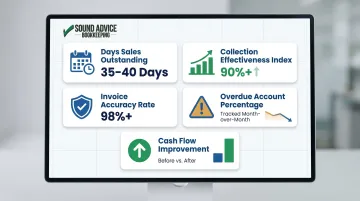
- Days Sales Outstanding (DSO) — reduce to 35–40 days within 6 months
- Collection Effectiveness Index (CEI) — percentage of receivables collected within terms
- Invoice Accuracy Rate — 98%+ to minimize disputes
- Overdue Account Percentage — tracked month-over-month to show improvement
- Cash Flow Improvement — compare collections monthly before and after outsourcing
Establish baseline measurements before outsourcing begins — these benchmarks are only useful if you have a starting point to measure against.
None of this works, though, if your underlying books are disorganized going in. Sound Advice Bookkeeping helps manufacturers clean up their financial data and map existing processes so everything is accurate and integration-ready before a new AR partner comes on board. Their Phase 1 cleanup process addresses backlogged invoices and establishes the clean baseline that makes the rest of the transition possible.
How to Choose the Right Accounts Receivable Outsourcing Partner
Manufacturing industry experience and references
An AR partner familiar with manufacturing billing cycles, ERP integrations, custom contract terms, and distribution channel complexity will onboard faster and make fewer errors than a generalist firm.
When vetting candidates, ask for references from other manufacturing clients. Confirm they understand milestone-based invoicing, complex pricing structures, and compliance requirements like FAR Subpart 32.9 for federal contracts.
Technology integration and reporting transparency
The right partner should integrate with your existing accounting or ERP software—whether QuickBooks Online, QuickBooks Desktop, QuickBooks Enterprise, or another platform—and provide real-time access to AR data, not just periodic email updates.
Look for partners that offer:
- Clear aging reports, collection performance metrics, and cash flow summaries
- Automated invoice delivery and payment application
- General ledger synchronization to eliminate manual data entry
Pricing structure and contract flexibility
Once you've confirmed a partner's technical fit, turn to the numbers. Pricing structures vary widely, so understand exactly what you're paying for before signing. Common models include:
- Flat monthly fees of $2,000–$3,500 for 200–500 invoices per month
- Per-transaction pricing at $8–$15 per invoice processed
- Percentage-of-collections models ranging from 3–8% of collected amounts
Look for partners offering month-to-month options or clearly defined contract terms without long-term lock-in penalties—especially important for small businesses managing tight budgets or dealing with seasonal volume fluctuations. Before signing, confirm whether setup fees, software costs, and dispute resolution services are included or billed separately.
Frequently Asked Questions
What is accounts receivable outsourcing for manufacturing?
AR outsourcing for manufacturing means hiring an external team to handle invoicing, payment collection, and reconciliation tied to production cycles and shipments. This allows the manufacturer's internal staff to focus on production operations while specialists manage the complete billing cycle.
What is the accounts receivable process in the manufacturing industry?
The manufacturing AR process typically covers five core steps:
- Customer onboarding with credit term setup
- Invoice generation tied to shipments or production milestones
- Payment processing and application
- Systematic follow-up on overdue accounts at 30/60/90-day intervals
- Final reconciliation against the general ledger, including dispute and partial payment resolution
How much does it cost to outsource accounts receivable services for manufacturing?
Costs vary based on invoice volume, service scope, and provider model. Flat monthly fees typically range from $2,000–$3,500 for small-to-mid-sized manufacturers processing 200–500 invoices monthly—significantly lower than the $68,000–$75,000 annual cost of maintaining a full-time in-house AR clerk when factoring in salary, benefits, software, and training.
Is outsourcing accounts receivable services for manufacturing legitimate?
Yes, AR outsourcing is a well-established business practice used across industries. Reputable providers operate under formal service agreements with defined security standards, compliance protocols, and reporting requirements. 48% of CFOs currently outsource accounts receivable functions, and the practice is growing particularly among SMEs.
How long does it take to see results after outsourcing AR for manufacturing?
Most manufacturers see measurable improvements in collections speed and cash flow within 3 to 6 months. The timeline depends on the complexity of existing AR processes, the quality of onboarding, and how backlogged receivables were before the transition.
What metrics should manufacturers track after outsourcing accounts receivable?
Track Days Sales Outstanding (DSO), Collection Effectiveness Index (CEI), invoice accuracy rate, percentage of overdue accounts, and cash flow improvement—with baselines set before outsourcing begins. Top performers reach DSO of 28–35 days, collection effectiveness above 90%, and invoice accuracy above 98%. Require monthly reporting from your provider to monitor progress against these benchmarks.