
Virtual bookkeeping services have emerged as a practical solution for agents who need professional financial oversight without hiring full-time staff. The right partner doesn't just categorize transactions—they understand how commission cycles, brokerage splits, and 1099-NEC income actually work.
This guide covers the top virtual bookkeeping services for real estate agents, what to look for when evaluating providers, and how to choose a partner that treats your books as a strategic asset rather than a compliance checkbox.
Key Takeaways
- Real estate agents deal with commission cycles, quarterly taxes, and deductions that generic bookkeeping software routinely misses
- Virtual bookkeeping combines cloud tools with human expertise for clean, tax-ready records
- The best services bring real estate familiarity, monthly reconciliation, and predictable flat-fee pricing
- Top options reviewed: Sound Advice Bookkeeping (real estate-aware, flat-fee), 1-800Accountant, QuickBooks Live, Bookkeeper360, and Bench
- Pick a service based on real estate experience — industry fit matters more than brand name
Why Real Estate Agents Need Specialized Virtual Bookkeeping
Virtual bookkeeping pairs cloud-based accounting software with remote human bookkeepers who handle transaction categorization, reconciliation, and financial reporting. Unlike software-only solutions, this model provides professional judgment alongside automation.
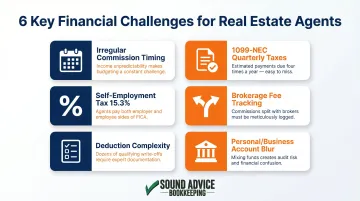
Real estate agents operate in financial territory most general bookkeepers don't understand well:
- Irregular commission timing creates cash flow gaps between closings
- 1099-NEC self-employment income requires quarterly estimated tax payments (due April 15, June 15, September 15, and January 15)
- Self-employment tax burden adds 15.3% on top of income tax for most agents
- Brokerage fee structures vary considerably and must be tracked separately from gross commission
- Deduction complexity spans mileage (72.5 cents per mile in 2026), home office use, MLS fees, staging, photography, and continuing education
- Commission checks frequently land in personal accounts, blurring the line between business and personal expenses
According to NAR data, median gross income for all REALTORS® was $58,100 in 2024—but agents with two years or less experience earned just $8,100, while veterans with 16+ years earned $78,900. That income gap makes predictable bookkeeping costs and accurate cash flow tracking essential, not optional. The providers below were evaluated specifically for their ability to serve commission-based agents, not just general small businesses.
Top Virtual Bookkeeping Services for Real Estate Agents
Each service below was selected based on real estate relevance, pricing transparency, service depth, and track record with self-employed professionals.
Sound Advice Bookkeeping
Founded in 2007 and having served over 1,000 small businesses across 30+ states, Sound Advice Bookkeeping delivers boutique, personalized bookkeeping built around entrepreneurs and small business owners—including real estate professionals.
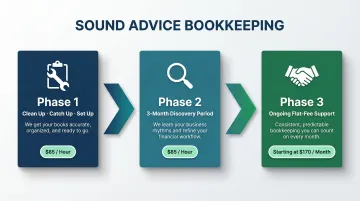
What sets it apart is a combined 100+ years of QuickBooks expertise, a consultative approach that treats bookkeeping as business intelligence rather than just tax compliance, and a 3-Phase onboarding process that determines a customized flat monthly fee. The team functions as an extension of your business, translating financial data into actionable growth insights.
The 3-Phase Process works like this:
- Phase 1 (Clean Up/Catch Up/Set Up): Address existing records, backlog, or new system setup at $85/hour
- Phase 2 (3-Month Discovery Period): Analyze your transaction volume and business patterns at $85/hour to determine appropriate service level
- Phase 3 (Ongoing Support): Transition to flat-fee monthly pricing based on transaction volume, starting at $170/month
| Key Features | QuickBooks-based bookkeeping, monthly financial reporting, cash flow analysis, business growth consulting, flat-fee monthly packages, dedicated bookkeeper |
|---|---|
| Best For | Independent agents and small real estate teams wanting a personalized, consultative partner beyond basic recordkeeping |
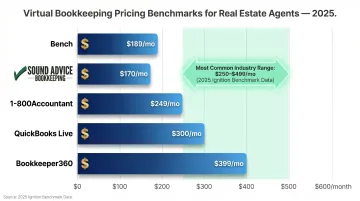
| Pricing | Customized flat monthly fee determined through 3-Phase intake process (starting at $170/month); hourly services at $85/hour during setup |
1-800Accountant
1-800Accountant is a full-service virtual accounting firm with a nationwide CPA network handling bookkeeping, tax preparation, payroll, and advisory for small business owners including real estate agents.
It stands out for agents who want bookkeeping and taxes handled by one firm:
- Dedicated bookkeeper with real estate familiarity
- Flat-fee pricing with year-round tax advisory
- Quarterly estimated tax support and audit defense included
That combination makes it a practical all-in-one option for agents who prefer a single vendor for both their books and tax filings.
| Key Features | Dedicated bookkeeper, monthly reconciliation, tax preparation and filing, payroll, quarterly estimated tax support, audit defense |
|---|---|
| Best For | Agents wanting bookkeeping and taxes managed by one firm with structured year-round advisory |
| Pricing | Starting at $249/month (billed annually); dedicated bookkeeper included in Core Accounting+ plan at $419/month |
QuickBooks Live
QuickBooks Live combines the industry's most widely used bookkeeping software with professional expert support, offering cleanup bookkeeping, ongoing monthly reconciliation, and financial reporting within the QuickBooks Online ecosystem. QuickBooks holds a dominant 62.23% market share in SMB accounting software.
For agents already on QuickBooks, the appeal is straightforward: seamless integration, a financial accuracy guarantee, and flexible plan options. The tradeoffs are worth knowing—there's no proactive tax planning, it isn't tailored to real estate, and tax filing requires a separate service (QuickBooks Live Expert Tax).
| Key Features | QuickBooks Online integration, monthly and weekly bookkeeping plans, bank reconciliation, financial reports, one-time cleanup option |
|---|---|
| Best For | Agents already using QuickBooks who want expert-supported bookkeeping without switching platforms |
| Pricing | Starting at $300/month after initial cleanup fee; cleanup-only starts at $150/month |
Bookkeeper360
Bookkeeper360 is a technology-driven bookkeeping and accounting firm offering both hourly and full-service monthly plans, making it flexible for agents at different business stages.
Transparent pricing, a US-based team, and real-time financial dashboards are among its strengths. It also supports both QuickBooks and Xero, and tax or fractional CFO services can be added as your business grows.
| Key Features | Pay-as-you-go or monthly plans, dedicated accountant, real-time dashboards, QuickBooks/Xero compatibility, optional tax and CFO add-ons |
|---|---|
| Best For | Agents wanting pricing flexibility or scaling businesses needing bookkeeping that grows with them |
| Pricing | Monthly plan starts at $399/month; onboarding/cleanup starts at $1,000; optional business tax from $1,000/year |
Bench (Mainstreet)
Bench, now operating as Mainstreet, is known for its simple visual interface and monthly reconciliation delivered through a proprietary platform, making it an accessible entry point for agents newer to outsourced bookkeeping.
Its intuitive dashboard, dedicated bookkeeper, and clean monthly statements make it easy to get started. That said, it isn't built for commission-based income complexity, and agents with high transaction volumes may outgrow it quickly.
| Key Features | Proprietary bookkeeping platform, monthly financial statements, dedicated bookkeeper, optional tax filing support |
|---|---|
| Best For | Newer agents or small solo practices wanting straightforward, easy-to-use platform with minimal onboarding friction |
| Pricing | Starts at $189/month (annual billing); Core plan from $339/month; Core + Tax from $599/month |
What to Look for in a Virtual Bookkeeper for Real Estate Agents
Real Estate Industry Familiarity
A bookkeeper who understands commission income structures, brokerage fee arrangements, and 1099-NEC self-employment income will make fewer categorization errors and identify deductions a generalist would overlook. This includes:
- Mileage tracking at the 2026 IRS rate of 72.5 cents per mile
- Home office deductions under Publication 587
- MLS fees, staging, photography, and continuing education costs
- Technology subscriptions for CRM and transaction management
- Marketing and advertising expenses specific to real estate

Monthly Reconciliation and Financial Reporting
A monthly close gives you a clear picture of cash flow between commission payments, prevents year-end surprises, and produces clean documentation for quarterly tax estimates, loan applications, or audit scenarios.
Tax Readiness and Quarterly Estimated Tax Support
Most agents operate as sole proprietors or single-member LLCs and must submit quarterly estimated tax payments to avoid IRS underpayment penalties. A bookkeeping partner that keeps records current and flags underpayment risk beats one that only reviews your books at year-end.
According to the 2025 NAR Member Profile, income volatility is significant—newer agents earning $8,100 annually face very different tax obligations than veterans earning $78,900.
Transparent, Predictable Pricing
Agents with variable income particularly benefit from flat-fee or clearly tiered monthly pricing—it allows budgeting bookkeeping as a fixed cost rather than worrying about hourly billing spikes during busy commission months.
According to the 2025 Ignition Accounting and Tax Pricing Benchmark, the most common fee for monthly bookkeeping ranges from $250 to $499 per month, with fewer than 10% of firms charging hourly for bookkeeping services.
Dedicated Point of Contact and Integration Capability
One assigned bookkeeper who knows your financial patterns, brokerage setup, and expense categories cuts down on back-and-forth and reduces errors. Seamless integration with tools you already use minimizes manual data entry:
- Receipt capture apps (HubDoc, Expensify)
- Live bank feeds for automatic transaction import
- CRM and transaction management platforms
How We Chose the Best Services
Services were assessed on real estate agent relevance (not just general small business fit), service depth (bookkeeping only vs. full-service including tax), pricing transparency, client support quality, and track record with self-employed professionals.
Common Mistakes Agents Make
- Choosing based on price alone without confirming real estate familiarity
- Selecting software-only tools expecting them to replace human advisory
- Waiting until tax season to evaluate whether books are accurate
A note on software: Tools like QuickBooks, Zoho, FreshBooks, Xero, and Wave can assist with transaction tracking. They don't replace the judgment of a dedicated bookkeeper who understands how commission income, business deductions, and estimated tax obligations work together.
Conclusion
Real estate agents operate in one of the most financially unpredictable sectors for self-employed professionals. Clean, up-to-date books are the foundation of sound business decisions—from managing slow months to capturing every available deduction at tax time.
When evaluating your options, real estate familiarity, monthly reliability, and transparent pricing matter more than brand name recognition. The agents who stay financially stable through market swings are the ones who treat their books as a year-round management tool, not a tax-season scramble.
Sound Advice Bookkeeping has served over 1,000 small businesses since 2007, with a personalized, QuickBooks-based approach built to help entrepreneurs actually understand their financials, not just keep them tidy for tax season.
Real estate agents looking for a dedicated partner can reach out at 303.228.8911 or info@soundadvicebookkeeping.com to explore a customized flat-fee plan.
Frequently Asked Questions
What is the best bookkeeping software for real estate agents?
QuickBooks Online is the most widely used option among agents for its flexibility and integrations. Real estate-specific tools like REI Hub suit landlords and investors better. For commission-focused agents, pairing any software with a virtual bookkeeping service typically delivers more accuracy than software alone.
What are people replacing QuickBooks with?
Popular alternatives include FreshBooks (simpler invoicing), Xero, Wave (free tier), and Zoho Books. That said, many virtual bookkeeping services manage QuickBooks on your behalf — so the software choice matters far less than the expertise behind it.
How much does a virtual bookkeeping service cost for a real estate agent?
Pricing varies widely—from entry-level plans around $189/month to full-service packages exceeding $600/month depending on transaction volume, tax inclusion, and level of dedicated support. Flat-fee monthly plans offer the most predictability for agents with variable commission income.
Do real estate agents need a bookkeeper or an accountant?
Most agents benefit from both. A bookkeeper keeps records current throughout the year; a CPA handles filing. Some virtual services combine both under one roof, keeping tax strategy and recordkeeping in sync.
Can a real estate agent deduct the cost of bookkeeping services?
Yes, bookkeeping and accounting fees are generally deductible as ordinary and necessary business expenses for self-employed agents on Schedule C, Line 17. This makes the net cost of professional bookkeeping lower than the sticker price.
What expenses should real estate agents track for bookkeeping purposes?
Key deductible categories include:
- MLS and brokerage fees
- Marketing and advertising
- Mileage and transportation (mileage and transportation (rate adjusted annually by the IRS — check IRS.gov for the current year))
- Home office use
- Staging and photography
- Professional development and licensing
- Technology subscriptions
Tracking these consistently throughout the year — not just at tax time — is what separates agents who minimize their tax bill from those who leave money on the table.