
Introduction
Most restaurant closures aren't about bad food—they're about bad financial management. Full-service restaurants operate on 3–5% net profit margins, while quick-service restaurants average 6–9%. When your margin is this narrow, even small bookkeeping inefficiencies can wipe out profitability.
Restaurants operate with financial complexity most businesses never face:
- Multiple revenue streams — dine-in, takeout, delivery platforms, catering, and bar sales
- Unpredictable food costs tied to supplier pricing and waste
- Tip-based payroll that complicates compliance and reporting
- Daily POS data that must reconcile against actual bank deposits
This guide covers the unique financial challenges restaurants face, what poor bookkeeping silently costs owners, and what professional restaurant bookkeeping services actually do — and why it matters for your bottom line.
Key Takeaways
- Restaurant finances demand specialized bookkeeping—volatile food costs, tip-based payroll, inventory waste, and multiple revenue streams can't be handled with generic accounting approaches
- Weak bookkeeping quietly compounds losses: missed tax deductions, payroll fines, untracked waste, and cash flow blind spots add up fast
- Professional services cover daily POS reconciliation, COGS tracking, payroll and tip management, and financial reporting to support smarter operational decisions
- Choose bookkeepers with restaurant-specific expertise, QuickBooks proficiency, and transparent flat-fee pricing
Why Restaurant Finances Are More Complex Than Most Industries
Restaurants face financial challenges unlike most small businesses. While software companies operate on 19.1% net margins and construction averages 10.2%, full-service restaurants scrape by on 3–5%. This means a $2,000 bookkeeping error that might be noise for other businesses can represent 40% of a restaurant's monthly profit.
The complexity stems from operational realities other businesses don't face. In 2022, 63% of restaurants employed seven or more different service models simultaneously, each with different margins, tax implications, and reconciliation requirements:
- Counter service, table service, curbside, delivery, and catering revenue all reconcile differently
- POS systems record hundreds of daily transactions across multiple payment methods
- Vendor invoices from dozens of suppliers arrive with fluctuating prices and inconsistent billing cycles
Inventory and Food Cost Volatility
Restaurant inventory is uniquely challenging. You're managing perishable goods with daily price fluctuations, recipe-level cost tracking, and a gap between "theoretical" versus "actual" food costs that must be reconciled regularly.
The industry standard target for food cost is 28% to 35% of total revenue—but that target is hard to hit when the all-food Consumer Price Index rose 23.6% between 2020 and 2024.
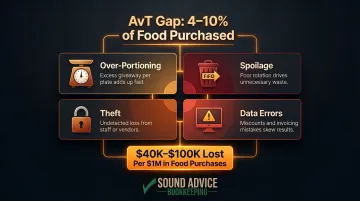
The Actual vs. Theoretical (AvT) Gap is where that loss shows up on the books. Commercial kitchens typically waste 4–10% of purchased food before it reaches a customer—$40,000 to $100,000 lost per $1 million in food purchases. The variance typically traces back to:
- Over-portioning: portions drift when staff skip the scale
- Spoilage: over-ordering and poor FIFO rotation
- Theft: product loss that doesn't show in POS data
- Data errors: miscounts in your inventory system or POS
Tracking AvT variance daily or weekly lets you isolate specific ingredient waste and correct the behavior before it erodes your margins.
Payroll Complexity: Tips, Multiple Pay Rates, and Compliance
Restaurant payroll involves complexities standard payroll processing never encounters: tip pooling, tip-outs, multiple pay rates for servers versus kitchen staff, tipped minimum wage laws, and IRS tip reporting requirements. Under the Fair Labor Standards Act, employers must pay tipped workers at least $2.13 per hour in direct cash wages. This tip credit of up to $5.12 per hour counts toward the $7.25 federal minimum wage—and if tips plus cash wages fall short, you're required to make up the difference.
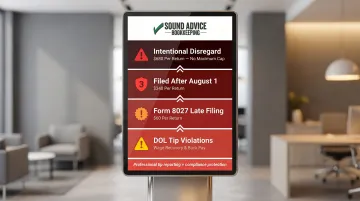
The Department of Labor actively enforces tip violations, recovering $159,525 for 26 employees at a Texas restaurant where managers illegally kept tips, and $81,681 for 12 workers at a New Orleans restaurant that withheld credit card tips. IRS penalties for incorrect Form 8027 filing (required for large food establishments) range from $60 to $340 per return depending on how late corrections occur—with no maximum penalty for intentional disregard. A knowledgeable bookkeeper treats tip reporting as a compliance function, not just a math exercise.
The Hidden Costs of Poor Restaurant Bookkeeping
Poor bookkeeping doesn't feel like a crisis—it feels like normal stress until it becomes a financial emergency. Restaurant owners often don't see the damage until it's too late.
Untracked Expenses Eroding Your Margins
Without granular expense tracking, food waste, over-ordering, spoilage, and vendor overcharges go unnoticed. Small expenses compound over months: comps, voids, petty cash, delivery platform fees. Third-party delivery platforms charge 15–30% commissions, but improper accounting distorts both COGS and sales tax liabilities.
When you record only the net bank deposit instead of gross sales minus commissions as separate line items, you understate revenue and complicate marketplace facilitator sales tax tracking. These untracked costs make it impossible to know your true margins or which revenue streams are profitable versus which are actively losing money.
Missed Tax Deductions and Compliance Penalties
Restaurant owners commonly miss deductions a specialist would flag: equipment depreciation, employee meals, uniforms, repairs, and utilities allocated to business use. Beyond missed deductions, payroll tax errors, missed sales tax filings, and incorrect tip reporting create compliance penalties that dwarf the cost of professional bookkeeping.
The IRS imposes steep penalties under IRC 6721 for incorrect information returns:
- Corrected within 30 days: $60 per return
- Corrected 31 days to August 1: $130 per return
- After August 1 or not filed: $340 per return
- Intentional disregard: $680 per return with no annual maximum
A generalist bookkeeper or DIY approach misses these details — a restaurant-savvy bookkeeper knows where to look and actively prevents them. That same visibility also protects you from a deeper problem: making financial decisions without accurate data.
Operating Blind Without Real-Time Financial Visibility
The "checking account trap" ensnares restaurant owners who make decisions based on bank balance rather than financial reports. You can appear cash-positive while carrying unpaid vendor invoices, payroll liabilities, and upcoming tax obligations that will wipe out that balance overnight.
Cash flow mismanagement has severe consequences. According to Gusto bank-linked data, about one-third of small businesses experience at least one payroll where available funds cannot fully cover wages.
After a missed payroll, the average small business's headcount declines by 8–10% and doesn't recover within two years. Without clean monthly financials, you can't make informed decisions about menu pricing, staffing levels, or expansion — every decision becomes a guess.
What Restaurant Bookkeeping Services Actually Cover
Professional restaurant bookkeeping isn't just data entry or "making things look right for the tax man." It's a proactive financial management function that drives operational decisions and protects your margins.
Daily Sales Reconciliation and POS Integration
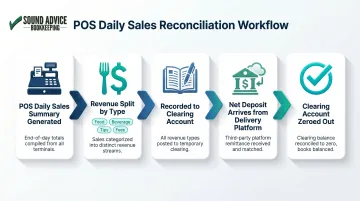
Correct daily sales reconciliation follows a specific process: your POS generates a detailed daily sales summary (food, beverage, tips, sales tax, discounts, delivery platform fees), which must be reconciled against the actual bank deposit using a clearing account method—not simply recording the deposit as "sales."
A clearing account is a general ledger account whose balance reflects transactions in transition. For third-party delivery sales, payment tenders are recorded to a clearing asset account daily. When the net deposit arrives from the delivery provider, it's split between sales, commissions, and fees, zeroing out the clearing account.
Experienced restaurant bookkeepers manage POS integrations with platforms like QuickBooks to automate this reconciliation, flagging discrepancies between reported sales and deposited funds immediately.
Inventory Tracking and COGS Management
Bookkeepers set up a restaurant-specific chart of accounts that separates food COGS from beverage COGS and other categories. This granular breakdown reveals which revenue streams are profitable versus which are operating at a loss.
The Uniform System of Accounts for Restaurants requires distinct tracking across two groups:
- Food: Meat, Seafood, Poultry, Produce, Dairy, Grocery
- Beverage: Soft Beverages, Liquor, Bottle Beer, Draft Beer, Wine
Regular inventory counts compare actual inventory on hand to theoretical inventory (based on recipes and sales volume), surfacing theft, over-portioning, and supplier errors. This is how you close the AvT gap that's costing you thousands monthly.
Payroll, Tip Reporting, and Labor Cost Analysis
Professional payroll management for restaurants covers calculating tip allocations, recording credit card tip liabilities, managing tip-outs to back-of-house staff, and ensuring FICA tip credit is captured correctly on tax returns. The FICA Tip Credit allows food and beverage employers to reduce taxable business income by the amount paid for the employer's share of Social Security and Medicare taxes (7.65%) on certain employee tips—specifically, tips that exceed the amount needed to meet the $7.25 federal minimum wage.
Labor cost reporting tracks labor cost as a percentage of revenue and compares it to target benchmarks, giving you actionable data to adjust scheduling before labor costs spiral out of control.
Financial Reporting That Drives Decisions
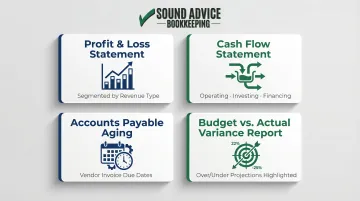
Core financial reports a restaurant bookkeeper should deliver monthly include:
- Profit and Loss Statement segmented by revenue type (dine-in, takeout, delivery, catering, bar)
- Cash Flow Statement breaking down operating, investing, and financing activities
- Accounts Payable Aging showing which vendor invoices are due and when
- Budget-vs-Actual Variance Report highlighting where you're over or under projections
Sound Advice Bookkeeping treats these reports as working tools, not year-end formalities. The goal is books that are accurate enough to act on — every month, not just at tax time.
Key Benefits of Professional Restaurant Bookkeeping
Restaurant owners who offload bookkeeping to experts reclaim hours each week to invest in staff training, guest experience, and menu development—the activities that actually differentiate your restaurant from the place down the street.
Professional bookkeepers eliminate the errors that distort your financials and quietly corrupt decision-making over time:
- Incorrect COGS categorization that skews your true food costs
- Unreconciled POS data that hides where revenue is actually landing
- Payroll miscalculations that affect both compliance and labor cost reporting
These aren't just administrative slip-ups. Each one feeds into bad pricing, staffing, and purchasing decisions that compound month after month.
Scalability is where professional bookkeeping really earns its keep. A solid financial setup grows with your restaurant — whether you're adding a second location, launching a catering arm, or onboarding a new delivery platform. DIY approaches break down as complexity grows, forcing you to rebuild systems when you can least afford the distraction.
How to Choose the Right Restaurant Bookkeeping Service
Evaluate prospective bookkeepers on these criteria:
- Industry-specific experience: Not just general small business bookkeeping, but proven restaurant expertise
- Software expertise: QuickBooks proficiency, POS integrations, payroll platform familiarity
- Transparent pricing: Flat monthly fee versus hourly billing (flat fees provide cost predictability)
- Clear communication: Detailed explanation of what's included versus billed separately
Ask these targeted questions during consultations:
- How do you handle daily POS reconciliation?
- How do you track food versus beverage COGS separately?
- How do you manage tip reporting and FICA tip credit?
- What does your monthly close process look like?
- How are your fees structured—flat monthly or hourly?
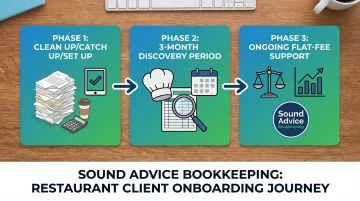
Sound Advice Bookkeeping, for example, uses a structured 3-Phase Process before locking in a flat monthly fee — so you're never overcharged for complexity you don't have:
- Phase 1 — Clean Up/Catch Up/Set Up: Organizes existing records or builds new systems from scratch at $85/hour
- Phase 2 — 3-Month Discovery Period: Analyzes your transaction patterns and operational rhythms at $85/hour
- Phase 3 — Ongoing Support: Transitions to a flat fee based on transaction volume, not time spent
Rather than handing your books off to a generalist firm that processes numbers remotely, Sound Advice assigns a dedicated team that learns your restaurant's financials end-to-end. The firm serves clients across 30+ states and has direct food service experience, including work with Sage Catering.
The accounting industry is rapidly abandoning hourly billing. Only 4% of firms charge hourly for bookkeeping, while 29% use flat monthly fees ranging from $250–$499 for basic services. Flat-fee models prevent surprise invoices and give restaurant owners predictable monthly costs — critical when margins are already tight.
Frequently Asked Questions
Do restaurants use FIFO or LIFO?
Most restaurants use FIFO (First In, First Out) for inventory management because perishable goods must be used in the order received to minimize spoilage. LIFO is rarely used in restaurants and is prohibited under IFRS accounting standards.
What does a restaurant bookkeeper do?
A restaurant bookkeeper handles daily sales reconciliation, COGS tracking, payroll and tip management, accounts payable, and monthly financial reporting. They translate financial data into operational insights—not just record transactions.
What is the difference between restaurant bookkeeping and restaurant accounting?
Bookkeeping handles day-to-day recording and categorization of financial transactions. Accounting involves higher-level analysis, tax strategy, and financial planning. Some bookkeeping providers bridge both disciplines, pairing clean, accurate records with actionable business insight.
What accounting method do restaurants typically use—cash or accrual?
Larger restaurants typically use accrual accounting—recording revenue and expenses when earned or incurred—because it gives a more accurate picture of financial health. Under IRS rules, businesses exceeding $32 million in average annual gross receipts must use accrual. Smaller restaurants may use cash basis, but accrual is recommended as the business grows.
How much does professional restaurant bookkeeping cost?
Costs vary based on revenue volume, number of locations, and services included. Reputable providers typically offer flat monthly packages starting around $170–$499 per month for basic services. That cost typically runs well below what errors, missed deductions, or an in-house hire would cost you.
How can professional bookkeeping help my restaurant stay tax compliant?
Professional bookkeepers keep accurate records year-round, report tip income correctly, track deductible expenses, and deliver clean financial statements for your CPA. This reduces audit risk, maximizes legitimate deductions, and helps you avoid IRS penalties for missed quarterly payments or incorrect Form 8027 filings.